

.png) Cedric Prakash
Cedric Prakash
.jpg)
It took place in 2002! A tragedy that will NEVER be FORGOTTEN! The Gujarat Carnage 2002 is easily one of the bloodiest chapters in post-independent India. The burning of the S-6 compartment of the Sabarmati Express (from Faizabad to Ahmedabad), some distance away from the Godhra railway station in Gujarat, on February 27 (unfortunately, resulting in the deaths of 59 innocent people) was (and is) strongly condemned.
Several persons were convicted for this act, though there is still a raging debate on what caused the fire. There is enough evidence to prove that it was an accident. The sad fact is that any death, particularly the tragic ones, is bound to leave a great void in the lives and hearts of the loved ones whom they have left behind.
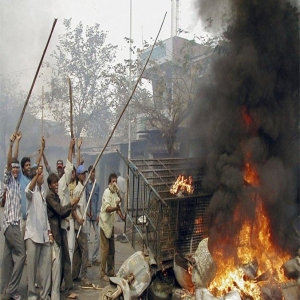
What followed this unfortunate tragedy was, however, a bloody carnage beyond comprehension, totally unjustifiable and unacceptable. Apparently (and this from eyewitness accounts), the Chief Minister of the State, Narendra Modi, convened a meeting of some high-level BJP and Government functionaries very late in the evening of February 27. There are different versions of what transpired at this meeting (the minutes, the written official record of the meeting, were never made public) - but the actions that resulted were blatantly obvious: Muslims all over Gujarat were brutalised, raped, dispossessed of their lands and houses and even murdered.
The intensity of violence for days was certainly a crime against humanity. Thousands were affected all over Gujarat! Numbers pale into insignificance when one recollects the brutality of what took place. For weeks and then months, rampaging mobs indulged in some of the most despicable acts. Besides, the law-and-order mechanism had not merely abdicated its responsibility but was also seen actively siding with the perpetrators involved in the Carnage!
On November 21, 2002, the Concerned Citizens' Tribunal, consisting of several eminent citizens and headed by Justice V Krishna Iyer (a former Judge of the Supreme Court of India), released a report entitled 'Crime Against Humanity' that contained incontrovertible facts and details of the Gujarat Carnage. It was written based on more than 2,000 oral and written testimonies, both individual and collective, from victim-survivors, independent Human Rights Groups, Women's Groups, NGOs, academics, concerned citizens, and others.
The Tribunal, in its findings and recommendations, indicted the Government of Gujarat and held it responsible for the unfettered violence, murder, arson and looting that took place in Gujarat. The Concerned Citizens' Tribunal's findings also corroborate those of several other groups.
1. What took place in Gujarat was not merely communal violence or riots; it was a genocide, a carnage, an ethnic cleansing, designed to marginalise and even wipe out an entire community.
2. It was well-planned and clinically executed. It was not a "spontaneous reaction" as some tried to justify it pathetically. The preparations must have taken several months. Sometime earlier, a widely circulated Gujarati daily listed several hotels run by the Chiliya community, which had non-Islamic names. During the Carnage, most of their hotels were razed. A meticulous census was conducted on the Muslims and Christians of Gujarat in 1999. The data helped marauding mobs know exactly whom to attack and where.
3. It was meant to break the backbone of the Muslim community's economy; it succeeded to a great extent.
4. The middle-class, including several well-to-do and educated women, were involved in the violence; there were very few people who were willing to come out and take a stand to prevent what was happening.
5. In some areas, Adivasis and Dalits were used very effectively in the arson and looting of Muslim homes and establishments.
6. It was undoubtedly a State-sponsored genocide. The Concerned Citizens' Tribunal indicted, in addition to the Chief Minister and politicians, several high-ranking bureaucrats and police officials. The Sangh Parivar was given a free hand to do what they wanted. The police were apparently given clear instructions not to take any action. There is also evidence to show that some were encouraged to join in the violence, which they did, with ruthless finesse. State Ministers and leaders of 'the Parivar' were seen leading the mobs. A couple of them even were in the Police Control room at the time of the violence. The sting operation conducted by 'Tehelka', made public in October 2007, provides ample evidence to substantiate these facts.
In December 2003, the then Chief Justice of India, VN Khare, presiding over a Divisional Bench of the Supreme Court, criticised the Government of Gujarat, saying, "I have no faith left in the prosecution and the Gujarat Government. I am not saying Article 356. You have to protect people and punish the guilty. What else is raj dharma? You quit if you cannot prosecute the guilty." And in a landmark ruling on February 8, 2012, the Acting Chief Justice of Gujarat Bhaskar Bhattacharya, emphatically stated, "Gujarat government's inadequate response and inaction (to contain the riots) resulted in an anarchic situation which continued unabated for days on ... the state cannot shirk from its responsibilities."
In the context of the many cases and the fact that several fingers were pointing to the connivance of the Modi Government, the Supreme Court of India appointed a Special Investigation Team (SIT) to look into certain cases, very specially a complaint made by the late Zakia Jafri (who died on February 1, 2025 at the age of 86) concerning the murder of her husband, the former Member of Parliament Ehsan Jafri and several others. It is common knowledge that the role even played by the SIT was highly questionable. The SIT report was full of lapses and inaccuracies. It never looked conscientiously at the complicity and the culpability of the powerful and of vested interests.
In June 2022, a three-judge Bench led by Justice AM Khanwilkar upheld the closure report filed by the Supreme Court-appointed Special Investigation Team (SIT) in Ms Jafri's complaint in February 2012. The SIT had found no material evidence against Mr Modi and the other higher-ups in the State. The Gujarat High Court, too, in October 2017, had refused to entertain Ms Jafri. "No fault can be found with the approach of the SIT in submitting final report dated February 8, 2012, which is backed by firm logic, expositing analytical mind and dealing with all aspects objectively for discarding the allegations regarding larger criminal conspiracy (at the highest level) for causing and precipitating mass violence across the State against the minority community during the relevant period," stated Justice Khanwilkar, who authored the 452-page judgment for the Bench. Whilst the judgement needs to be respected, few who have witnessed the Carnage and who know the facts, are taking it at face value.
On January 17, 2023, the BBC, the independent British news channel, aired the first of a two-part documentary it had produced titled 'India: The Modi Question' (the second part was aired a week later, on January 24). The first part of the Documentary alleges that Narendra Modi, who was then the Chief Minister of Gujarat, ordered the police to turn a blind eye to the Gujarat Carnage of 2002 that went on for weeks and months; the second part details how Muslims have been systematically targeted in India ever since Modi came to power. It shows how perpetrators of heinous attacks on Muslims do so with impunity, knowing fully well that they have all the immunity from those who govern the nation.
At the very start of the Documentary, the BBC screens two strong and telling statements: "More than 30 people in India declined to take part in this series because of fears about their safety," and "The Indian Government declined to comment on the allegations made in this film." One can conclude several things from these statements; for example, that many people know the truth, that they would like to do so, but are frightened to. Yes, fear is palpable in several sections of Indian society today. Secondly, the BBC wanted the Government's comments on the film, so presumably Indian authorities were given an earlier opportunity to watch it and rebut it if necessary. The Government declined to do so, which could easily imply that the BBC film had incontrovertible footage and evidence, the factuality of which cannot be challenged by anyone. Besides, among those interviewed in the film were those who sided with the Government, which gives the film a high degree of objectivity and neutrality!
The BBC documentary has a scoop: the first episode reveals a previously unpublished report, a classified and confidential document of the UK Government produced by its Home Office on the Gujarat Carnage. In ordinary parlance, such documents are referred to as 'top secret' and are not easily accessible. The statements in the internal brief are indicting. The document states, among other things, that the 2002 violence "was planned, possibly in advance" by Vishwa Hindu Parishad, a Hindu nationalist organisation, adding that, "the attack on the train at Godhra on February 27 provided the pretext. If it had not occurred, another one would have been found."
Further, the report cites evidence for stating the violence was pre-planned, "Police contacts confirmed that rioters used computerised lists to target Muslim homes and businesses. The accuracy and detail of the lists, including businesses with minority Muslim share-holding, suggest that they were prepared in advance."
The most defining statements say, "the VHP and its allies acted with the support of the state Government. They could not have inflicted so much damage without the climate of impunity created by the state Government. Chief Minister Narendra Modi is directly responsible. His actions have not just been guided by a cynical assessment of political advantage. As an architect of the BJP's Hindu nationalist agenda which it has pursued since it came to power in 1995, he is a believer in the VHP's ideological motivation."
In short, the confidential report indicts the State Government of Gujarat with an unequivocal statement, "Chief Minister Narendra Modi is directly responsible." Part of the Documentary is the role played by Haren Pandya (a former Home Minister of Gujarat) and his exposure of the Modi regime's complicity. Pandya was assassinated on March 26 2003!
The film also highlights that the report, quoting unnamed sources, says that Modi met senior police officers and "ordered them not to intervene" in the attacks on Muslims. Footage in the film clearly shows how the police stood by as Muslims were targeted: victims of arson and loot, rape and murder. "A conservative estimate based on information from reliable human rights contacts puts the number of deaths at 2000 ... The killing was accompanied in many areas by widespread and systemic rape of Muslim women, sometimes by police ... police contacts accept that implicit state Government pressure inhibited their response." Further the document says that "the violence was politically motivated" and the aim "was to purge Muslims from Hindu areas." It concluded that "the riots were impossible without the climate of impunity created by the state government ..."
Obviously, the Government of India has banned the Documentary, calling it merely 'propaganda' without countering the documented evidence and incontrovertible facts contained therein.
Twenty-four years after those terrible, bloody days, there is among some a feeling of fatigue. Some of the perpetrators feel justified and vindicated, with an "I told you so" attitude. It was just sensationalism. Even some of the victims feel it should be a closed chapter. "Don't we have to move on?" they ask in despair! Some of the human rights defenders are silent – they seem to have given up. Besides some media that earlier took strong, unequivocal stands, seem to have given up – sheer fear!
Gujarat is now planning to host the Commonwealth Games in Ahmedabad in 2030! They certainly do not want any memories of the past to start popping up! And definitely not the Gujarat Carnage 2002! Houses of the poor (mainly Muslim and Dalits) are being demolished with bulldozers. There is plenty of hype and propaganda to show how welcoming this State can be.
The hard fact remains that there are several today like Teesta Setalvad, R. B. Sreekumar, Rupa Modi, and Sanjiv Bhatt who, despite all odds, continue relentlessly in pursuit of justice and truth! The road ahead is not going to be easy! One has to deal with muscle, money, and manipulations, among other things! The Gujarat Carnage 2002, however, will never be forgotten! It will remain etched in the minds and hearts of many forever! There is hope that one day we will overcome Satyameva Jayate! Truth will triumph!
.jpeg)
 A. J. Philip
.jpg)
.png) Jacob Peenikaparambil
Jacob Peenikaparambil
.jpg)
.png) John Dayal
John Dayal
.jpg)
 Pachu Menon
.jpg)

.png)
.png)
.png) Robert Clements
Robert Clements
.jpg)