

.jpg) Prakash Louis
Prakash Louis
.jpg)
MGNERGA: Right to Work
It is a global fact that MGNREGA, that is, the Mahatma Gandhi National Rural Employment Guarantee Act (MGNREGA) of 2005, was and is acclaimed as a global model for social security and public works programs, particularly for its unique rights-based legal framework. For the last 20 years, this entitlement has been utilised by the citizens of the country, especially rural households, to ensure guaranteed wage employment. This constitutional and legal assurance gave the rural household the security of food and, when needed, some cash.
Anyone who cared to examine MGNREGA found that its vision and concept were sound and sustainable. The Act came into existence in 2005 but was officially launched in 2006. For the last 20 years, it has done its job irrespective of the ups and downs, challenges and constraints, achievements and accolades. Now the BJP and NDA government want to do away with this right in the name of reforming it. They hurriedly bulldozed the new bill through both houses of Parliament. This contentious act was published in the Gazette of India on December 21, 2025, and has become the VB-G RAM G Act, 2025.
Salient Features of MGNREGA
1. Right to Work: Legal guarantee of 100 days of unskilled manual work per financial year for every rural household.
2. Job Card: Job cards to be issued within 15 days from the date of receipt of the application for the job card registration
3. Demand-Driven: Work to be provided within 15 days of demand, or an unemployment allowance to be paid.
4. No Contractors/Middlemen: Work executed by Gram Panchayat, government departments and similar agencies, without contractors or agents, to prevent exploitation.
5. Gram Sabha Focus: Gram Sabha to do micro-planning, implement and audit. At least 50% of the work (by cost) is to be implemented through Gram Panchayats.
6. Equal Wages: Equal pay for men and women (in some states, including Bihar, the amount of work women do for the same wage is less than that of men).
7. Wage-Material Ratio: A mandated 60:40 ratio for wage to material costs for fund expenditure.
8. Central Government Sponsored: 100% of wage cost and 75% material cost borne by the Central Government. About 90% of the overall cost financed by the Central Government.
9. Timely Payment: Wages paid within a fortnight (14 days) through bank or post office accounts. No intermediaries of any kind.
10. Worksite: Preferably within 5 kilometres of the household.
11. Worksite facilities: Provide drinking water, shade, a first-aid kit, and crèches.
12. Social Audits: Mandatory periodic audits by Gram Panchayats to ensure transparency.
13. Grievances Redressal: Mechanism for addressing complaints.
14. Focus on Rural Asset Creation: Aims to create durable, productive assets like water harvesting structures, rural infrastructure, orchards, ponds, sanitation facilities, etc.
15. Machines: No machines to be used for work.
16. Transparency: Proactive disclosure of information, real-time monitoring with GPS/mobile tech, and Aadhaar-Based Payment Systems (ABPS).
Thus, it can be stated that MGNREGA was aimed at ensuring Swa-raj (Self-rule), Su-raj (Right Rule) and Su-shasan (Right Governance) work in favour of the rural masses who are often left out in the existing administrative and government systems. It is not claimed here that all these objectives were achieved everywhere at all times. But where the governance structure was favourable for the implementation of this program, there were some achievements. What is extremely painful is that the rural women who were able to get some wages to take care of the basic needs of their families are now denied this right.
It is not claimed here that MGNREGA was hugely successful. What is claimed here, based on facts and figures, is that, despite many constraints and challenges, it achieved, at least partially, the objective of the right to work. But the present BJP/RSS combination, along with some NDA partners, has decided to do away with this entitlement and introduce a scheme in its place.
Rationale for change from MNREGA to VB G RAM G as stated by the government:
1. Addressing Structural Weaknesses: Despite administrative and technological improvements over the years, persistent issues such as fund misappropriation, weak monitoring, the use of machines for manual work, and the creation of low-quality, non-durable assets persisted.
2. Evolving Rural Landscape: Rural India has transformed since 2005, with declining poverty rates, rising incomes, increased digital penetration, and more diversified livelihoods. The government argues that the old framework no longer fully aligns with these contemporary realities.
3. Shift from Welfare to Development: The new Act aims to move the program from a basic social safety net to a "productivity engine" focused on creating durable, climate-resilient rural infrastructure that contributes to the broader national development goals, PM Gati Shakti.
4. Enhancing Accountability and Transparency: The Act introduces a comprehensive digital governance ecosystem, including AI-based fraud detection, biometric authentication, GPS monitoring, and mandatory bi-annual social audits, to ensure efficient and transparent implementation.
5. Balancing Agricultural Labour Needs: A provision has been introduced that allows states to notify an aggregated 60-day pause in public works during peak sowing and harvesting seasons to ensure an adequate supply of labour for private agriculture, addressing a long-standing complaint from farmers about labour shortages and wage inflation.
6. Fiscal Restructuring: Centre-state fund sharing to be in the ratio of 60:40
In the last 10 to 12 years, the BJP/RSS have given one death blow after the other to the poor and the marginalised. Despite enacting acts like MGNREGA that would benefit the rural masses, they have done away with them. One of the crucial facts which re-establish this emerging India is that the citizens and the country are on the path to destruction. This sinister plan is revealed in their attempt to replace MGNREGA with the VB G RAM G, Act 2025.
RSS's century-old efforts to do away with Mahatma Gandhi, the Father of the Nation, are clearly reflected in this new act. All conscious citizens of this country are well aware that any attempt to do away with Bapuji's history and legacy will not succeed. But what conscious citizens are concerned about is that, alongside efforts to remove Gandhiji's name, they are taking away the rights of the common, ordinary, poor, rural citizens.
The present regime sheds crocodile tears, claiming it lacks the funds to implement various schemes purportedly to benefit common people, while systematically cutting welfare and development spending. Interestingly, it calls it 'lollipop' when non-BJP governments undertake welfare schemes which are within the purview of the Constitution. But during the elections, it doles out crores of taxpayers' money both 'legally' and illegally. For instance, before and during the assembly elections in Bihar, it deposited ?10,000 per woman in the bank accounts of Ajeevika women members. It cost the country ?75,000 crores; however, once the elections are over, there is no talk of 'women's empowerment.'
In contrast, the salary hike initiated under the 8th pay commission for central government staff is extensive. Table 3, in clear, categorical terms, highlights the payments made to various officials of the central government. It is reported that this hike in central government staff salaries would impose an annual burden of ?2 lakh crores on the treasury. It is ultimately the poorest and the vulnerable who have to pay this through their hard labour and toil.
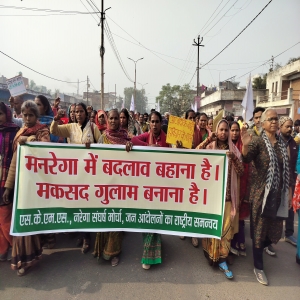
While the present government was busy doing away with MGNREGA, rural women, rural workers, youth, activists, civil society, legal experts, and concerned citizens have been raising their voices and protesting against the imposition of a scheme in place of the entitlement. On December 16, 2025, the VB-GRAM-G Bill was made public for comments. Since then, many rallies and protests have been organised by individuals, organisations, trade unions and platforms.
Meetings, roundtables, conferences, workshops and trainings were and are being organised to understand the impact and to resist its imposition. Press conferences and labourers' meetings have been organised in various parts of India. Political parties have also been opposing this sinister move to do away with this 'reformed' act. Online and offline meetings are organised to raise awareness of the negative consequences of the new act.
In addition to the above activities, the following programs of action have also been planned: protests, advocacy with concerned officials, burning copies of the act as a protest, rallies at the panchayat, block, district, state and national levels to express citizens' disapproval of the act, writing letters of protest through the Gram Sabha, etc. Mobilise rural households to oppose the bill and advocate for the continuation of MGNREGA.
Those who have been closely observing the policies and programs, pronouncements, and proclamations of the BJP government are aware that, having watered down many of the entitlements enacted by the previous UPA government, it will gradually do away with them completely. From its track record, it is comprehended that the Rights to Work, Food, Forest, Education, and Information would be done away with. At this critical juncture, it is crucial to understand the impact on poor rural households if this shift from MGNREGA to VB-GRAM-G is allowed to proceed. A clear understanding that MGNREGA was an entitlement, while the VB G RAM G is a scheme which is against constitutional rights, is expected to unite in resisting this move to do away with the Right to Work and Right to Food.
.jpg)
 A. J. Philip
.png) Cedric Prakash
Cedric Prakash
.jpg)
 P. A. Chacko
.jpg)
.jpg)
.jpg) Thomas Menamparampil
Thomas Menamparampil
.png)
.png)
.png) Robert Clements
Robert Clements
.jpg)
.png)
.png) Chhotebhai
Chhotebhai