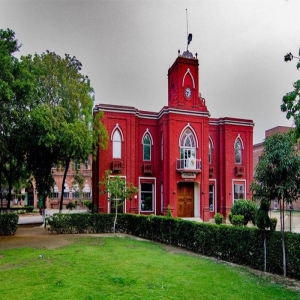


 A. J. Philip
.jpg)
I have had a few occasions to visit the Christian Medical College in Ludhiana, once at the invitation of the management to deliver the Christmas message. Those visits left a deep impression on me—not merely because of the warmth of the community or the quiet discipline of the campus, but because that institution embodies something precious and increasingly contested in India: the marriage of faith, reason and modern science.
CMC Ludhiana also happens to be where my niece Jisha did her MBBS. On one of my visits, while she was still a student, I wandered past the notice board where examination results were displayed. Like any proud uncle, I scanned the sheets with interest. Jisha was at or near the top in most subjects. But there was one subject—surgery—where she was consistently second. Every time, she was beaten by the same student: a Jain boy.
I teased her about it. Why could she never beat him in surgery? Jisha laughed and gave me an answer I have never forgotten. "God created his hands for surgery," she said. "How can I beat him?"
I was amused, but also struck by the humility of the remark. We often talk loosely of talent, but occasionally we encounter ability that seems almost metaphysical. Of course, I had heard the ex
I remembered that moment recently when I read a piece by my friend and former colleague at The Indian Express, Manoj Mitta, published on December 13, 2025. Titled "The Big Picture: Macaulay and a Medical College," the article is vintage Mitta: precise, layered, and quietly devastating to lazy certainties.
Tall, handsome and perpetually enthusiastic are adjectives that come easily to mind when I think of Manoj. But if I had to choose just one word to describe him, it would be "meticulous." In his reporting days, he might have filed close to deadline, but no one—editor, sub-editor or reader—could ever catch him out on a fact or a comma.
When he stepped away from the daily hurly-burly of journalism to focus on serious writing, it was perhaps the wisest decision he made. His book "Caste Pride: Battles for Equality in Hindu India" proves beyond doubt that "meticulous" is not merely a journalistic habit for him; it is an intellectual ethic.
It was from this article that I learnt that Friday next, January 10, marks the 190th anniversary of a cataclysmic event in Indian medical history. On that day in 1836, Madhusudan Gupta, a student of the first batch of Calcutta Medical College, performed the first-ever dissection of a human corpse in the history of Indian medical education.
Small wonder that the day is observed as Medical Day in West Bengal. Nowhere else in the world would such an act—today utterly routine, almost banal—have required courage bordering on heroism. As Mitta writes, for what is now a standard part of teaching anatomy, the colonial administration had to deploy security at the Calcutta Medical College because a crowd of orthodox Hindus had gathered outside to protest what they considered a deeply polluting act.
For generations, those who claimed leadership positions in the Hindu religion—let me avoid naming the caste—had taught their followers that anyone who touched a dead body lost caste purity. This injunction was not a marginal belief; it was central to the social order.
Any medical student today knows that human anatomy cannot be learnt without dissecting the human body. Even veterinarians must dissect carcasses to understand animal anatomy. By prohibiting contact with the dead, caste orthodoxy did not merely preserve "purity"; it killed the science of surgery in indigenous medical systems like Ayurveda. It amputated progress at the altar of prejudice.
Manoj's article aroused my curiosity for another reason as well. The Indian Express was founded by Ramnath Goenka, a man about whom myths, anecdotes and jokes abound in journalistic folklore. One such story goes like this: a journalist was invited to participate in a defence programme organised by the Indian Air Force, which included mid-air sorties. The Express management was expected to indemnify him in case of an accident. Goenka reportedly refused.
He was a rightist with a visceral hatred for the Congress—not just for a particular leader, but for the party as an institution. He once contested and won a Lok Sabha seat from Vidisha, Madhya Pradesh, on a Jan Sangh ticket.
Last year, the Express organised its annual Goenka Lecture, delivered by Prime Minister Narendra Modi. Modi used the prestigious forum to vilify Thomas Babington Macaulay and attribute to him motives that Macaulay himself would not have imagined even in his wildest dreams. The Prime Minister should have remembered that suppressio veri, suggestio falsi—the suppression of truth is as misleading as the assertion of falsehood. Half-truths distort reality not by inventing lies, but by withholding inconvenient facts, thereby constructing a narrative that appears credible while being fundamentally deceptive.
Like the news of Ashwatthama's death in the Mahabharata, it was a calculated half-truth—technically defensible, morally deceptive—deployed to achieve a larger objective. By suppressing a crucial fact while foregrounding another, the speaker shaped perception without uttering an outright lie, weaponising ambiguity as truth.
Whenever Modi wants to attack a Christian—like former Chief Election Commissioner James Michael Lyngdoh—he carefully uses the full name, lest the audience miss the religious association. In the same vein, he named Thomas Babington Macaulay (1800–1859) and accused him of destroying India's native education system to create, in Macaulay's own words, "a class of persons, Indians in blood and colour, but English in taste, opinions, morals, and intellect."
Several writers and journalists took strong exception to Modi's claims and exposed them as historically illiterate assertions, amplified through the Sangh Parivar's communication machinery and sustained by distortions, omissions and outright falsehoods masquerading as cultural nationalism.
I have a small personal connection with Macaulay. Years ago, after I wrote something critical of the Sangh Parivar in The Indian Express, I received a response from one of its defenders who attempted to abuse me by calling me "a child of Macaulay." In India, questioning one's paternity is considered the ultimate insult. But I was not offended. Macaulay, after all, died 58 years before my father was born—coincidentally, in the same year that Indira Gandhi was born. Far from being insulted, I felt oddly honoured by the association.
I also wondered whether the editors who published Manoj's article realised that they were, in effect, shredding the Prime Minister's Macaulay theory to bits. The writer certainly did not mince his words.
Before the Calcutta Medical College was established, there had been a failed attempt to start a medical institution in Calcutta itself. It was called the Native Medical Institution, which tried to teach medicine in local languages through a curious blend of allopathy, Unani and Ayurveda. The experiment, replicated in Bombay as well, collapsed under the weight of its own flaws.
First, its admission policy was blatantly elitist and nepotistic: "Hindoos and Mussalmans were equally eligible, if respectable; the sons of native doctors in the service to be preferred." Sons, not daughters! In a society where caste purity mattered more than capability, this exclusion was entirely unsurprising.
There was also a fundamental problem regarding the medium of instruction. The institution was promoted by Orientalists like John Tytler, who had translated Western medical texts into Arabic. Orientalism, as Edward Said famously argued, was not merely an academic interest in the East but a framework through which the West defined, controlled and patronised Eastern societies, often freezing them in a timeless, inferior past while denying them the dynamism of modernity.
These Orientalists did not want English or even a vernacular language like Bengali. They believed such languages were inherently inadequate for higher learning. As Manoj notes, Tytler considered the three "parent languages" of India to be Arabic, Persian and Sanskrit. But Sanskrit, the language of Hindu scripture, was traditionally the preserve of the upper castes. None of the existing Sanskrit colleges was open to lower castes, who constituted the vast majority of Hindus. In a telling admission, Tytler wrote that these languages could be taught "as much as can be done with propriety among all classes above the very lowest."
Had this vision prevailed, Dalits would have been shut out of medical education forever.
Tytler was not keen on Persian or Hindustani either. He wanted Arabic to be the medium of medical education. It was Macaulay, who had a missionary background and wielded enormous influence over Governor-General William Bentinck, who said a firm no. He insisted on English as the medium of instruction. It was against this backdrop that Macaulay wrote his famous Minute on Education—the very document Modi criticises without, it appears, ever having read carefully.
Yes, Macaulay destroyed a system—but it was a system where education was the hereditary privilege of a few. Thanks to him, I can write in English today, however imperfectly, and you can read and understand it. Many Indian reformers of the time supported this shift. Rajaram Mohun Roy favoured English education. Jai Narayan, a wealthy Indian, donated £1,800 to establish an English-medium school. Raja Badrinath Rai donated ?20,000 to an evangelical organisation to start an English school for girls. Otherwise, for all I know, I might have been writing this column in Arabic.
If today tens of thousands of Indians thrive professionally in the West—and even in Muslim countries like the UAE and Saudi Arabia—it is again thanks to Macaulay's insistence on English education. A worrying reversal is now underway. Madhya Pradesh has introduced Hindi-medium MBBS courses. The dangers are obvious: medicine is a global science, its vocabulary standardised internationally. Translating complex terminology into Hindi risks confusion, isolation from global research, and reduced mobility for students. In the name of cultural pride, we may end up crippling competence.
The Orientalists believed Indians could never master English. Macaulay disagreed. He believed, initially, Indians could serve as interpreters—bridges between English knowledge and the masses. His controversial remark must be seen in this context. His Minute ultimately led to the establishment of universities in Calcutta, Bombay and Madras in 1857. This transformed Indian education and produced an elite that could question colonial rule, organise protests, and eventually lead the freedom movement.
And then there is Macaulay the lawgiver. In a delicious irony, the Indian Penal Code and the Criminal Procedure Code—both drafted under his influence—were amended far less frequently than the Indian Constitution, which has been amended over a hundred times. Today's Bharatiya Nyaya Samhita is essentially Macaulay's draft, with section numbers juggled and the language translated.
If India, today, is the world's third-largest economy and attracts medical tourists from across the globe, it owes far more to Macaulay and to pioneers like Madhusudan Gupta than to those who protested corpse dissection 190 years ago. The real tragedy is this: the heirs of those protesters are now in power. And that, perhaps, is the most disquieting lesson of all.
.jpg) A. J. Philip
A. J. Philip
.png) Cedric Prakash
Cedric Prakash
.jpg)
 P. A. Chacko
.jpg)
.jpg)
.jpg) Thomas Menamparampil
Thomas Menamparampil
.png)
.png)
.png) Robert Clements
Robert Clements
.jpg)
.png)
.png) Chhotebhai
Chhotebhai