

.png) Jacob Peenikaparambil
Jacob Peenikaparambil
.jpg)
The manipulation of religious festivals to foment hatred and provoke communal violence has been a strategy employed by certain right-wing political forces in India for many years. Since 2014, however, the intensity and frequency of such attempts have increased phenomenally. Election rallies are often marked by speeches laced with hatred against particular religious communities. Some political parties and affiliated organisations appear to operate with impunity, openly indulging in hate speech and spreading communal disharmony.
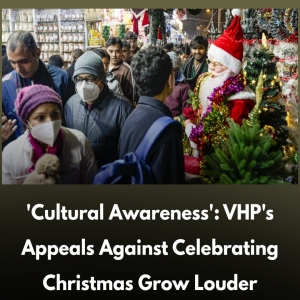
In recent years, Christmas has increasingly become a target of communal forces. According to a report published by The Wire on December 22, 2025, the Vishwa Hindu Parishad (VHP) issued a controversial appeal on December 13, urging Hindus to boycott Christmas celebrations. The appeal targeted not only individuals but also shopkeepers, shopping malls, and schools that observe the Christian festival.
Surendra Gupta, the VHP's Indraprastha Province Secretary, stated in his appeal that Hindu society should practise religious conduct with "self-restraint and self-respect." He argued that participation in other religions' festivals could encourage religious conversions. He further claimed that "Christian missionaries misuse our liberal attitude and carry out conversions," asserting that the appeal was intended to prevent this.
Supreme Court lawyer Shahrukh Alam described the VHP's appeal as being contrary to the spirit of fraternity enshrined in the Preamble of the Indian Constitution. He pointed out that when such exclusionary advice comes from a politically and socially dominant organisation, it has tangible consequences and creates real exclusion, thereby violating constitutional values.
The Catholic Connect, on December 23, reported that police in Palakkad arrested RSS workers in connection with an attack on a Christmas carol group during a house-to-house carol performance in the Pudussery–Kasba area of the district. In another incident in Odisha, a group of men allegedly harassed and intimidated poor roadside vendors selling Santa hats, claiming that the state was a "Hindu Rashtra" in which Christian symbols should not be sold.
In yet another disturbing incident, a video that has gone viral from Jabalpur in Madhya Pradesh shows a visually challenged woman attending a Christmas programme being publicly abused and physically harassed by Anju Bhargava, identified as the city vice-president of the Bharatiya Janata Party.
The draconian anti-conversion laws enacted by BJP governments in various states, coupled with the role of the so-called godi media and the IT cell of the ruling party, have together created an ecosystem in which any Christian prayer gathering is presumed or interpreted as a religious conversion programme.
Festivals—especially in BJP-ruled states—have increasingly become occasions for Hindutva groups to generate communal tension and violence. The higher echelons of the ruling party maintain a studied silence when such disturbances are fomented by the foot soldiers of the Sangh Parivar. Subsequently, leaders of these groups are often rewarded with promotions within the party and, at times, with positions in government.
Reacting to the VHP's appeal urging Hindus not to celebrate Christmas, journalist Tavleen Singh wrote a strongly worded article in The Indian Express on Sunday, December 21. Criticising the right-wing organisation, she wrote: "Pluralism is what makes India what it is. Without it, there is a danger that we could descend into the grim situation in which some of our less pluralistic neighbouring countries find themselves today."
Interestingly, while the foot soldiers of the Sangh Parivar indulge in hate speech and disrupt Christmas celebrations, leaders at higher levels publicly extol the teachings of Jesus and the contributions of the Christian community. Addressing the Christmas 2025 celebration organised by the Catholic Bishops' Conference of India (CBCI) in New Delhi, the Vice President of India, Shri CP Radhakrishnan, remarked that the essence of Christianity lies in the life and teachings of Lord Jesus Christ, who came into the world to establish peace and harmony. He observed that these values are especially relevant in contemporary times, when societies around the globe are facing deep divisions and conflicts.
Traditionally, religious festivals in India have been occasions for people of different faiths to greet one another, understand the spiritual messages of various traditions, and build social harmony. Many schools celebrated major festivals of different religions to inculcate in students the constitutional value of pluralism (secularism)—the acceptance, appreciation, and celebration of diversity. Since 2014, however, this ethos has been steadily eroding, particularly in BJP-ruled states.
The VHP and Bajrang Dal had also issued directives to non-Hindus during Hindu festivals in the past. For instance, in 2024 and 2025, right-wing Hindu organisations—primarily the VHP and Bajrang Dal—issued strict warnings across several states restricting non-Hindus, particularly Muslims, from participating in Navratri Garba and Dandiya celebrations. Organisers were instructed to check Aadhaar cards at entry points to verify participants' religious identity. Monitoring teams were reportedly formed in states such as Maharashtra, Madhya Pradesh, and Rajasthan to ensure compliance.
At the same time, a few state governments remain committed to fostering religious harmony through the celebration of festivals of different faiths. On December 21, 2025, Kerala's General Education Minister, V Sivankutty, strongly condemned the decision of certain private school managements to cancel Christmas celebrations. He described the cancellation of planned events and the refunding of money already collected from students as "cruel" and emotionally harmful to children. He warned that schools must not be turned into "communal laboratories" or platforms for narrow political interests. He asserted that the government would not tolerate "North Indian models" of religious division in Kerala.
The minister emphasised that all schools—whether aided or unaided—are bound by the Constitution and state educational rules, which mandate the celebration of festivals such as Onam, Christmas, and Eid to promote mutual respect and understanding.
Against this backdrop, it is both disturbing and alarming to read recent statements by Shri Mohan Bhagwat, the Sarsanghchalak of the Rashtriya Swayamsevak Sangh (RSS). While addressing a programme commemorating 100 years of the RSS in Kolkata on December 21, 2025, Bhagwat stated that India is, and will continue to be, a Hindu nation, asserting that this reality does not require constitutional endorsement. He remarked that whether Parliament amends the Constitution to include such a declaration or not is irrelevant, adding that the caste system based on birth is not the hallmark of Hindutva.
Such confusing and contradictory statements by the supreme leader of a pan-Indian organisation—which serves as the ideological parent of the BJP and other Sangh Parivar organisations—provide tacit licence to right-wing groups to attack diversity, which lies at the core of the Indian nation. While the RSS may speak in different tones at different times, its ideological position remains clear: the vision of a Hindu nation in which Muslims and Christians are relegated to second-class status, as articulated in We, or Our Nationhood Defined by MS Golwalkar, whom the RSS venerates as "Guruji."
Golwalkar Wrote:
"The foreign races in Hindustan must either adopt the Hindu culture and language, must learn to respect and hold in reverence Hindu religion, must entertain no idea but those of the glorification of the Hindu race and culture, i.e., of the Hindu nation and must lose their separate existence to merge in the Hindu race, or may stay in the country, wholly subordinated to the Hindu Nation, claiming nothing, deserving no privileges, far less any preferential treatment — not even citizen's rights."
The root of the weaponisation of religious festivals—whether Hindu or Christian—appears to lie in the exclusionary ideology of the RSS–BJP. Targeting Muslims and Christians and branding them as anti-national has become a calculated strategy to polarise the Hindu electorate, enabling the BJP to win election after election and thereby perpetuate its hold on power.
The ideology and political strategy of the RSS–BJP are fundamentally opposed to both the letter and the spirit of the Indian Constitution, as well as to India's millennia-old pluralistic heritage. This is a critical moment for all those committed to the Indian Constitution to renew their resolve to build and defend a secular (pluralistic), inclusive, and democratic India.
.jpg)
 A. J. Philip
.png) Cedric Prakash
Cedric Prakash
.jpg)
 P. A. Chacko
.jpg)
.jpg)
.jpg) Thomas Menamparampil
Thomas Menamparampil
.png)
.png)
.png) Robert Clements
Robert Clements
.jpg)
.png)
.png) Chhotebhai
Chhotebhai