

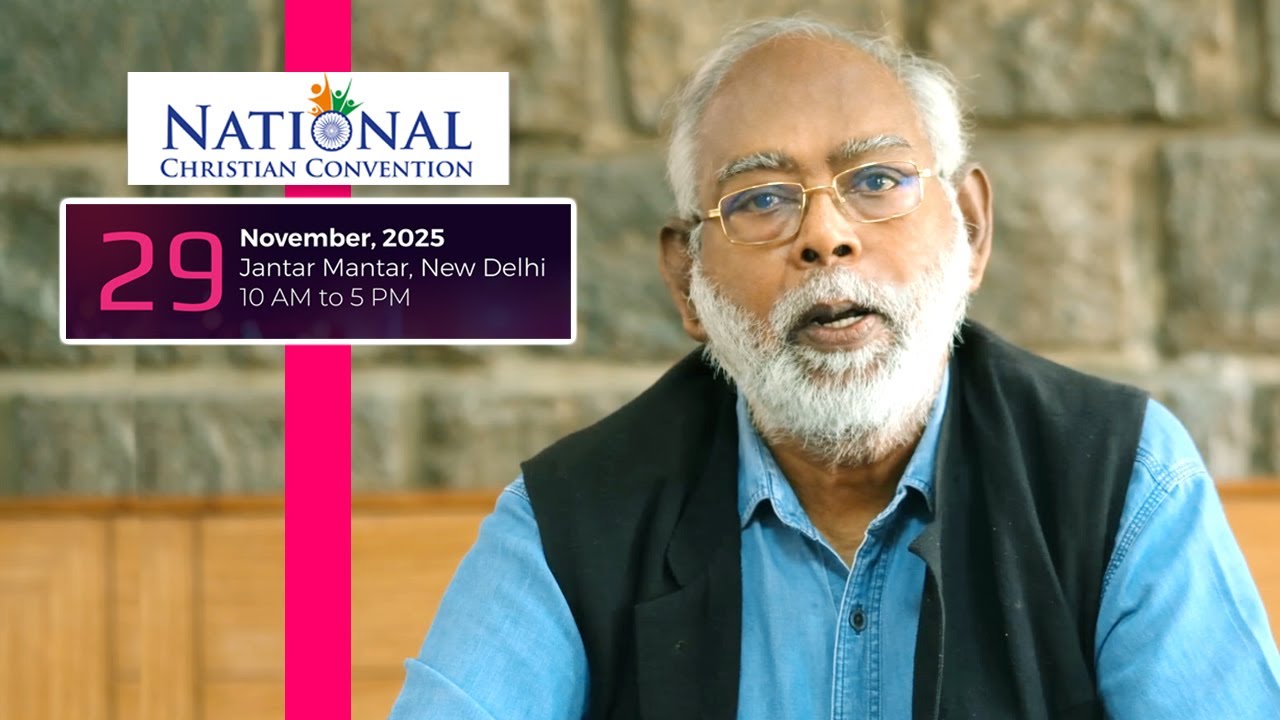
On November 29, a National Christian Convention was held at Jantar Mantar in Delhi, just before the winter session of the Parliament. It was not a festival or a spiritual retreat. It was a constitutional gathering, presenting documented evidence of systematic violence against Christians. The numbers were sobering. Between 2014 and 2024, incidents increased 500%, from 139 to 834. In nine months of 2025 alone, 579 incidents were recorded. Police registered First Information Reports in only 39 cases. A justice gap of 93%. Nearly five thousand incidents over twelve years, each number representing families living in fear. A memorandum was prepared for the Prime Minister, and some members of Parliament attended the event. The organisers expected 5,000 believers to turn out. Fewer than fifteen hundred came.
A day later, a church fete in the same vicinity drew massive crowds and inspired viral social media posts, signalling the arrival of the Christmas season for the Christian community in Delhi. This is about more than one event. It is about what moves us and what leaves us unmoved. We gather readily when the atmosphere is celebratory, when worship lifts us, when we are sure to be encouraged. But when the call is to stand in solidarity for justice for persecuted Christians, to be visibly present for suffering we would rather not see, something in us hesitates.
Christmas is nearly here, and it asks us to remember something we may have begun to forget. God did not send a strategy from heaven. He sent Himself. The Word became flesh and dwelt among us (John 1:14). Emmanuel. God with us. Not managing from a distance, not just inspiring from above, but present, vulnerable, sharing our condition, our suffering. If God's answer to human need and suffering was presence, what does it mean that we have learned to be absent from one another?
Across the global Church, a vision is stirring, and many of us in India have embraced it. By 2033, the two-thousandth anniversary of Pentecost, movements worldwide are mobilising to see the Great Commission significantly advanced. Christians across nations and traditions are working together to reach those who have never heard the Gospel. This vision is good and right. There is something beautiful in the ambition, something that reminds us that the Gospel is for all peoples.
But I cannot escape a harder question. How will our witness be credible if we cannot stand with our own suffering members? What does it say about our love for distant peoples if we will not be present to those beside us? The Apostle John wrote: whoever does not love the brother he has seen cannot love God whom he has not seen (1 John 4:20). The foundation of mission is always Christ and His Gospel. That does not depend on us. But the integrity of our witness does. We are not called to perfect our love before we can speak the Gospel. We are called to live in a manner worthy of the Gospel we preach, not as a prerequisite to mission, but as its authentic ex
Manipur haunts me. Over 250 were killed. More than sixty thousand people were displaced. Nearly 400 churches were destroyed. Two years later, believers still live in camps, afraid and unable to return home. They stare into an uncertain future even as the government talks about closing the relief camps in the state. At the convention in Delhi, Manipur itself was largely absent. The very people whose voices needed to be heard did not come in significant numbers. What does that mean? Have they given up believing the rest of us will show up? Or have we trained them so well to bear their suffering in silence that they no longer expect solidarity?
Dalit Christians have been denied Scheduled Caste status for seventy-five years. Three generations were excluded from constitutional protections solely because of their faith. Seventy-five years. We know this. We discuss it in our seminars. But when a national gathering called us to stand together and demand justice before our own government, the Church stayed home. And now there are growing calls to delist Christian tribals from the Scheduled Tribe status, stripping them of the protections that have been theirs, threatening their welfare and their dignity based on religious identity alone. Where is the outrage? Where is the solidarity?
But we do show up for other things. Christian concerts fill auditoriums with staging and production that rival those of the entertainment industry. Worship bands release singles on YouTube, each hoping to go viral. The music is often good, and I do not question the sincerity of many who lead worship with genuine hearts. But look at what we have created. We have created a culture where spiritual authority is measured by platform size rather than by faithfulness, where visibility matters more than character, where the persecuted believer's quiet endurance counts for less than the celebrity preacher's Instagram following.
Scripture testifies to the apostles Christ appointed to lay the Church's foundation, and to the prophets through whom God spoke His word. These were not titles to be claimed but callings to be received. The apostolic teaching they gave us remains, inscribed in Scripture. The work of pioneering mission, of prophetic faithfulness, of building Christ's Church continues. But today we see these sacred titles self-adopted as brands, claimed not because of divine appointment or proven fruit, but because in a marketplace of ministries, impressive titles attract crowds and confer status.
Stadiums fill for those who promise dramatic encounters, while a convention for persecuted believers draws fifteen hundred. We pack venues for religious spectacle but stay home when persecuted believers need us to stand with them before authorities. Thousands gather when the lights are bright, the music is polished, and extraordinary experiences are promised. Fewer than fifteen hundred come when the call is to be present for those who suffer. The platform has become the point. Visibility has become the measure of anointing. And the suffering Body of Christ has become a prayer request we forward before moving on to what is more appealing.
Are we forming disciples who will take up the cross, or consumers who love the experience but scatter when faithfulness becomes costly? The irony is that the persecuted believer in a remote village watches the glamour of urban Christian culture and aspires to it, not because it looks like Jesus, but maybe because it seems like escape.
The justice gap is not only in police stations and lower courts. It exists in our own communion. One part of the Body suffers, and the rest carries on undisturbed. We receive reports from distraught believers in Chhattisgarh, from village Churches in Uttar Pradesh, where families are threatened, and worship is disrupted. We pray. We add them to our intercession lists. We forward the prayer requests and shake our heads at how things have come to be. And then we return to planning the next concert tour, the next building campaign, the next leadership summit with international speakers. We have learned to live as distant relatives rather than as members of one Body.
I do not write this to shame us, but let's not pretend that this is acceptable. I love the Church in India. I believe we are capable of faithfulness that matches our rhetoric. But we seem to be drifting. We measure success by how many gather when it costs them nothing. What if we measured it by who shows up when it costs them something? We celebrate platforms when we should celebrate costly obedience. We make plans for 2033 while ignoring 2025. The gap between what we say we believe and how we actually live is widening.
The vision for 2033 is good and right. But we cannot complete the Great Commission globally while failing in love locally. The world will not be moved by our strategies, our music videos, or our ambitious timelines. It will be moved, if at all, by whether we actually love one another. That has always been the test. "By this all people will know that you are my disciples, if you have love for one another. (John 13:35)" Not if you have great productions. Not if you have grand visions. If you have love.
The God who came to us as Emmanuel shows us the way. His answer to a broken world was not a program or a strategy sent from a distance. It was Himself. The Word made flesh, who came to dwell, to suffer, to die, and to rise for us. If we belong to Him, we cannot do less. Presence is not optional for Christians. Solidarity with those who suffer is not for the exceptionally spiritual. It is the baseline expectation for everyone who bears the name of Christ.
The convention on November 29 documented 4,959 incidents of violence, a 93% justice gap, seventy-five years of Dalit exclusion, and threats to tribal protections. The Church did not show up. But it is not too late. The call to presence is still before us. Will we answer it in 2026? Will we stand with Dalit Christians seeking justice? Will we resist the delisting of tribal believers? Will we carry Manipur's burden, not just forward its updates? Will we measure our faithfulness not by plans for distant peoples but by love for the brother beside us?
May the God who came to us as Emmanuel give us grace to become a Church known not for the size of our events or the polish of our productions, but for our willingness to be present with those who suffer. This is where the mission begins. This is where the integrity of our witness is tested. Not in 2033, but now. Not somewhere far away, but here, with the brother and sister beside us, and the choice to show up when it costs us something.
.jpg)
 A. J. Philip
.png) Cedric Prakash
Cedric Prakash
.jpg)
 P. A. Chacko
.jpg)
.jpg)
.jpg) Thomas Menamparampil
Thomas Menamparampil
.png)
.png)
.png) Robert Clements
Robert Clements
.jpg)
.png)
.png) Chhotebhai
Chhotebhai