

hidden image

Agnipath: A Personal Perspective

N. Kunju N. Kunju
04 Jul 2022
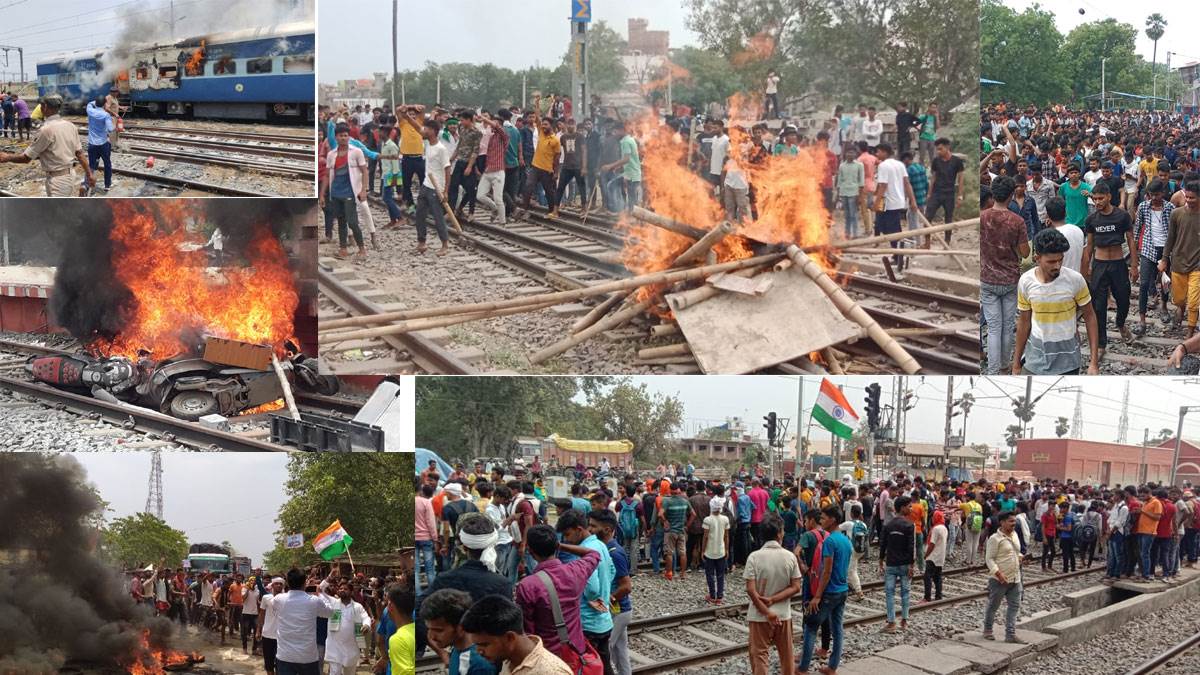
The present violent agitations are an ex<x>pression of dissatisfaction of the youth because of unemployment.

I joined the British Indian Army in June 1947 as a Sepoy Clerk. In August, India won independence. The Army changed hands from the British to Indian, but it remained just as the British left it. It became the Indian Army but retained all the characteristics of a colonial army.

All my service period, till 1973 when I retired, I had felt that the Army should have adapted to the national needs. But as a soldier, I had no way of expressing my opinion and demands openly.

After release from Army, I worked as a journalist and had a chance to express my views through writings about the need for changes in the Army. I wrote several articles in CARAVAN, the fortnightly I worked for, and in some dailies. I wrote two books on the subject: Indian Army – A Grassroots Review in1991 and Free India’s Army – Problems at 50 in1997.

On my first book, Maj. Gen. Ashok Mehta wrote in the weekly SUNDAY: “A junior commissioned officer, Subedar Major N. Kunju, the first ever among his tribe to write in English, tells in his new book some home-truths about the olive green. For him (and many others) while the organization, culture and traditions have been time tested, they are “time-barred”. He wants the Army to Indianise so that it can meet the aspirations of the rank and file.”

However, the Army remains as it was even after 75 years of freedom. So, I was happy to know that the Modi Government was going to bring about radical changes in the Army, to make it truly national through a plan named Agnipath.

I appreciate the change of name of the lowest rank of the soldier, Sepoy. I was recruited as a Sepoy Clerk in 1947. I felt odd and humiliated. How could I be a peon and clerk at the same time? Anyhow I had to put up with the humiliation till I was promoted to the next rank, Naik clerk.

Now if I were to be recruited today, I will be known as Agniveer clerk, a flattering designation. But why Agniveer? Why not call him just Sainik? Agniveer sounds as if he belonged to the fire brigade.

The Agniveer’s service is for four years unless he falls in the 25% that would be retained. What about the ranks when he would be promoted? Will they be Naik and Havildar? The Indian Air Force personnel who retained the British ranks of Corporal and Sergeant, look down upon army-men with Indian ranks. A Sergeant will never concede a Havildar is equal to him.

    Some points on the induction of Agniveer into the Forces are given below:

  1. The emoluments of the proposed Agniveer are quite attractive though his four years service is a problem. The present violent agitations are an expression of dissatisfaction of the youth because of unemployment. Recruitment to the Army is in thousands but unemployment is in millions.
  2. The jobs offered to ex-Agniveers are an afterthought of authorities when the agitations against Agnipath turned violent and nationwide. Employers want fresh men and not ex-servicemen who are conscious of their rights. Statistics show the intake of ex-servicemen in civil and police forces is meager despite quota.
  3. What will be the impact of Agniveer on the existing servicemen? How their emoluments compare with that of Agniveer? Will it not result in jealousy among personnel and discontent?
  4. Retention of 25% of Agniveers after four years could cause unhealthy competition to please superiors. It will have a negative impact in the cohesion of the Unit.
  5. How would Agniveers with a year of service fare when posted to India-China border of sub-zero temperature, especially when his mind is preoccupied with his impending discharge shortly?

Certainly, the Army needs change from the colonial to the national. I had given the changes needed in detail in my two books mentioned earlier. I had sent the books to successive army chiefs and they had acknowledged them. Two Chiefs called me to discuss the matter. General Malik had discussed the matter with me over a cup of tea. General Bikram Singh appreciated my writing on Army and presented me with a memento. However, no one wanted to disturb the status quo.

The measures to be taken to change the colonial army into truly national, would form matter for another article.

(The writer is an ex-serviceman, journalist and author)


Recent Posts

Communal hatred, seeded by colonial divide-and-rule and revived by modern majoritarianism, is corroding India's syncretic culture. Yet acts of everyday courage remind us that constitutional values and
apicture Ram Puniyani
16 Feb 2026
What appears as cultural homage is, in fact, political signalling. By elevating Vande Mataram symbolism over inclusion, the state is diminishing the national anthem, unsettling hard-won consensus, and
apicture A. J. Philip
16 Feb 2026
States are increasingly becoming laboratories of hate; the experiment will ultimately consume the nation itself. The choice before India is stark: reaffirm constitutional citizenship, or allow adminis
apicture John Dayal
16 Feb 2026
Mamata Banerjee's personal appearance before the Supreme Court of India has transformed a procedural dispute over SIR into a constitutional warning—questioning whether institutions meant to safeguard
apicture Oliver D'Souza
16 Feb 2026
This is a book by two redoubtable Jesuit scholars. Lancy Lobo is currently the Research Director of the Indian Social Institute in New Delhi, while Denzil Fernandes was its former Executive Director.
apicture Chhotebhai
16 Feb 2026
The cry "Why am I poor?" exposes a world where fear of the other, corrupted politics, and dollar-driven power reduce millions to "children of a lesser god." Abundance will coexist with deprivation, an
apicture Peter Fernandes
16 Feb 2026
O Water! There is a facade of democracy. In which caste is appropriated As a religious tool, To strengthen the caste hierarchy For touching their water.
apicture Dr Suryaraju Mattimalla
16 Feb 2026
From Washington's muscle diplomacy to Hindutva's cultural majoritarianism, a dangerous erosion of values is reshaping global and Indian politics. When power replaces principle and identity overrides j
apicture Thomas Menamparampil
16 Feb 2026
In today's world, governance is not merely about policies. It is about performance. The teleprompter screen must glow. The sentences must glide. The applause must arrive on cue.
apicture Robert Clements
16 Feb 2026
From Godhra to Assam, a once-neutral word has been weaponised to stigmatise, harass, and exclude a section of the people. This is not a linguistic accident but a political design wherein power turns l
apicture A. J. Philip
09 Feb 2026