

.jpg) Jessy Kurian
Jessy Kurian
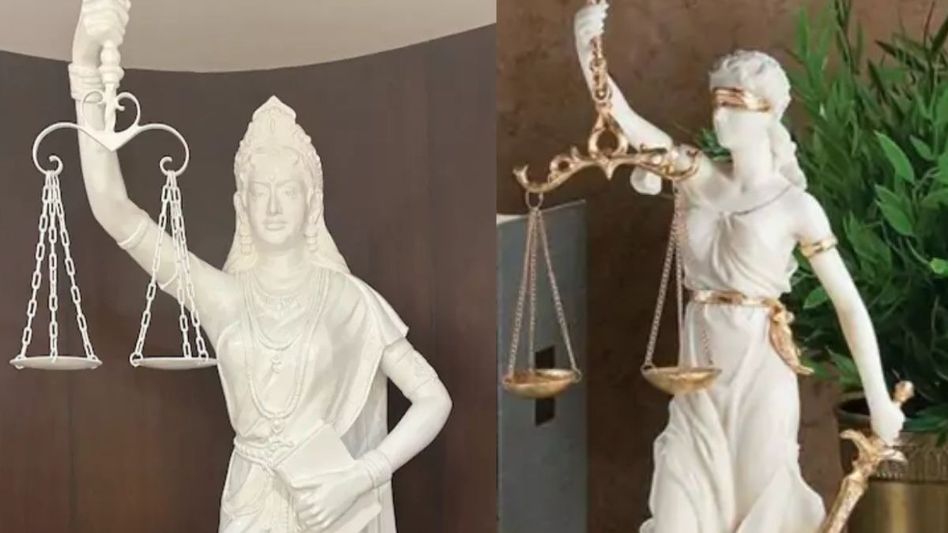
The familiar Lady Justice's statue, long associated with courts and legal institutions, has been redesigned by the Supreme Court of India with the intent to move away from its colonial legacy. Traditionally, it was depicted with a blindfold and a sword.
The figure of Lady Justice finds her earliest echoes in ancient civilisations, particularly in Egypt, Greece, and Rome, where the goddess symbolised concepts of truth, justice and order.
One of the oldest forerunners to Lady Justice is "Ma'at," the Egyptian goddess of truth, balance, and cosmic order. Dating back to 2300 BC, Ma'at was often depicted with an ostrich feather in her headdress, which weighed against the souls of the dead in the afterlife to determine their worthiness. In Greece, the goddess "Themis," whose name means "divine law" or "order" personified justice. She is frequently represented holding scales, a sword, and sometimes a cornucopia to signify abundance.
The ancient Romans embraced Themis as Justitia, the personification of justice. Emperor Augustus solidified Justitia's symbolism, associating her with Roman law. Like Themis, Justitia also wielded scales and a sword, embodying the impartiality and enforcement of legal judgements.
Perhaps the most defining feature of Lady Justice recently installed in the Supreme Court is that it is without a blindfold. In fact, the earliest depiction of Justitia in medieval and Renaissance art showed her without a blindfold. It was consistent with the classical interpretation that justice must "see" clearly to deliver fair judgments. However, when humanism and critical thinking flourished, the blindfold was introduced again in the 17th and 18th centuries. Thinkers like John Locke, Voltaire, and Montesquieu argued that justice should be delivered without favour, fear or bias. The blindfold, initially a symbol of ignorance, was reinterpreted as representing objectivity - the notion that justice should be blind to power, wealth, or status.
Chief Justice DY Chandrachud, while unveiling the statue of Lady Justice on 7th October, emphasised that justice is not blind, but open eyes represent a justice system that "sees all equally" (as interpreted before the 17th century). The Indian Lady Justice is depicted without the sword, symbolising punishment and violence. Instead, she holds the Indian Constitution, symbolising that justice in India is grounded in the democratic values of equality and fundamental rights. There is a change in her attire, too. She is clad in a saree to shed colonial imagery and create a symbol rooted in Indian cultural identity while still upholding the principles of impartiality, fairness, and justice for all.
Despite her complicated history, Lady Justice remains a powerful symbol in modern legal institutions. Such statues adorn courts and government buildings worldwide, like the Supreme Court in Washington DC, the Old Bailey in London, and even in former colonial nations like India, South Africa and Nigeria.
In an age of rising social movements, from "Black Lives Matter" to "MeToo," Lady Justice has become a relying figure in the fight against systemic injustice. Activists often invoke her to critique legal systems that claim impartiality. The scales are retained, meant to balance truth.
However, what is more important is that judges, whom we address as "Lords," should deliver justice without fear and favour. As Justice AK Sikri stated in his article, "Role of Judges," the duties of a judge duties are (1) to ensure that all persons are able to live securely under the rule of law, (2) to promote, within the proper limits of the judicial function the observance and the attainment of human rights, (3) to administer the law impartially among persons and between persons and the State etc. However, the first role of a judge is to protect the very Constitution under which a judge has been appointed.
In His Holiness Kesavanada Bharati Sripadagalvaru vs State of Kerala & Anr, the Supreme Court held that the Parliament representing the sovereign will of the people could not use its amending power to alter the basic structure or framework of the Constitution. Above all, it could not use its amending power to shut our judicial review for finding whether a statute enacted by a Legislature is in respect of the subject for which judicial review has been excluded.
The role of the judge on political questions was crystallised in the case of Minerva Mills Ltd & Ors vs Union of India & Ors. The Supreme Court held that it would decline to entertain a political controversy. Pure political questions are outside its domain. However, in the matter of interpretation of the Constitution, the Supreme Court must interpret it, even though the answer to the question would have political effect.
The protection of constitutional democracy necessitates an independent judiciary that protects not only its own independence but also the base of parliamentary democracy - free and fair elections. In People's Union for Civil Liberties vs Union of India (NOTA CASE), the Supreme Court developed the already established concept of democracy as a fundamental feature of the Constitution to hold that free and fair elections are necessary for ensuring this essential feature.
In Vineet Narain & Ors v Union of India & Anr, the Court spelt out its obligation under Article 32 to protect and enhance fundamental rights even in the absence of legislation by Parliament as emanating from Article 32 and the Beijing Statement of Principles of Independence of the judiciary in LAWASIA region.
In Badshah v Urmila Badshah Godse & Anr, the Court recognised the duty of a judge to bridge the gap between law and society and the need to give purposive interpretation to the provisions of law according to signs of the time.
It is important to note the ruling of the Court in Dattatraya Govind Mahajan and Ors vs State of Maharashtra and Anr, where the Court held, "Our Constitution is tryst with destiny, preambled with Inscent solemnity in the words - 'Justice - social, economic and political.' The three great branches of Government, as creatures of the Constitution, must remember this promise in their functional role and forget it at their peril, for to do so will be a betrayal of those high values and goals which this nation set for itself in its objectives Resolution and whose elaborate summation is in Part IV of the paramount parchment."
As Chief Justice DY Chandrachud rightly said, "The role of judges is to serve people and not to be served as deities in the temple of justice." Let us hope that justice will reign in our nation and that it will flow to the doorsteps of common men and women. Let Lady Justice stand erect, upholding the Constitutional values and protecting the dignity of every citizen of our great nation, India.
Jai Hind!
.jpeg)
 A. J. Philip
.jpg)
.png) Jacob Peenikaparambil
Jacob Peenikaparambil
.jpg)
.png) John Dayal
John Dayal
.jpg)
 Pachu Menon
.jpg)

.png)
.png)
.png) Robert Clements
Robert Clements
.jpg)