

.png) Ram Puniyani
Ram Puniyani
.jpg)
Eric Hobswam famously stated that history is as important to (sectarian) nationalism as poppy is to an opium addict. The right wing is surging with great speed; its ideologues keep a matching pace to construct the history which suits their political agenda of exclusion of some and glorification of their past. In this direction, medieval Indian history was the major one to be mauled by showing particularly that the medieval period of Indian history was an era of Islamic imperialism and by projecting the Muslim kings in a bad light, which helped them create hate against today's Muslims.
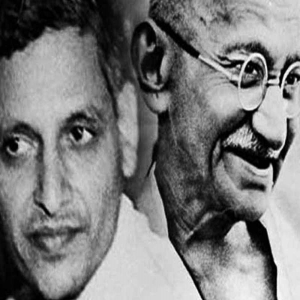
Even ancient Indian history, a golden period for them, was manipulated to show that the Aryans, their ancestors, were the indigenous people of this land. Coming to the freedom movement, they first focused on Nehru, the colossus who articulated and practised secularism in India. He was aware that practising secularism in India is not easy as large sections of Indian society are in the grip of blind religiosity. He was the one to see the threat of majoritarian (Hindu) communalism and equated it to fascism. He said minority communalism was, at worst, separatist. His mentor Gandhi, though murdered by the one who was trained by RSS and was working for Hindu Mahasabha, could not be demonised easily. Gandhi's place in the global arena and in the heart of Indian people was at its peak.
As the communal right-wing feels it is on firm feet, its ideologues are beginning to overly project some of Gandhi's shortcomings and undermining his contribution to freedom. On January 30, 2025, as the nation was paying tributes to the father of the nation, many portals relayed videos to propagate that Gandhi was just one of the efforts in India to get freedom. Various podcasts and social media channels asserted that Gandhi's efforts had only a marginal effect on the British leaving India.
In the last few years, Godse has been glorified in Twitter storms of 'Mahatma Godse Amar Rahe' (Long Live Godse). The ilk of Pooja Shakun Pandey enacting the shooting of Gandhi using effigies, and then blood dripping from it has become a common sight. Observing national mourning on January 30 with sirens being sounded at 11 AM for two minutes of silence has been muted. This year, the Maharashtra state circular on the two-minute silence at 11 AM did not mention even the name of Gandhi.
As we observed the Gandhi Martyrdom Day on January 30, many of these irritants flashed to our minds. He was given the honorific Mahatma by none other than Guru Rabindranath Tagore. It is propagated that the Gandhi-Congress ignored Netaji Subhash Chandra Bose. The fact is that Bose and Congress had some differences in strategy, but the core agenda of freedom from British rule remained the same. It was Netaji who addressed Gandhi as 'father of the Nation'. He also named one of his battalions of Azad Hind Fauj (Free India Army) the Gandhi Battalion. The Gandhi-Congress fought the cases of prisoners belonging to the Fauj by forming a committee with top lawyers like Bhulabhai Desai, Kailashnath Katju and Jawaharlal Nehru.
The propaganda that Gandhi did not do anything to save Bhagat Singh's hanging is being instilled into the society as common sense. They hide that it was Gandhi who wrote to Lord Irwin to rescind Bhagat Singh's hanging. Irwin showed his inability to accept this request as all British officers in Punjab had threatened to resign if Gandhi's request was accepted. Most interestingly, Bhagat Singh requested his father, Kishan Singh, to support the 'General' of the Freedom Movement (Gandhi), which his father did by working for Congress.
The attempt to undermine Gandhi comes in the form of nitpicking the three major movements that Gandhi launched. The non-cooperation movement of 1920, which was the first genuine attempt to involve ordinary people in the struggle against the British, was ineffective as it was withdrawn due to the Chauri Chaura incident, where the crowd had burnt the police station, killing many policemen. They allege that Gandhi's support for Khilafat was demoralising, as it related to supporting the restoration of the Ottoman Empire in Turkey. Let's remember it was this move which brought in Muslims in large numbers into the vortex of popular anti-British struggle. Also, the Mappila (Moplah) rebellion is supposed to have been an aggressive move by Muslims against Hindus. It was, in fact, a rebellion of poor Muslim farmers against Janmis (landlords who were Hindus) and the British authorities who were protecting the interests of landlords.
The counterargument regarding the Civil disobedience of 1930 is that it just led to the Gandhi–Irwin Pact. This pact was a major step in furthering the pressure of the Indian freedom Struggle. The accusation is that the Salt March did not lead to the abolition of the salt tax, which it aimed at. The fact is that people could produce salt after this; its illegality was lifted.
It is true that as Gandhi and the major leaders of Congress were arrested, the 1942 'Do or Die' and 'British Quit India' movements took a violent turn. The point is that they created huge awareness about getting freedom from the British. It came as a culmination of the long process of creating mass consciousness, which began picking up after the 1920s Non-Cooperation movement.
There is no denying that revolutionaries Bhagat Singh and his likes, Subhash Bose's Azad Hind Fauj and the Revolt of Naval Ratings, were valuable additions to the whole process of raising people's consciousness towards longing for freedom. Gandhi's contribution is monumental as it created fraternity and Indianness among the people, as Surendranath Banerjee very aptly described in "A Nation in Making."
These were twin aspects of the freedom movement: the first was the struggle against the British, and the second was to build a nation, India, through this. Gandhi understood that bringing people together is the core of the process of getting freedom. A recent flourishing attempt by right-wing communalists totally ignores the process of people and masses waking up and constituting India as a nation. This was the most significant endeavour for which Gandhi was really the 'Father of the Nation'.
.jpg)
.png) Cedric Prakash
Cedric Prakash
.jpg) Elsa Lycias Joel
Elsa Lycias Joel
.jpg)
 A. J. Philip
.png) Jacob Peenikaparambil
Jacob Peenikaparambil
.jpg)
.png) John Dayal
John Dayal
.jpg)
.jpg)
.png) Joseph Maliakan
Joseph Maliakan
.png)
.png) Robert Clements
Robert Clements
.jpg) Cedric Prakash
Cedric Prakash
 ICPA
ICPA