

 Fr. Gaurav Nair
Socialism, in its purest form, has never been successful. The premise of such a framework is that everyone acts altruistically, even if they do not believe in it. Such a situation only becomes self-sustaining when there is a compulsion to appear genuine in public. Proponents of this system refuse to accept the liberal view that people are individualistic and self-serving. No wonder then that Socialism survives today as assorted versions of personalised chimerical monsters that have no likeness to the original idea.
Every movement against corruption bears contours of unstinting beneficence, but deep within the umbrage of its shadows lie emissaries, awaiting their chance at creating mischief. Such scenes have oft been repeated across time and space. The domain of our beloved country has some very telling examples of such incidents within contemporary history, even after independence.
Janata Party's Anti-Corruption Campaign (1977), which rose in the aftermath of the Emergency, failed. Instead of delivering on anti-corruption promises, leaders focused on settling personal and political scores. The opposition, led by VP Singh, used the Bofors Scandal in the 1980s as a rallying point to target the Congress government. He came to power in 1989, but his focus and initial support of the BJP led to a shift into caste and communal politics and general instability.
The case in focus is Anna Hazare's India Against Corruption Movement (2011), which uprooted the UPA. The whole campaign was stage-managed by the right-wing with a Hindutva agenda, as is ostensibly manifest from clues that litter the scene. Anna has openly been called an RSS mask. He had actually praised Narendra Modi's governance of Gujarat even after seeing the 2002 carnage, and his authoritarian views on justice are well known. What kind of Gandhian would applaud and condone violence? In the aftermath of his movement, the AAP was born, and the BJP got a firm footing to rise and remain in power, using religion as its pillar.
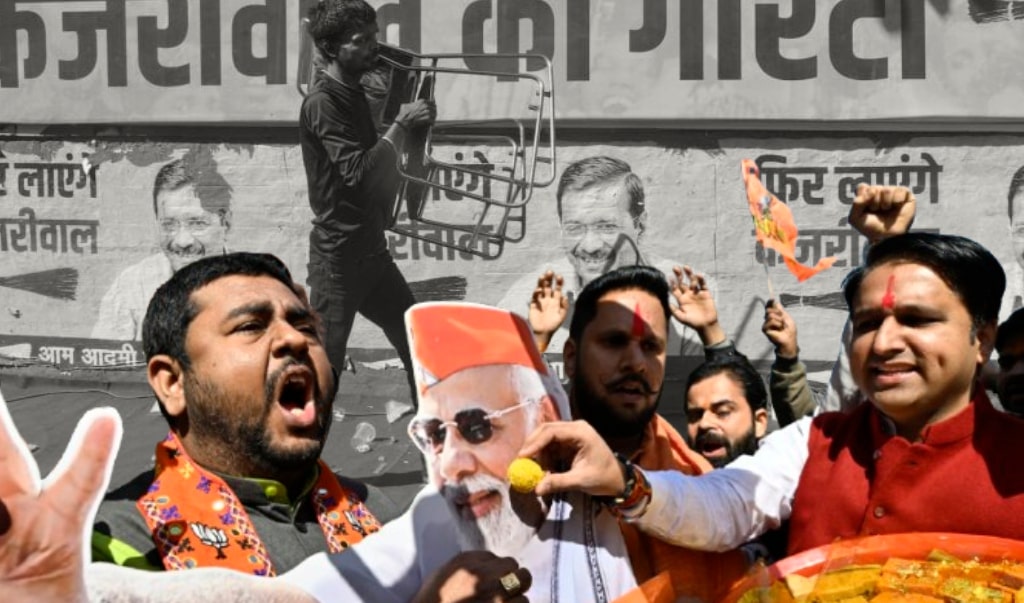
In the Byzantine chess game of Indian politics, Delhi has always been a prized square—a symbolic stronghold. The meteoric rise and equally meteoric fall of the Aam Aadmi Party (AAP) in this territory is fascinating. When Arvind Kejriwal took the stage, he embodied the quintessential political disruptor – armed with an anti-corruption crusade and the common man's muffler. His party's name, "Common Man", was a branding masterstroke. Yet the AAP's falling trajectory paradoxically aligned with that of what it sought to replace.
The BJP, meanwhile, played the long game with remarkable acumen. While the AAP
was busy repackaging freebies, the BJP was weaving a national narrative of cultural
resurgence and muscular nationalism. It then returned to Delhi to claim it with freebies
while criticising it. The BJP emerged as both the catalyst and the beneficiary.
Speculation has swirled around Kejriwal as a potential Trojan horse for right-wing
forces. The RSS's documented strategy of organisational infiltration, coupled with
Kejriwal's remarkable gift-wrapping of Delhi for Modi's forces, lends an unsettling
plausibility to this theory. However, our collective capacity to believe in any
countercultural political movement claiming to challenge entrenched power structures
has genuinely been shattered.
Had Kejriwal maintained his ideological integrity, he could have transformed Delhi into a
showcase for governance. Instead, he has accomplished something far more
damaging: he has vaccinated the public against hope itself, ensuring that future
reformists will be met with eye-rolls rather than enthusiasm. In his spectacular fall from
grace, Kejriwal hasn't just failed himself – he's poisoned the well for an entire generation
...
.jpg)
.png) Cedric Prakash
Cedric Prakash
 ICPA
ICPA
 ICPA
ICPA
 ICPA
ICPA
 ICPA
ICPA
 ICPA
ICPA
 ICPA
ICPA
.jpg)
 A. J. Philip
.jpg)
.png) Jacob Peenikaparambil
Jacob Peenikaparambil
.jpg)
.png) John Dayal
John Dayal