

.png) Jacob Peenikaparambil
Jacob Peenikaparambil
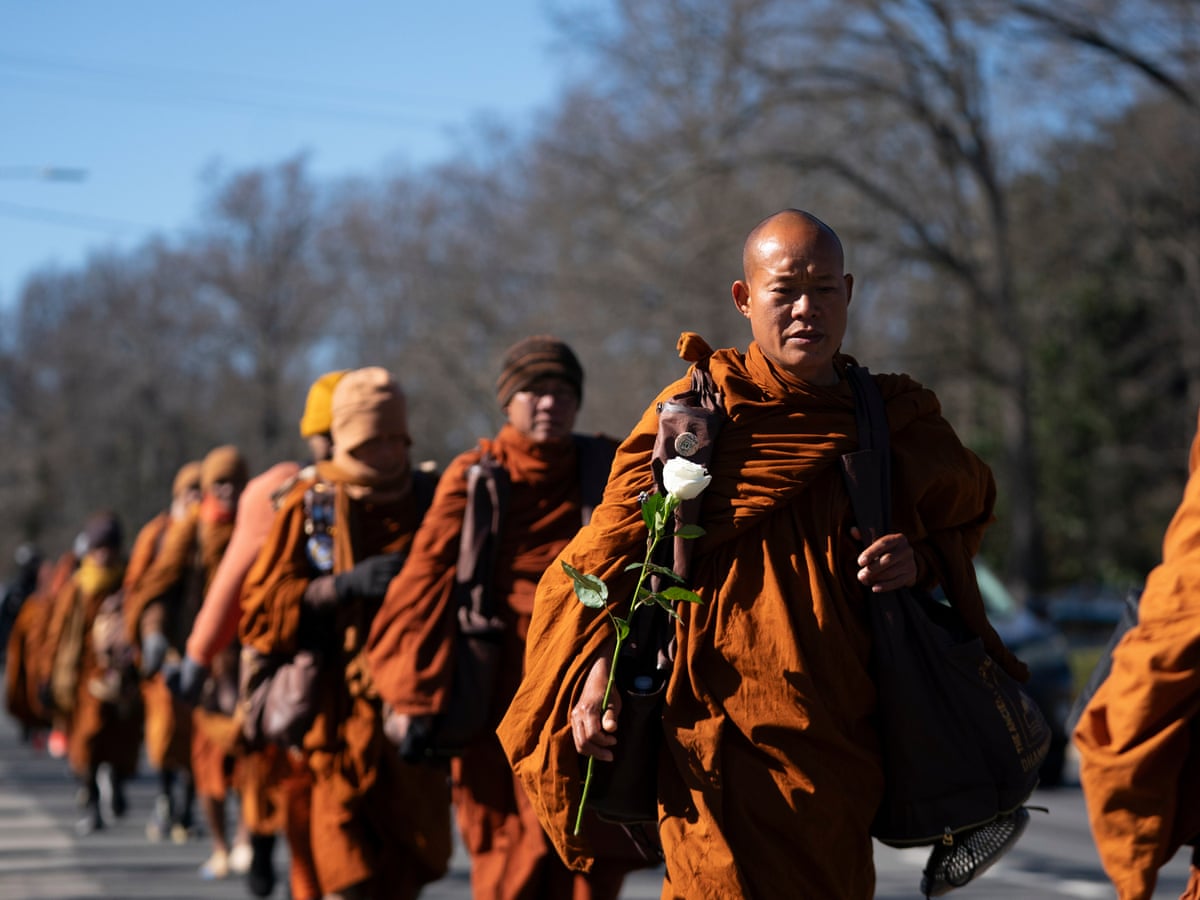
A group of nineteen Buddhist monks who walked for peace from Texas to Washington, DC, covering 3,700 kilometres in 108 days, demonstrated to the world what it truly means to become a Vishwa Guru. Their journey proclaimed a powerful message: it is neither military might nor economic power, nor even technological advancement, that captures human hearts—but love, peace, and harmony.
The nineteen monks began their 3,700-kilometre journey from the Huong Dao Vipassana Bhavana Centre in Fort Worth on October 26, 2025. They came from Theravada Buddhist monasteries across the world and were led by Venerable Bhikkhu Pannakara, Vice President of the Fort Worth temple.
Accompanied by support vehicles and local law enforcement officers, the monks stopped at houses of worship, government buildings, and hotels along the way. They relied entirely on donations, according to the journalist who covered the peace walk.
They carried very little with them. Often their hands were open; sometimes they held flowers placed there by strangers. Yet they always carried a calm presence—one that drew people out of their homes and onto sidewalks and courthouse steps.
There were no shouted slogans, only soft-spoken teachings for those who wished to listen. The monks urged people to cultivate peace in their own lives and then to protect it. According to them, when peace is nurtured within, it naturally radiates outward into society.
Day after day, they continued their mission: to teach people to chant, to love and bless, to forgive and heal, to remain positive, and to find deep joy in the present moment. They taught not through dogma or debate, but through humble hearts and simple practices—sleeping eight hours, eating healthy food, keeping the body active, staying present, and nurturing positivity in mind and heart.
Venerable Bhikkhu Pannakara, the group's gentle, soft-spoken leader, offered mindfulness teachings at stops along the route. "My hope is that when this walk ends, the people we met will continue practicing mindfulness and find peace," he said.
In a post on TikTok, he clearly articulated the purpose of the walk: "We are here for just one mission together: to have peace for ourselves, to have peace for this country, and to have peace for this universe. We all believe in different faiths. We have different mindsets. But all religions teach us how to purify our minds and become good people in society. In the end, all religions lead us back to one religion—peace, love, kindness, and compassion."
Along the route, hundreds of people gathered to meet the monks, braving subzero temperatures because they experienced something that touched their innermost being. The monks were surrounded by crowds at nearly every stop. No matter how miserable the weather, people came out to catch a glimpse of the monks, draped in saffron and maroon robes, walking silently by.
The crowds transcended racial, religious, economic, educational, and geographic boundaries. What united them was a sense of comfort and hope. Many struggled to articulate why the walk touched them so deeply, but it offered encouragement at a time when such hope seemed scarce.
People openly shared their emotions with journalists. "I just want to have a moment of calmness and peace—and to feel like I'm enough," said Ms Peters, tears welling behind her sunglasses.
Ms Logan, who identified herself as a Christian, said she believed the monks were on a mission inspired by Jesus, even though they were Buddhists. "We may not be speaking the same language, but it adds up to the same thing," she said.
"In these divisive times, we saw entire towns in the Bible Belt come out for these monks—many with no idea what Buddhism is—yet they were uplifted and moved. That's inspirational," said Mark Duykers, a retired mechanical engineer who practices mindfulness.
Washington Episcopal Bishop Mariann Budde, who hosted an interfaith reception for the monks at the cathedral, remarked, "Their long journey and gentle witness invite us all to deepen our commitment to compassion and the work of peace in our communities."
The peace walk was not without hurdles. In Georgia and South Carolina, several Christian protesters arrived at the monks' locations with megaphones and signs—some resembling MAGA flags—shouting, "Christ is coming to set you free." The monks also faced serious physical danger.
Nearly a month and 277 miles into their journey, in Dayton, Texas, two monks were struck by a car, resulting in one monk losing his leg.
Yet these obstacles did not deter them. The monks completed their mission successfully, inspiring millions of people not only in the United States but across the world.
Rev. Michael J. Christensen, a Methodist minister who met the monks, reflected: "These venerable monks are making an unmistakable spiritual impression in America—in a dark time, across faith traditions, and among many who claim no religion at all. As a Methodist minister, I am grateful for them. Through this unexpected witness, we are reminded that peace walks, grace moves, and holiness takes hold in those who are ready to receive it."
The monks' Walking for Peace initiative attracted millions of followers on social media, with reports indicating over 2.7 million followers on Facebook, 1.9 million on Instagram, and more than 1.2 million on TikTok. Their journey from Texas to Washington, DC, created a massive global online community that followed their daily updates.
Political leaders in India dream of making the country a Vishwa Guru by 2047. To achieve this, they aim to transform India into a global power through military strength, economic growth, technological advancement, and cultural dominance.
Unfortunately, the methods adopted are divisive—imposing uniformity, centralising governance, and promoting one culture, one language, and one religion. Such policies risk conflict and violence. The experiences of Pakistan and Afghanistan demonstrate that states built on religious uniformity often lead to instability and peril.
The nineteen Buddhist monks who walked for peace have shown the world—including India—that the true path to becoming a Vishwa Guru lies in peace, harmony, non-violence, and unity in diversity.
.jpeg)
 A. J. Philip
.jpg) Jacob Peenikaparambil
Jacob Peenikaparambil
.jpg)
.png) John Dayal
John Dayal
.jpg)
 Pachu Menon
.jpg)

.png)

.png)
.png) Robert Clements
Robert Clements
.jpg)