

.png) John Dayal
John Dayal
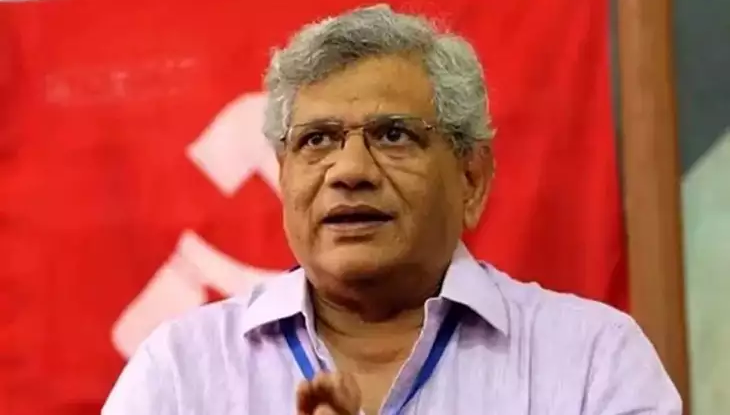
Sitaram Yechuri, the general secretary of the Communist Party of India Marxist and arguably the one person with close friends in every political party, trade union or think tank, passed away on Thursday, September 12, at Delhi's All India Institute of Medical Sciences, losing his last battle with an infection of his scorched lungs. He was 72, though he looked ten years younger.
Sita, as his contemporaries and senior comrades called him, is survived by his wife, journalist Seema Chisti, son Danish and daughter Akhila. His eldest son, Ashish, died in the COVID pandemic, dealing him a blow from which he never recovered. His body was donated to the All-India Institute for Medical Sciences for academic research.
In his death, India's Christian community lost a friend and warm supporter in Parliament and other forums. Although the CPI(M) was seen as hostile, if not outright hostile, to the Christian cause in Kerala, the one state where it was in power, even as its General Secretary, Yechuri was seen as more alive to the political, economic and cultural issues of the Christian church, clergy, and institutions facing the brunt of the BJP government at the centre and in several states, especially in the last ten years.
Till his recent illness, Sita was available to any activist or group that sought his counsel, lending them a caring and inquisitive ear and agreeing readily to requests to be chief speaker at meetings, conclaves, and seminars, especially after the first Bhartiya Janata Party coalition government of Prime Minister Atal Bihari Vajpayee.
He was a polymath, born in 1952 into a Telugu family in the then-Madras. His father was an engineer, and his mother was a teacher. Christian education had a significant impact on him during his school years at All Saint High School in Hyderabad. This was followed by a stint in the government school at President's Estate School in New Delhi, where he topped the All-India higher secondary examination.
Winning laurels as a debater in the Hyderabad YMCA, he aced his skills as a scholar in Economics at St. Stephen's College, followed by postgraduate studies at Jawahar Lal Nehru University, where he came close to the Communist movement. His seniors in the university included Prakash Karat, his predecessor later in life as general secretary of the CPI(M), and Brinda Karat. That sealed his commitment to Marxism and the cause of the poor, the deprived, and religious minorities.
He rose rapidly in the ranks of the party's student wing, heading the then-powerful Student Federation of India, before being given responsibility in the main party, where he was a member of the powerful Politburo for 35 years until his death. He was elected general secretary in 2015, succeeding Prakash Karat, who had held the post from 2005 to 2015. Sita was himself elected thrice to the post, the last time on April 10, 2022.
As a communist, he may have had a view about the organised church, especially as he had seen it practised in various states of south India in varying shades of patriarchy and institutional authoritarianism. But he kept it to himself and was warm and receptive.
His powerful impact on national discourse was seen in his twelve years in the Rajya Sabha on the Marxist benches, where he, together with party colleague Brinda Karat, Congress member Kapil Sibal, and Trinamool Congress leader Brian O'Neil, helped articulate the issues of the community with great impact.
He was at his best when the Modi government first foisted the New Education Policy on an unsuspecting nation in 2016. The church was rightfully worried about how the policy would impact the almost 50,000 big and small academic institutes run by Catholics and Protestant Churches in almost every district and town of the country.
Leading the discussion in the Rajya Sabha on August 11, 2016, Sitaram Yechury criticised the draft policy as unreflective of the education needs of the country, trashing the claims of the ministry that the draft was a result of widespread consultations at various levels across the country. He said the draft was a copy of the RSS inputs from their 3-day international conference on 'New Education Policy and NAMODI Framework' held earlier at Amarkantak in Madhya Pradesh.
In his passionate speech, Sita charged the government with debasing education and selling it in the marketplace. He identified the 3Cs—centralisation, commercialisation, and communalisation—that marked the policy, reflected in the draft: "History is becoming Hindu mythology, and Indian philosophy is becoming Hindu theology."
He wondered why people "who are so fond of our ancient heritage and knowledge" tended to ignore the next 400 years of Buddhist and Mughal achievements. "Don't go halfback but imbibe best of all," he said, adding, "Education defines the character of the nation and its people. Unless you universalise education, you can't reap the potential of the country. All developed countries have universalised their education," he said.
Sita always found time to address people's rallies at Jantar Mantar, Constitution Club, Press Club, and anywhere else friends, comrades, and even smaller groups of activists wanted him to come.
With the same ease, he met political leaders across the spectrum, from Sonia Gandhi and the president to heads of the other parties. Perhaps he did not meet Trinamool Congress chief Mamta Banerjee or Mayawati, but he had close friends even in those parties. In this, he reminded politicians and journalists of one of his seniors, the redoubtable Harkrishan Singh Surjeet, whose voice was heard in every party office in Delhi, as well as in Bihar and Punjab.
Journalist M Somasekhar, who knew him well, wrote in the Hyderabad-based Siasat news portal that Sita had left his impression on public debate, discourse, and Parliamentary democracy.
Sitaram Yechury and lawyer Kapil Sibal of the Congress played a key role in the opposition's move to give the impeachment notice for the removal of the Chief Justice of India, Dipak Misra, in 2018. He was also one of the important United Front leaders who drafted the Common Minimum Programme (CMP), which was the basis for the 16-party coalition government.
"A distinct feature of Yechury's politics was his affable demeanour and ability to bring together various leaders. This also helped him maintain friendly relations with leaders, cutting across political parties and ideological differences. He used this trait to help stitch together coalitions among the warring opposition parties even during the UPA government led by the Congress," Somasekhar wrote.
The rise of Modi and the BJP has seen the rapid erosion of the number of Marxists in legislatures and parliament. The mantle of rebuilding the party fell on the shoulders of Sitaram Yechury in 2016. As General Secretary, he played a significant role in forging the INDIA Alliance of the opposition to put up a strong fight against the Modi-led NDA in the 2024 elections.
In its official statement mourning the death of its top leader, the CPI(M) said his death "at this crucial juncture in our national politics is a big blow for the CPI(M) and a grievous loss for the Left, democratic and secular forces." It said it was in the field of ideology that Sitaram played a distinctive role. The party adopted a resolution "On certain ideological issues at the 14th congress, which formulated the ideological positions of the Party consequent to the setbacks to socialism."
In recent times, Sitaram Yechury had devoted much of his time and energy to forging a broad unity of the secular opposition parties, which took the shape of the INDIA bloc. During the United Front government and later the UPA government, Sitaram was one of the key interlocutors for the CPI(M), which supported these coalitions.
.jpeg)
 A. J. Philip
.jpg)
.png) Jacob Peenikaparambil
Jacob Peenikaparambil
.jpg) John Dayal
John Dayal
.jpg)
 Pachu Menon
.jpg)

.png)
.png)
.png) Robert Clements
Robert Clements
.jpg)