

.png) John Dayal
John Dayal
.jpg)
Punjab does not have an anti-conversion law of the sort that twelve BJP-governed states — from Uttar Pradesh to Madhya Pradesh, from Gujarat to Uttarakhand — have enacted with varying degrees of severity.
But for Christian converts and Hindus, and the occasional Muslim, the AAP government's recent Jaagat Jot Sri Guru Granth Sahib Satkar (Amendment) Act has become a "present and active" threat.
The 2026 Act, also referred to as the sacrilege amendment, was passed in a special session of the Punjab Assembly on Baisakhi — April 13, 2026, remembered by the community as Khalsa Sajna Diwas — and notified within the week.
With every passing day, the law's institutional opponents multiply — the Akali Dal and the Church of North India are two such — and its political managers in the AAP dig in.
The theological foundation of the Act has not been questioned because, in Sikh belief, the Guru Granth Sahib is not merely a scripture but the eternal, living Guru, and is accorded every dignity that a physical presence commands.
Each saroop (copy of the Guru Granth Sahib) is housed in a dedicated room, ceremonially unveiled at dawn, and laid to rest at night, and to tear its pages or scatter its verses is not, for a believing Sikh, just a matter of hurt sentiment.
In 2015, in the Bargari case, pages of scripture were found strewn across the fields of Faridkot, and two men were shot dead in the protests that followed, creating a wound from which the state has not recovered.
The conviction rate in the nearly 600 sacrilege cases recorded between 2015 and early 2026 hovered at a mere 7% (around 44 convictions out of 597 cases), fuelling the demand for a stronger law.
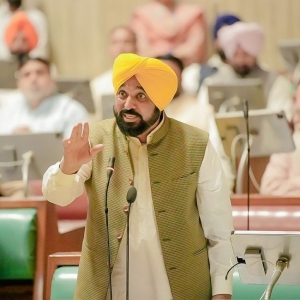
What the AAP government of Chief Minister Bhagwant Mann has produced, however, is a law that reaches considerably beyond desecration, raising the minimum sentence for wilful sacrilege to seven years' rigorous imprisonment, extendable to 20 years.
For criminal conspiracy intended to disturb communal harmony, the floor is 10 years, the ceiling is life imprisonment, with fines as high as 25 lakh rupees.
The "conspiracy" clause, which carries a potential life sentence for acts intended to disturb communal harmony, is broad enough to encompass a great deal that is not desecration by any reasonable construction.
The offences are cognisable, non-bailable, and non-compoundable, and cover digital and electronic means, with a definition of sacrilege wide enough to encompass spoken words, signs, visible representations, and electronic communication that intentionally wound Sikh religious feeling.
Opposition to the law has grown rapidly. The Akal Takht — the supreme temporal seat of Sikh authority — gave a formal 15-day ultimatum to the government to remove clauses its acting Jathedar, Giani Kuldeep Singh Gargaj, has termed objectionable.
The Akal Takht, which says it had never been consulted and that the law was passed in a hurry, is worried that provisions governing the custody, record-keeping, and regulation of "saroops" amount to state interference in religious practice.
Clauses that impose criminal liability on granthis who recite from the Granth Sahib, pathis, and gurdwara committees for sacrilege incidents on their premises are seen as constitutionally overreaching.
Chief Minister Mann has been categorical in response, declaring "There will be no withdrawal of the Sacrilege Act at any cost," and has accused the family of former chief minister Sukhbir Badal of manipulating the Akal Takht for political ends.
Experts say the dispute goes to the heart of Punjab's political and religious identity, dating back to the time of the Sixth Guru, Guru Hargobind — Who holds authority to regulate matters of faith: the state or the Panth?
When an elected government and the highest Sikh religious authority are in open confrontation, the law's legitimacy is compromised in a way that no parliamentary majority can entirely repair.
The Shiromani Gurdwara Parbandhak Committee (SGPC), controlled by the Akali Dal, which manages Sikh places of worship in the state and several other cities in the country, has installed protest flex boards at gurdwaras across Punjab.
Reports indicate that even ordinary Sikhs are already removing chapters of the holy text from their homes out of anxiety about inadvertent legal liability.
That anxiety will not be confined to Sikh households.
It is in the lives of Dalit and Mazhabi Sikh communities that have, over two decades, quietly found their way to evangelical Christianity that the real danger of the Act is most acutely felt.
These are families making private choices, often at great personal cost, under conditions of intense social pressure and economic vulnerability, as they seek, in Christianity, dignity and access to education and social networks that the caste hierarchies of village gurdwaras have not always extended to them.
Though Sikh theology is profoundly egalitarian, social practice in too many Punjab villages is not, and Mazhabi or Dalit Sikhs often have separate gurdwaras of their own.
According to a professor in Punjab, when a family converts, the household "saroop" must be returned to a gurdwara or disposed of with an appropriate ceremony.
Under the new Act, the handling of that deeply intimate moment becomes legally fraught.
A WhatsApp message about the saroop's relocation, a spoken word misconstrued by a hostile neighbour, or a sign interpreted through suspicion rather than good faith — all fall within the law's provisions covering speech, signs, visible representations, and electronic means.
Christians fear it might be weaponised — by an estranged family member, a caste panchayat, or a village strongman with political connections.
The non-bailable character of the offences sharpens this danger considerably, with a malicious FIR lodged without evidence by a rival or an estranged relation, translating into police custody before any judicial examination of its merits.
This has been seen as a common practice in the 12 states with anti-conversion laws.
The absence of a requirement for prior government sanction before prosecution — a safeguard that the British colonial-era Section 295A of the Indian Penal Code (still operational in India and Pakistan) provides — spells out the danger to unsuspecting citizens.
The Anglican Church of India's Amritsar diocese has filed a High Court petition, arguing violations of Articles 14, 15, 25, and 26, and of the Constitution's secular basic structure, and has sought a stay.
Academician and minority rights defender Dr Emmanuel Nahar and others have drawn attention to the telling silence of larger, more established church bodies, which leaves the smaller evangelical and Dalit congregations — those most exposed to ground-level harassment — without institutional cover or adequate legal resources.
The Ferozepur convert cases of 2024, which predate the Act, already reveal the texture of communal anxiety into which it has been introduced.
Specific high-profile "convert cases" in Ferozepur from 2024 are not prominently detailed in major English media searches, but local tensions around conversions have been reported in the region.
Governor Gulab Chand Kataria, who assented to the law with uncommon speed, has floated the idea of parallel protections for other faiths — and, in the same conversation, suggested that an anti-conversion law for Punjab might follow.
Faith-specific legislation, even when drafted with genuine theological grounding and authentic historical grievance, normalises the state's entry into the adjudication of religious sentiment, label experts say.
Law scholars have noted that the minimum seven-year sentence exceeds penalties for many categories of sexual assault and have questioned whether it passes any reasonable proportionality scrutiny.
As in the anti-conversion laws, definitions are vague. For instance, the scope of sacrilege is capacious enough to sweep in academic criticism, journalistic commentary, or artistic representation, even when online and originating outside Punjab.
The first FIR under the new Act, filed in Malout (Muktsar district) in early May after torn Sukhmani Sahib Gutka pages were found in a slum, produced no arrests and no forensics.
.jpg)
.jpg)
.png) Jacob Peenikaparambil
Jacob Peenikaparambil
 John Dayal
.jpeg)
.png) Joseph Maliakan
Joseph Maliakan

.png) Dr Arnald Mahesh SDB
Dr Arnald Mahesh SDB

.jpg) Jose Vattakuzhy
Jose Vattakuzhy
.png)

.jpg) Isaac Gomes
Isaac Gomes
.png)
.png) Robert Clements
Robert Clements