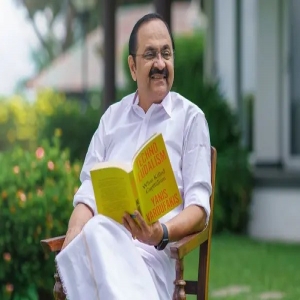


 A. J. Philip
.jpg)
My first acquaintance with VD Satheesan came in 2018, when Kerala witnessed one of the worst floods in its recorded history — a calamity so devastating that many compared it to the Great Flood described in the Book of Genesis. Rivers burst their banks, homes vanished under muddy waters, roads disappeared, and schools became relief camps or ruins.
At that time, I was serving as the Chief Executive of Deepalaya, àn NGO founded in 1979 by seven Malayalees in Delhi. Though Deepalaya's work was spread across North India, my heart told me that we should do something meaningful for Kerala in its hour of suffering. Since education had always been our core concern, I felt the best tribute we could pay to the flood-hit people was to rebuild a government school damaged by the deluge.
I particularly wanted the school to be in Central Travancore, a region emotionally familiar to me. My first instinct was to contact the MLA from Chengannur, one of the worst-affected constituencies. He was courteous and enthusiastic. "I can give you a dozen schools," he told me. But enthusiasm alone does not build schools. Weeks passed without progress.
On the suggestion of my friend, the cartoonist Sudheernath, I contacted the Director of Education, an IAS officer. He was even more generous. "I can give you a hundred schools," he declared. I only needed one school and permission to work on it.
That was when another cartoonist, whose wife taught at a government school in Chendamangalam, entered the story. He called me through Sudheernath's reference and said his wife's school had been severely damaged in the floods. I sent a trusted friend to inspect the situation. The report he brought back was heartbreaking.
I travelled to Chendamangalam soon afterwards. In a small comedy of errors, I was first directed to the Government Lower Primary School instead of the Upper Primary School that I was supposed to visit. There I met Radhika Teacher, the headmistress-in-charge. Calm, practical and deeply committed to her institution, she walked me through the school premises, showing walls stained by floodwater, damaged classrooms and broken facilities.
She immediately called the Assistant Education Officer, who, without the bureaucratic delays so common in India, gave written, signed and sealed permission for the renovation. What more could I have asked for?
Meanwhile, my cartoonist friend called anxiously from the nearby Government Upper Primary School where the principal and teachers were waiting for me. Another mistaken identity — but perhaps providential. That school, too, was in terrible condition.
I made a quick estimate. The work would cost around ?35 lakh. On returning to Delhi, I contacted a Supreme Court lawyer who had been supporting some of Deepalaya's educational initiatives. Without hesitation, he agreed to finance the project.
What followed still fills me with pride. In a little over a month, all the work entrusted to us was completed. Toilets were built, classrooms repaired, walls repainted, and the schools made functional again. Our colleague Kuriakose stayed there throughout to supervise the work personally.
When we returned for the formal handover ceremony, accompanied by the then Deepalaya chairman, Y. Chackochan, and others, we were received in traditional Kerala style with a chenda melam. The warmth of the people was overwhelming.
Just before the function began, I received a phone call from the local MLA, VD Satheesan. He apologised for not being able to attend because of a prior engagement and thanked Deepalaya for its gesture. It was a brief conversation, but one that stayed in my mind because of its courtesy and sincerity.
A few months later, I had another opportunity to speak about the Chendamangalam schools. I was compering a book release function attended by Chief Minister Pinarayi Vijayan. His media adviser and my friend John Brittas wanted me to meet the Chief Minister. During our conversation, I narrated how Deepalaya had become involved with the schools and requested him to visit them someday.
I was especially happy when the distinguished writer Sethu, an alumnus of one of the schools, later praised the renovation work after seeing it personally. For us, that appreciation mattered more than official recognition.
Earlier this year, Radhika Teacher invited me to attend the 65th anniversary celebrations of the school as the guest of honour. She had reached superannuation. The function was held on January 19, and the chief guest was none other than VD Satheesan.
My wife and I were stunned by the affection with which we were welcomed. Teachers whom I had met years earlier remembered every detail of the renovation. Parents came forward to thank Deepalaya. Students performed cultural programmes with remarkable confidence. It felt less like a public function and more like a family reunion.
But the most revealing moment came during Satheesan's speech. He spoke not like a distant politician but like someone emotionally invested in the school's future. With humour and affection, he described how Radhika Teacher had persistently pursued him for the institution's development.
He announced immediately that arrangements would be made for a new school van to replace the rickety old vehicle being used by the children. He openly expressed regret that students were still studying in an asbestos-roofed temporary structure. Most importantly, he promised to help construct a proper two-storeyed building with broad verandahs.
Now that VD Satheesan is set to become Kerala's Chief Minister, fulfilling that promise should become easier. Wherever I may be when the new building is inaugurated, I shall try to attend — not necessarily as a guest of honour, but simply as a well-wisher of the Government Lower Primary and Upper Primary Schools at Chendamangalam.
Often, it is better to be a listener than a speaker.
As a journalist, I have never believed in blindly supporting or opposing governments. I support policies that deserve support and criticise those that deserve criticism. During the last Assembly election, I had suggested that Pinarayi Vijayan should gracefully step aside and allow someone like KK Shailaja to lead the campaign. Had he done so, Kerala could have seen its first woman Chief Minister, and the Opposition would have struggled to attack her with the same aggression directed at him. Anti-incumbency, too, might have been softened.
Instead, the CPI(M) has made yet another questionable decision by apparently choosing him again as the Leader of the Opposition. In politics, as in life, nobody is indispensable. Graveyards are full of people who imagined otherwise. Leadership renewal is essential for democratic vitality. A younger leader with wit, patience and argumentative skill could have held the government accountable more effectively. Time spares no politician, however formidable.
If I still had a vote in my hometown in Kerala, I might well have voted for the CPI(M) candidate there, whom I personally respect for her qualities of head and heart. Yet I remain convinced that the LDF deserved a severe electoral setback for alienating large sections of society. The CPI(M)'s traditional social base, especially among sections of the Ezhava community, has also begun to fragment, with younger voters gravitating toward the BJP. Kerala's elections are therefore likely to become increasingly triangular in the years ahead.
That said, there is no doubt that the Congress finally made the right choice in elevating VD Satheesan.
I can understand why Ramesh Chennithala entered the race. He belongs to a generation shaped by stalwarts like K Karunakaran and ÀK Antony. He became one of Kerala's youngest ministers, served as Home Minister and headed the KPCC. Had the UDF won in 2021, Chennithala would almost certainly have become Chief Minister.
But politics ultimately belongs to those who can seize the moment.
It was after that defeat that the relatively younger Satheesan was chosen as Leader of the Opposition. Under his stewardship, the UDF won by-elections and strengthened its political momentum. Former KPCC president K. Sudhakaran also played a role in rebuilding the organisation.
True, Chennithala remains the senior-most leader. Yet politics is not a museum where seniority alone guarantees relevance. No amount of hair dye can disguise the passage of time. Leadership today demands stamina, adaptability and the ability to connect with younger voters.
One remembers how Tony Blair was still a young father while serving as British Prime Minister, projecting energy and modernity. By contrast, contemporary politics in several democracies, including the United States, has increasingly become dominated by ageing leaders struggling to inspire younger generations. Kerala, too, needs leadership that reflects vitality rather than nostalgia.
To use another political analogy, when Narendra Modi became Prime Minister in 2014, towering BJP leaders like LK Advani and Murli Manohar Joshi were still present. They were more academically accomplished and ideologically seasoned. Yet the political momentum of that moment belonged unmistakably to Modi. Ironically, Modi first entered national prominence while accompanying Advani during the Somnath-Ayodhya Rath Yatra. Politics has its own poetic justice.
For the last five years, it was Satheesan who consistently kept the government under pressure. I have heard him dissect state budgets with impressive command over economic issues. Politically, he proved astute and strategically patient.
But at this important juncture, a word of caution is necessary. People do not want another authoritarian leader. Kerala has had enough of impatience, intolerance of criticism and refusal to hear dissenting voices. Satheesan must not become a carbon copy of his predecessor. The very qualities that made him acceptable across communities, like accessibility, civility and willingness to listen, should not disappear once power arrives.
I normally avoid campaigning for individuals in internal party matters. Yet circumstances compelled me to write an open letter to KC Venugopal, urging him not to seek the Chief Ministership.
My argument was simple. As the Congress general secretary and close associate of Rahul Gandhi, Venugopal had national responsibilities that far outweighed any state-level ambition. If he wished to claim credit for the Congress victory in Kerala, he would also have to accept responsibility for setbacks in states such as West Bengal, Assam, Tamil Nadu and Puducherry. More importantly, Kerala's mandate was not necessarily an endorsement of individual Congress leaders but a rejection of the previous government's style of functioning.
I also pointed out the practical consequences. His elevation would have triggered multiple by-elections, one for his Lok Sabha seat and another for an Assembly constituency vacated to accommodate him. In a politically volatile state, that could have proved disastrous. Malayalees are not easily dazzled by power. Their political culture, shaped by satire from the days of Kunchan Nambiar onwards, instinctively resists arrogance and manipulation.
The letter struck a chord far beyond my expectations, receiving enormous circulation across Facebook and WhatsApp. Many evidently shared the fear that an avoidable power struggle could weaken the UDF government even before it formally began.
As delays continued, I addressed another open letter to Rahul Gandhi himself. My argument was that indecision can destroy political credibility. Kerala had delivered a decisive mandate to the UDF, yet the Congress appeared paralysed over leadership selection. I contrasted this with developments in neighbouring Tamil Nadu, where actor-politician C. Joseph Vijay moved swiftly after the election to form a government with confidence and clarity.
Leadership, I argued, demands decisiveness. If the Congress high command could not arrive at a consensus, then the elected MLAs should simply be allowed to choose their leader democratically. Public patience, I warned, was not infinite, and hesitation often creates opportunities for rivals. Fortunately, wiser counsel seems to have prevailed.
Satheesan possesses several strengths rarely found together in contemporary politics. He has earned the confidence of multiple communities. Among Christians, he commands extraordinary goodwill because he speaks about faith with conviction and familiarity. Muslims, too, find him approachable and trustworthy.
He also belongs to a rapidly disappearing category in Indian politics: leaders who actually read books.
The other day, former diplomat KP Fabian remarked on Satheesan's reading habits. His observation immediately reminded me of my interview decades ago with former Kerala Chief Minister C Achutha Menon. I had gone to meet him at Kerala House in New Delhi and found him seated comfortably on the terrace, deeply immersed in a philosophical work. That image never left me.
A reading politician is often a reflective politician. Such leaders understand nuance. They appreciate art and culture. They recognise that governance is not merely about administration but also about civilisation.
Like countless Malayalees, I am happy that Kerala has found a new leader who appears capable of combining development with cultural sensitivity, administrative firmness with democratic openness, and political ambition with intellectual curiosity.
As for Ramesh Chennithala, he should accept Satheesan's invitation, join the government and strengthen both the administration and the party. Democratic politics is not diminished by graceful accommodation; it is strengthened by it.
Kerala today stands at the beginning of a new political chapter. Its people have voted not merely for change, but for a different style of governance, one that listens more than it lectures. That, perhaps, is the greatest challenge before VD Satheesan. My best wishes.
.jpg) A. J. Philip
A. J. Philip
.png) Cedric Prakash
Cedric Prakash
.jpg)
 P. A. Chacko
.jpg)
.jpg)
.jpg) Thomas Menamparampil
Thomas Menamparampil
.png)
.png)
.png) Robert Clements
Robert Clements
.jpg)
.png)
.png) Chhotebhai
Chhotebhai