

.png) John Dayal
John Dayal
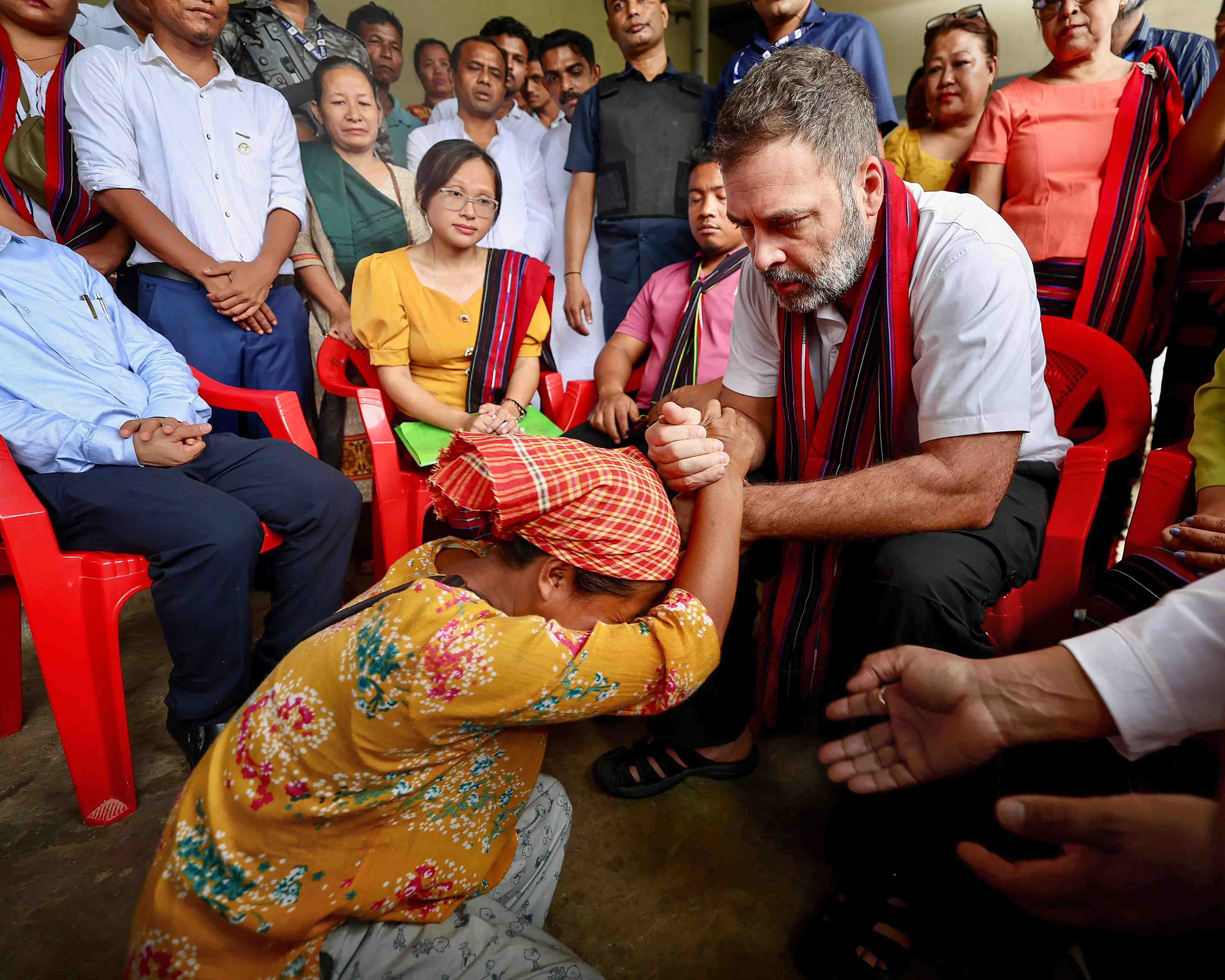
The glass is more than half full for Rahul Gandhi and his Congress, offering an opportunity to build a worthwhile challenge to the Bharatiya Janata Party in the general elections of 2029 — or even earlier if Narendra Modi and Amit Shah sense that even their ardent bhakts are growing a little tired.
Not much was on trial for Rahul Gandhi in the recent elections. Kerala was almost in the bag even before the first vote was cast, such was the groundswell against Chief Minister Pinarayi Vijayan. There was little to lose in Tamil Nadu, where the Congress was a junior partner in the ruling coalition (as it remains now), or in Bengal, where it barely existed at the booth level. There was pre-poll excitement only in Assam, but the Election Commission's antics put paid to it.
Success in Kerala has many fathers - AICC general secretary KC Venugopal, state party chief VD Satheesan, and senior leader Ramesh Chennithala are all correctly claiming credit. However, the UDF's landslide promises a story that goes far beyond Thiruvananthapuram.
Congress alone won 63 seats in the 140-member House, ending a decade of Left Front rule and delivering Rahul Gandhi a mandate that many see as the "starting pistol" for the long run to 2029.
The party enters this inflexion point with a freshly re-energised president and a severely fractured opposition landscape. Leaders such as Mamata Banerjee and Sharad Pawar, whose national ambitions and egos had hobbled the Congress's attempt to even choose a leader for the loose INDI Alliance, now lie politically weakened — especially in the northern plains.
In Tamil Nadu, while many saw the Congress as betraying MK Stalin, observers note that by pivoting from the DMK to extend visible support to Vijay's Tamilaga Vettri Kazhagam, Rahul signalled that Rahul Gandhi is ready and willing to take unexpected decisions — effectively preventing any drift towards the BJP.
The elections, and the year preceding them, have been singularly unkind to opposition groups that were almost praying for the Congress to become utterly insignificant so they could have their day in the sun and a shot at the Prime Ministership.
Mamata Banerjee and the Trinamool Congress were the most aggressive among them. Banerjee, the once fiery Youth Congress leader who had matched the Marxist toughs on the streets of Calcutta and other towns, had broken away from the parent party to try her luck independently.
This saw her team up with the BJP, with Mamata serving in the Atal Bihari Vajpayee cabinet in important ministries — Railways, Coal, Mines, and Youth — till she realised the BJP-RSS would not take her further.
As Chief Minister in Bengal, her lasting contribution was that while seemingly opposing the BJP, she worked even more vigorously to ensure the INDIA project never really gelled enough to become a threat to Narendra Modi.
She opposed Nitish Kumar becoming national convenor of INDIA, only to later see him partner with the BJP and eventually invite the party to lead the coalition government for the first time in Bihar.
In the other big state, Maharashtra, where Sharad Pawar had broken away from the Congress when Sonia Gandhi took charge, recent state and local body elections have seen the sharp decline of both Pawar (now in declining health) and the faction led by his nephew.
Punjab's ruling Aam Aadmi Party was born in opposition to the Congress, but it attracted many urban Congress workers. The party now seems in disarray, and Punjab could well be heading back to the traditional Congress-Akali Dal-BJP triangle, where the Congress alone can claim a spread across religious divides while the other two are largely confined to their communities.
Rahul Gandhi now has a golden opportunity to revive the cadres and reach out to people who, for generations, had claimed links with the party of Mahatma Gandhi and Jawaharlal Nehru, and later with Indira Gandhi.
For the better part of a decade, Congress has veered between a left-leaning political vocabulary of justice and rights, occasional forays into what critics have unkindly called "soft Hindutva," and its inherited secular-liberal constitutionalism.
While this has not confused the BJP — which has stayed firmly on its Hindutva path — it has been a poser for Congress cadres and many of its voters, including Dalits, Tribals, and Muslims, who have looked for reassurance.
Civil society and the large liberal segment of small-town urban youth, whom Rahul Gandhi sought to connect with during his yatras, have also voiced their demand for a clear alternative to Hindutva's acrid nationalism.
Rahul remains the only national politician to articulate a sharp rhetoric against crony capitalism — the repeated references to Adani and Ambani that have become his signature.
The Achilles' heel of the Rahul Congress is its currently creaky organisational infrastructure, especially the booth-level cadres so vital on polling day.
Travels across UP, Bihar, and Bengal reveal how thin the youth and other wings are on the ground. The situation is worst in Uttar Pradesh, with its 80 Lok Sabha seats, where every vote demands active vigilance to counter the BJP and Yogi Adityanath's private troopers, and in Bihar, where OBC parties (if not in a seat-sharing alliance) also pose a threat.
Thirty months does not seem a long time to rebuild and galvanise a party to fight a general election with the required aggressiveness. But it is not a short time either.
Joseph Vijay took about the same time to build his TVK from scratch as did Arvind Kejriwal with his AAP (though Kejriwal was aided by RSS cadres during the India Against Corruption and Youth for Equality movements).
Like his ancestors before him, beginning with Indira Gandhi, Rahul is both the engine and the glue that hold together the diverse — and often mutually competitive — factions and groups in the lumbering, often slothful political apparatus.
Critics, including some self-proclaimed well-wishers of the party, say the gravitational pull towards the Gandhis as the sole legitimate source of authority, resources, and candidacy retards genuine revival.
Regional satraps, hedging their bets, prefer to build personal fiefdoms rather than strong party structures when they see no clear path to senior power-sharing positions. Though Rahul has spoken of internal democracy, there are not yet sufficient signs of it on the ground.
Rahul has shown in recent weeks that he is mastering the science of political narrative — and doing so without any support from the national or social media, which are largely owned or influenced by crony capitalists, chiefly the Adani and Ambani groups.
He faces the BJP's formidable communication machine — WhatsApp forwards, prime-time anchors, and a well-funded digital army — which operates at a velocity and reach that Congress cannot currently match.
Rahul Gandhi is talking of hard facts that impact the nation: the fallout of the Gulf wars and India's alliance with Israel (including oil prices), the impending fertiliser shock, agrarian distress, youth unemployment, and institutional capture.
India's unemployment rate among educated youth remains stubbornly high, and farmer suicides have not stopped. Together they form the substance of a strong new political narrative that only needs research cells, rapid-response infrastructure, and vernacular communication capacity to challenge and counter the "Godi media."
Rahul has visibly matured since his first Bharat Jodo Yatra — from Kanyakumari to Kashmir, and then from Manipur to Mumbai — displaying a quality of listening that has altered his political voice, as heard in the Lok Sabha and in election speeches.
People are connecting with his talk about inequality, the concentration of wealth, and the undermining of institutions, including Parliament, the Supreme Court, and the Election Commission.
With the opposition landscape transformed, the Congress can now speak to others with more authority than it has had since Narendra Modi came to power in 2014.
How Rahul Gandhi engages with a bruised Mamata Banerjee, the caste satraps in Bihar and UP, and with the DMK and other southern groups — and how effectively he manages factions within the Congress in states such as Karnataka — will be the real test of whether he has come of age as the national leader who can take a shot at leading a government, perhaps as early as 2029.
The BJP's advantages are structural and deep. Central agencies — particularly the Enforcement Directorate's reach into opposition politicians and the Income Tax department's scrutiny of party finances — continue to create a climate of institutional asymmetry.
But the bureaucracy, steel frame though it claims to be, has historically shown that it can smell which way the wind is blowing two years in advance and can conveniently bend. Crony capitalists can too. One should remember that the Ambanis, more than the Adanis, were essentially creations of the Congress, especially during the halcyon days when the late Pranab Mukherjee was Finance or Commerce Minister.
Political analysts say the Congress needs to win somewhere between 180 and 200 seats on its own to lead a stable coalition government. That would require strong recoveries in UP, Bihar, and even Madhya Pradesh. That is the minimum target Rahul Gandhi will have to aim for in 2029.
.jpg)
 A. J. Philip
.png) Cedric Prakash
Cedric Prakash
.jpg)
 P. A. Chacko
.jpg)
.jpg)
.jpg) Thomas Menamparampil
Thomas Menamparampil
.png)
.png)
.png) Robert Clements
Robert Clements
.jpg)
.png)
.png) Chhotebhai
Chhotebhai