

.png) Julian S Das
Julian S Das
Kolkata and Chennai, two metropolitan cities separated by over 1,800 kilometres, one in the north-east and the other in the south, both holding the new innings of freshers as Chief Ministers. More than the similarities, the differences in the swearing-in and honeymoon periods of the first week showed what they are heading toward and what is in store for the two states.
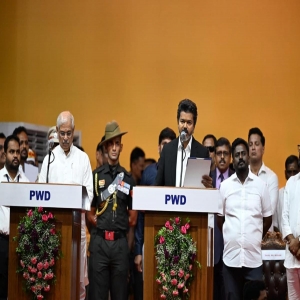
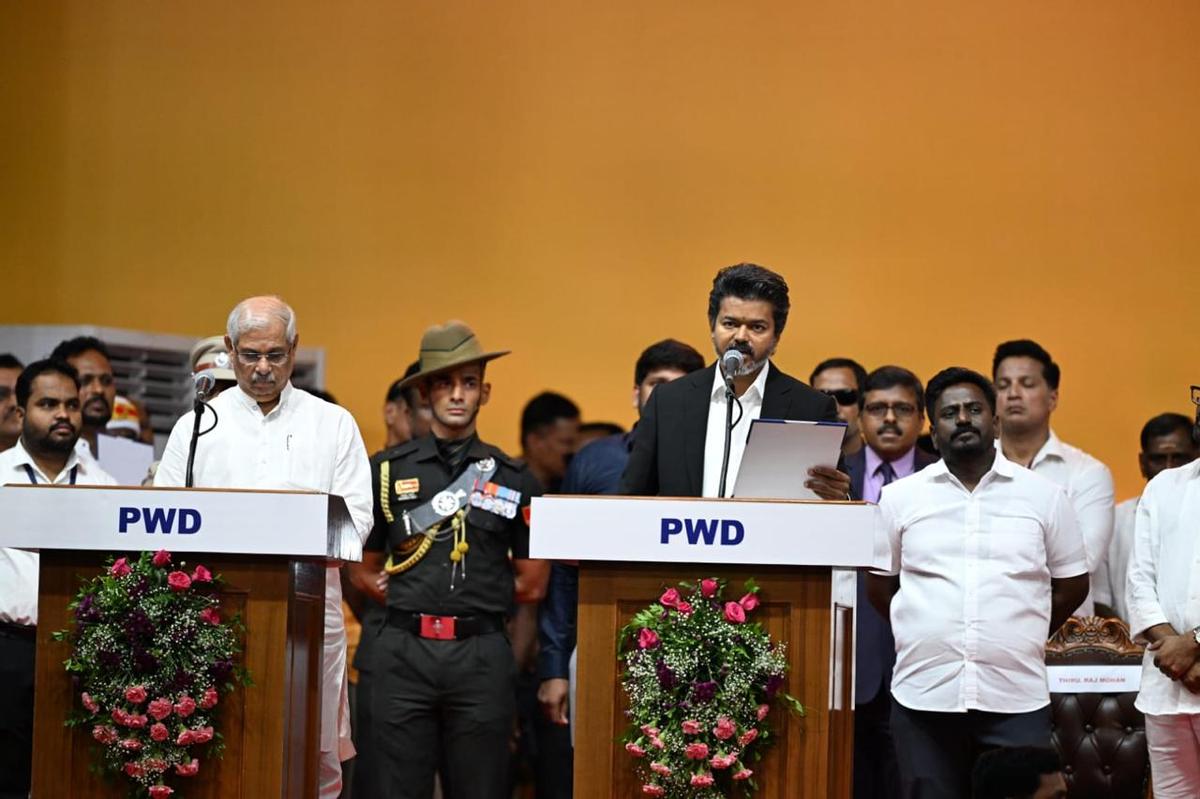
If one thought there was a lot of drama in the swearing-in ceremony of C Joseph Vijay in Chennai's Nehru Indoor Stadium, then they may have to rewind the tapes (aka YouTube live streaming videos) to note that Suvendu Adhikari's swearing-in witnessed drama and rhetoric which can put to shame even the best of Hollywood blockbusters.
High Drama All the Way
Starting with the trio – Prime Minister Narendra Modi in the middle, West Bengal Bharatiya Janata Party president Samik Bhattacharya and the chief minister-elect Suvendu Adhikari – taking rounds on a open vehicle around the maidan, greeting the people who had gathered for the historic event, to the Prime Minister making a sastanga pranam to the crowds and later touching the feet of 97 year old BJP worker Makhanlal Sarkar, and all the chief ministers from BJP governed states in full attendance, the City of Joy had witnessed no greater joy than the mightiest of the mighty gathered to kick start a historic journey after decimating Trinamool Congress.
There sure was drama in the south, though less at the swearing-in and more in the preceding days with the Governor, Rajendra Arlekar, sticking to his guns, demanding that the incumbent, Vijay, show he had the support of 118 MLAs to stake a claim to form the government. Even the best constitutional experts claimed that the governor's demand was unconstitutional and illegal, like a primary school kid who keeps correcting their notebook again and again and showing it to the teacher. Vijay did preserve his sanity and remained cool to get through the baptism by fire.
Sure, these are the moments when the people of the state see the true colour of their leaders, what stuff they are made of, and the strings connected to them, and behind-the-scenes operations imperceptible to the naked eye, yet easily perceivable to the mind.
Naturally, Vijay's swearing-in was more dramatic; some commentators who had a penchant for making obnoxious comments about non-conformist rising stars called it more theatrical. But one could not miss the determination and conviction with which he had uttered the words of the oath, and as an actor used to memorising, he had done his homework well.
Promises to Performance
Both the dispensations in Bengal and Tamil Nadu did not wait to implement their electoral promises. The high point of the day in Chennai on May 10, 2026, the day of swearing in, was the signing of three important decisions by the new chief minister of Tamil Nadu: 200 free units of electricity for two months, formation of singa-pen (lioness-lady) network to ensure safety and security of women in the state, and a crackdown on drug peddling.
How can his counterpart in Bengal wait on his part to remind the people of the state that he was a man who did not forget the promises he made (or say the Prime Minister made on his behalf); the West Bengal chief minister had promised that he would implement the social and welfare programs of the Centre/Prime Minister in the state, and from June 1, the women of the state would receive ?3,000, though not in the name of Lakshmi Bhandar (of the previous dispensation), but as Annapurna Bhandar.
Adhikari has also warned against street religious gatherings (indirectly hinting at the end of holding Id prayers on the prestigious Red Road in Kolkata), and religious heads in the state had welcomed the idea but reminded the chief minister that the rule should apply to all religious people. It is worth remembering that most streets are taken over during the month-long Durga Puja, causing tremendous inconvenience to the public. Would the chief minister come down heavily on the organisers of Durga Puja pandals? This is yet to be seen.
However, there is some good news from both states: the chief ministers have made it clear that they will not stop all social and welfare schemes initiated by the former governments. There was fear that the new parties and their heads might throw the baby with the bathwater. It will be seen in the coming months whether they really keep their word, as their egos might pop up now and then to thwart the initiatives of their predecessors and bring them in a different guise.
Backseat to Religion
There had been a lot of buzz on social media about the religious identity of C Joseph Vijay, the new chief minister of Tamil Nadu. It is obvious from his name that he bears a Christian identity. Though his mother is Hindu and his father is a Christian, the chief minister seems to be walking a tightrope balancing the two religious beliefs.
For those who had failed to notice, the red thread Vijay was seen wearing on his right arm on the day of the swearing-in is contrary to Christian belief. Also, the tilak on his forehead and his blind faith in astrology, going to the ridiculous lengths of making his astrologer a Special Officer on duty, namely a political advisor to the chief minister.
Of course, the opposition parties did not see this as a sensible decision by the fresher, who needs to keep personal religious beliefs aside on all public platforms. Fortunately, faced with fierce criticism from the opposition and the media, the government had to withdraw the decision the very next day, on May 13. But the bungled and momentary decision is sure to prick their conscience in the days to come.
It appears that Suvendu Adhikari was a changed man after his swearing-in on May 9, 2026, at the famous Brigadier Parade Grounds, which had hosted, among others, one of Narendra Modi's election campaigns. On the chanting of Jai Shri Ram at Jorasanka Thakurbari, the ancestral home of Nobel Laureate Rabindranath Tagore, on the same day, the newly elected West Bengal chief minister had chided the crowd to stop the slogan, as he is for everyone. He reiterated the same in his home constituency in Kontai that he is for all, Hindus and Muslims. It appears there might be a silver lining in the midst of the saffron clouds. But is this only a skin-deep show, or a genuine conviction by Adhikari? Time will tell.
Wait and Watch
It is too early to see in which direction the wind will take the present chief ministers in the months to come, as it might take some time for their initial enthusiasm to die down and they begin to show their true colours. The people of the states are slow to react to off-the-cuff executive decisions and orders, without sufficient consideration of the pros and cons or discussion with those who could offer sound counsel.
It is also true that both states are too eager to appease the hoi polloi, doling out freebies, as the former governments did, but this time doubling them. Both the states have promised to give financial assistance to women, West Bengal going to the extend of doubling the amount, from ?1,500 to 3,000, putting undue pressure on the treasury, not to mention both the governments deciding to give free ride for women on government buses, which might cost more to Tamil Nadu than West Bengal, where the government buses in operation are far less than the private. West Bengal should be able to steer through with fewer financial constraints, as the centre is sure to pump money into the state, even without asking, to keep the people hooked to it.
West Bengal is also in a frantic effort to push through decisions shelved by the previous government, for instance, allotting land for the Border Security Forces to put up a wire fence along the India-Bangladesh border in northern Bengal, and removing over 200 executive officers appointed by the Mamata Banerjee government. One can be sure there would be a sizable number of RSS men and women filling those seats.
Slow and Steady
Both governments in West Bengal and Tamil Nadu are expected to move slowly and steadily, gauging the depth of the waters before jumping in. As they are new to the state, they have yet to win the confidence of the people, so that they might be able to venture into the implementation of their electoral manifestos in toto.
While the opposition parties in the south show signs of partial support to the new government, to the extent that a floor test revealed a lot more supporters from the opposition taking the number to 144 in favour of the Tamizhaga Vettri Kazhagam (Tamil Victory Party), the story may be different in West Bengal, where the BJP is still looking at the main opposition TMC with contempt and condescension, literally taking it for granted they do not exist. They can do with the majority whatever they want (just as in the scenario at the centre).
History has shown that a strong opposition is essential in a democracy to keep tabs and checks on the ruling government, so that their enthusiasm or idiosyncrasies (as in the case of the astrologer appointed as special officer on duty in Tamil Nadu) do not cost the exchequer and irreparably damage the state and its precious image.
The decision of the BJP in West Bengal to reopen all corruption charges against TMC could boomerang, knowing that the chief minister of the state is no clean person, going by the viral video reposted by Dhruv Rathee, the Narada sting operation showing Suvendu Adhikari taking a bribe, and the Prime Minister, Narendra Modi, mimicking Adhikari of the bribe. But joining the BJP had made him clean, as it did for the then Congress man Himanta Biswa Sarma, who was involved in the Sarada scam. BJP might have saved them from legal proceedings, but their conscience will continue to haunt them when they show an accusing finger at others.
While the government in the south claims to be a minority government ready to protect the interests of minorities, it remains to be seen how the Bengal government is going to take on the minority communities in the state, the Muslims in particular, protecting their interests.
.jpg)
 A. J. Philip
.png) Cedric Prakash
Cedric Prakash
.jpg)
 P. A. Chacko
.jpg)
.jpg)
.jpg) Thomas Menamparampil
Thomas Menamparampil
.png)
.png)
.png) Robert Clements
Robert Clements
.jpg)
.png)
.png) Chhotebhai
Chhotebhai