

.png) Jaswant Kaur
Jaswant Kaur
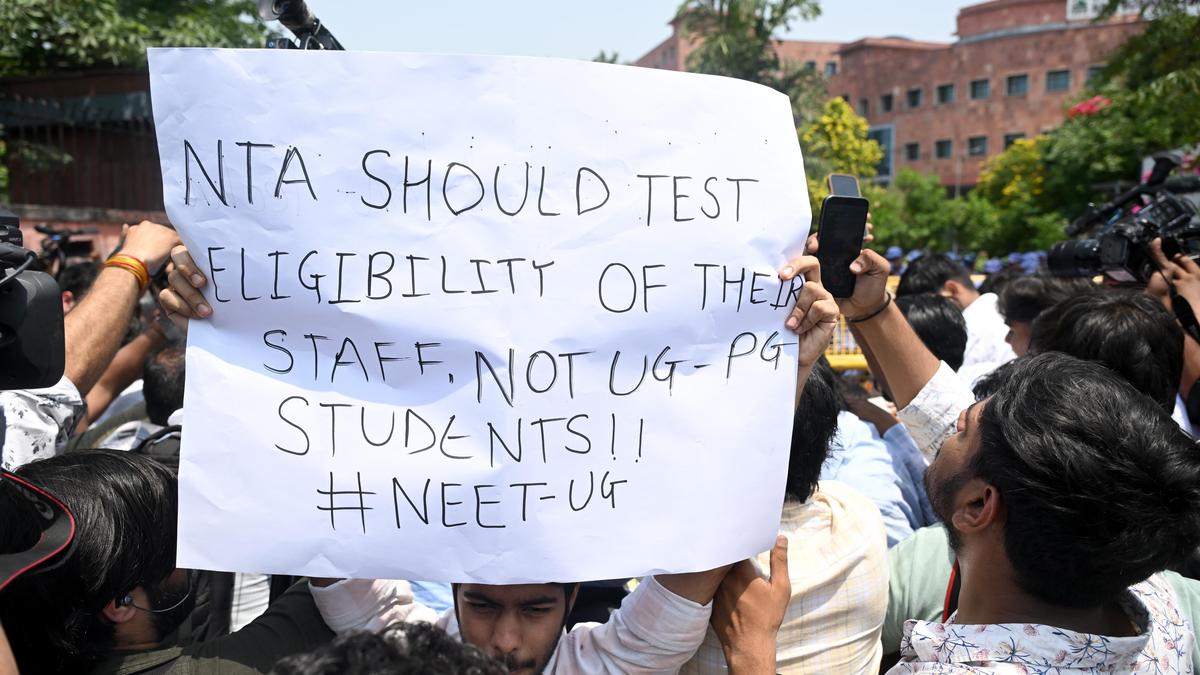
Every year, millions place their hopes, savings, and emotions on one examination, hoping that one day, they will land in a medical college of their choice.
For many students, clearing the National Eligibility cum Entrance Test (NEET) is seen as the only path to becoming a doctor. Parents borrow money, children sacrifice their teenage years, and entire families reorganise their lives around this dream. But in recent years, a painful question has emerged with greater force than ever before. Is this system fair in the true sense?
Be it 2016 or 2026, nothing much has changed. Reports of leaked papers, organised cheating networks, and students allegedly paying lakhs of rupees to gain unfair access to question papers have sparked anger and fear among honest aspirants. Ever since NEET became the single national medical entrance examination, we have witnessed at least four major controversies linked to the exam system involving leaks or cheating.
In 2015, even before NEET formally replaced other systems, the All-India Pre-Medical Test (AIPMT) had to be cancelled after a large cheating racket using Bluetooth devices was exposed. In the years that followed, there were repeated allegations of solver gangs, impersonation rackets and question paper leaks in different states. The 2024 controversy became one of the biggest examination scandals in recent Indian history, leading to protests, court hearings, arrests, and a CBI investigation.
The Union Government had to constitute a high-level expert committee headed by former ISRO Chairman K Radhakrishnan to recommend reforms in the functioning of the National Testing Agency (NTA). The committee made many recommendations, ranging from stronger cybersecurity systems to stricter monitoring of examination centres, to better coordination with state authorities, and so on.
The very need for such a committee showed that the concerns were not minor administrative lapses but serious structural weaknesses in the examination system itself. Now, fresh concerns in 2026 have once again raised doubts about the system's ability to protect the future of millions of students.
It is high time we stop treating these incidents as temporary embarrassments and start asking a more serious question. Have we created an examination system that is simply too large, too centralised, and too high-pressure for a country like India? After all, the larger the scale, the greater the risk of affecting more lives.
This year, around 22 lakh students appear for the exam to get access to around 1.2 lakh MBBS seats. Out of these, affordable government medical college seats are estimated to be barely around 60,000!
This means that lakhs of capable students are automatically left out, not because they are not talented, but because the seats are far too few compared to the number of aspirants.
This also means that a student may score extremely high marks and still fail to get into a government medical college. In many states, the cut-offs have become so high that even a single mistake can destroy years of preparation.
Not only this, the exam seems to have become unequal even at a stage one could not have imagined. In theory, NEET is supposed to create one common examination for all students. In reality, it has slowly become an exam where success often depends on access to expensive coaching systems. Across India, students begin preparing for NEET from Class 8 or 9. Coaching centres in cities like Kota, Hyderabad, Delhi, Chennai, and Patna have become parallel education systems of their own.
Families routinely spend ?5 to 10 lakhs over several years on coaching fees, hostels, transport, study material, online tests and private mentoring. Small wonder, our coaching industry is now estimated to be worth tens of thousands of crores.
For any middle-class family, it is a huge burden, but for the poor and the marginalised, it is like the grapes the fox sees and desires but never truly accesses.
This is where the debate around NEET is no longer about examination reform but a question of social justice. Can a student from a government school in a village really compete equally with a student who has spent years in elite coaching institutes? Can a first-generation learner from a Dalit, tribal, or low-income family compete on equal terms with students whose parents are doctors, engineers, or professionals who understand the system from the beginning? The honest answer is no.
What holds many of them back is not a lack of talent or hard work, but the unequal access to opportunities, resources, guidance, and support that others often take for granted.
One student studies in an English-medium school with smart classrooms, laboratory facilities, mock tests, doubt-solving apps, and personal mentors, another in a school where science teachers are absent for months, and laboratory equipment is scarce. Yet both are expected to compete in the same national examination and are judged by the same rank list.
This is why the language of "merit" often becomes misleading. When coaching becomes more important than classroom learning, the examination slowly stops measuring talent alone. It starts measuring privilege.
The emotional cost of this system is equally disturbing. Students preparing for the exam often live under extreme pressure for years. Many leave their homes at 14 or 15 to move to coaching hubs. Their daily lives become centred entirely around tests, rankings, and cut-offs. Failure is not treated as a normal part of life but as personal defeat.
We have already seen heartbreaking reports of student stress, depression, and suicides linked to competitive examination pressure. Kota is not only known as India's coaching capital, but also as a city associated with rising student stress, loneliness, and suicides.
And after all this sacrifice, when paper-leak allegations emerge, the emotional damage deepens.
Imagine a student from a poor family studying honestly for three years, waking up at four in the morning, travelling long distances for coaching, and watching parents struggle financially, only to later hear that some students may have bought leaked papers for lakhs of rupees! For such students, the issue is not merely unfairness, but a profound sense of betrayal.
The government's argument has generally been that a single national examination creates transparency and removes corruption from state-level admissions. There might be some level of truth in that. The systems before NEET too had problems, be it capitation fees, abuse of management quota or corruption. However, centralisation has created a different kind of danger.
India needs a fairer admission system, maybe one that gives weight to school performance and takes into account regional context, allowing students to take the exam more than once. Most importantly, the government must invest in expanding affordable medical seats with stricter regulations for the coaching industry.
A nation of India's size cannot continue treating medical education as an artificially scarce privilege while simultaneously complaining about doctor shortages, rural healthcare gaps, and overburdened public hospitals.
Ultimately, the NEET debate is not only about examination malpractice. It is about what kind of country we want to become. One that enables social mobility across all geographies and strata, or one that restricts it to those who can afford expensive coaching systems? The answer affects the future and dreams of more than 22 lakh young lives, not just a few!
.jpg)
 A. J. Philip
.png) Cedric Prakash
Cedric Prakash
.jpg)
 P. A. Chacko
.jpg)
.jpg)
.jpg) Thomas Menamparampil
Thomas Menamparampil
.png)
.png)
.png) Robert Clements
Robert Clements
.jpg)
.png)
.png) Chhotebhai
Chhotebhai