

 A. J. Philip
.jpg)
Every day, an average of 6.4 million people use the Delhi Metro to commute. On Raksha Bandhan day, the figure crossed 8.1 million, a number that is routinely cited by the Metro authorities with characteristic enthusiasm. In comparison, Norway has a population of just 5.6 million people. In contrast, India has a population of 1.4 billion, with the Andhra Pradesh government announcing incentives for people to produce more children, taking its cue from the world's most powerful NGO, which also runs a government.
The point is that Norway is a country we can just ignore. God alone knows why Prime Minister Narendra Modi thought it necessary to visit the UAE, Sweden, Norway, the Netherlands and Italy soon after announcing a series of austerity measures, including advice not to buy gold or travel abroad to save foreign exchange. I do not know what our missions in those countries and their bosses in the External Affairs Ministry cannot do that Modi alone can.
Anyway, his visit has cast a shadow over India-Norway relations, with supporters of Modi berating Norway and its media for asking what they consider unnecessary questions and portraying Modi in an unholy manner. Aftenposten is considered the newspaper of record in Norway. This means it is highly respected, much like The Hindu in India, when, in the past, it was more conservative than revolutionary.
The newspaper published a column by staff commentator Frank Rossavik, with an illustration by Marvin Halleraker, ahead of the Prime Minister's official visit to Oslo. The accompanying illustration depicted Modi as a "snake charmer." Unlike a professional snake charmer, who will look straight at the fully hooded cobra, the character in the cartoon looks down. Instead of the cobra's head, what is depicted is the handle used to fill petrol in motor vehicles. The point made was that India was out to obtain oil. After all, in the first leg of his journey, he visited the UAE, which has quit OPEC to pursue its own oil policy. Uncle Sam has allowed us to buy oil from Russia, which we had, in any case, been buying on the sly. It was a political statement.
Now, here is where the defence of our Prime Minister begins to unravel. The image of snake charmers was used pejoratively for Indians. That much is true. It could also be dismissed as the way a cartoonist sees Modi. Cartoonists have always enjoyed such freedom. In India, cartooning has almost died. A full-salaried cartoonist is difficult to find in India today, unlike in the past, when Shankar, RK Laxman, Abu Abraham and Sudhir Tailang enjoyed cosy offices and perks that rivalled those of the editor.
Every time Tailang did a cartoon on LK Advani, he would get a request from him for the original. Initially, he gave him the original. Later on, he began to copy the original and send the copy to Advani. It is no secret that it was Advani who helped Tailang get a Padma award, which did not please the editor, who managed to evict him from his perch at HT House. We all have heard about Jawaharlal Nehru complaining to Shankar that he had not been doing enough cartoons of him. Those were indeed the days!
Cartooning is thriving on social media. With the advent of artificial intelligence, anyone with imagination can create a cartoon. Recently, a relative of mine sent me a cartoon she created using AI to illustrate an article I published on Facebook. Instead of worrying about the Norwegian cartoon, we should worry about the end of cartooning in India.
Ever since America and Israel jointly attacked Iran, there have been a large number of cartoons in Indian media lampooning Donald Trump and Benjamin Netanyahu. I have seen Trump portrayed as a cowboy. Netanyahu has been portrayed outlandishly. Exaggeration is an element of cartooning. I myself got a cartoon made to illustrate a satirical piece I wrote, in which the Congress MLAs of Kerala, who were allowed to choose anyone as their chief minister, finally chose Trump. He was depicted wearing a Malayali dhoti and shirt, with a cut coconut on his table.
Those who criticised the Norwegian cartoonist did not find any fault with a leading English newspaper depicting Kerala Chief Minister VD Satheesan as Jesus having his "last supper" with his Cabinet colleagues. We also know that several cartoonists in India were jailed for their cartoons. The hypocrisy is staggering. When a foreign cartoonist draws a snake charmer, it is treated as an international insult. When Indian cartoonists are jailed, it is business as usual.
Let me tell you a story. During the World War, a group of Germans were arrested and kept in India as prisoners of war. They were housed in a snake-infested area. One of them, a herpetologist, developed an interest in snakes. He began his research, leading to the invention of an anti-venom. His son's job was to feed the reptiles he kept at home for research. The son later went on to study snake charmers and concluded that they did not possess any special remedy for snakebite. They were not friends of snakes but merely exploited them to make a living. The parallel is uncomfortable but instructive. We have been exploiting the symbol of the snake charmer to avoid the real question: why is our Prime Minister unable to answer questions?
When Prime Minister Narendra Modi landed in the Netherlands, the expectation was that the visit would underline India's growing global stature and deepen ties with one of Europe's most prosperous democracies. Even before the optics of diplomacy could settle into familiar comfort, Dutch Prime Minister Rob Jetten struck a discordant note. Replying to a journalist's question, he referred to concerns regarding India's secular character and the freedom of the press.
When journalists raised the same issue at the press conference addressed by the Secretary (West) in the Ministry of External Affairs, Sibi George, one expected a direct response. Instead, what came was a long detour through civilisational history. The issue before the world is not whether India is an ancient civilisation. The real question is whether modern India, governed by a Constitution that promises equality to all citizens, is living up to those promises today. On that crucial point, the official response descended into obfuscation.
The concerns raised by the Dutch prime minister are not inventions of hostile propagandists. Violence against Muslims, Christians, Dalits and women has undeniably increased in recent years. There is ample documentation by independent agencies, civil society groups and even official records to show that minorities increasingly live under anxiety and suspicion. The tragedy of Manipur remains a grim reminder. Similarly, anti-conversion laws in several states have increasingly become instruments of intimidation against Christians and their institutions. Attempts to redefine school management committees are viewed by many Christian organisations as efforts to erode their constitutional right to administer educational institutions according to their own traditions and values.
The Muslim community, too, continues to face discrimination in subtle and overt ways. Mob lynchings may have become less frequent in headlines, but social hostility has only increased. There are also troubling allegations that a disproportionately high number of those disenfranchised recently belong to the Muslim community.
The larger issue is credibility. India's ranking in the global Press Freedom Index has fallen steadily. In 2026, India stood at 157 out of 180 countries, slipping further from 151 the previous year. It ranked below Nepal, Sri Lanka and Bhutan, though marginally above Bangladesh, Pakistan and Afghanistan. The Netherlands, significantly, stands near the very top, second only to Norway. One may criticise the methodology of such rankings. Indeed, no index is perfect.
But dismissing every criticism as biased propaganda does not answer the fundamental question: why does India continue to slide downward year after year? That is why the Dutch prime minister's comments carry moral weight. A country that consistently ranks among the world's freest societies possesses the legitimacy to raise such concerns.
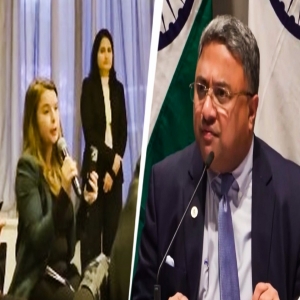
A lady journalist in Oslo made the mistake of asking Modi a question, which he ignored. She also asked why he was not taking questions from the media. She did not know that Modi had certain limitations when it comes to answering the media. He prefers monologues to dialogues. His Mann Ki Baat is a classic example in this regard.
When it became absolutely necessary in the US, he answered a question with a response that was akin to replying "There are four Vedas" to the question of how many states there are in India. All our prime ministers, not just the Congress ones, could answer questions from the press or the public. Atal Bihari Vajpayee proved that he could humour Pakistanis as much as he could keep Indians smiling, using his extraordinary oratorical skills. They also knew how to wriggle out of difficult questions. Alas, we have elected a man whose educational qualifications are suspect but who is, otherwise, a great communicator.
It is not necessary for Modi to expose his limitations on foreign soil. China's helmsman, Mao Zedong, never went abroad to defend his Cultural Revolution. He had Zhou Enlai negotiate with Nehru. So why does Modi insist on travelling, only to ignore questions once there? Because he cannot help himself. The limelight is an addiction. But the refusal to take questions is not the fault of Norwegian journalists or Dutch prime ministers. It is our fault. We have elected a leader who cannot perform the most basic function of democratic accountability, and, instead of demanding better, we attack the questioners.
Interestingly, we question the Press Freedom Index but gladly take pride in the hope that we will soon become the world's third-largest economy. The Indian spokesman started his long answer to a simple question in Oslo by referring to this possibility. On what basis do we say this? Norway will never have an economy larger than India's. It is also a fact that about 80 to 90 crore people in India are dependent on subsidised ration materials.
In Norway, per capita income is US$105,877, against India's US$2,695. If the incomes of people like Mukesh Ambani and Gautam Adani are excluded, this average will go down drastically.
The tragedy is that India needs not fear such scrutiny. India's strength has always lain in its pluralism, argumentative traditions and democratic practices. The world does not expect India to be flawless. No democracy is. What the world expects is honesty, transparency and a clear assurance that every citizen will enjoy equal protection and dignity. Grand speeches about civilisation and ancient glory cannot substitute for that assurance. Ultimately, the taste of the pudding lies in the eating. India will be judged not by rhetorical declarations abroad, but by what happens within India, amplified by social media.
It is pointless to blame others for our own faults. Let Modi admit that he is not cut out for international diplomacy. India has enough officials and leaders who can do the job. But he is good at winning elections, except in states like Tamil Nadu. Let him do that, with or without the support of the Election Commission. But let us stop pretending that a cartoonist in Oslo or a journalist in The Hague is the problem. The problem is us.
We have made excuses for silence, dressed up evasion as statesmanship and confused civilisational pride with contemporary accountability. If our Prime Minister cannot answer questions, do not blame Norway or the Norwegian lady who asked the question. Instead, blame the mirror.
.jpg)
.jpg)
.png) Jacob Peenikaparambil
Jacob Peenikaparambil

.png) John Dayal
John Dayal
.jpeg)
.png) Joseph Maliakan
Joseph Maliakan

.png) Dr Arnald Mahesh SDB
Dr Arnald Mahesh SDB

.jpg) Jose Vattakuzhy
Jose Vattakuzhy
.png)

.jpg) Isaac Gomes
Isaac Gomes
.png)
.png) Robert Clements
Robert Clements