

.png) Jacob Peenikaparambil
Jacob Peenikaparambil
.jpeg)
Since 2014, the Congress has been struggling to withstand the Hindutva avalanche unleashed by the BJP under Narendra Modi's leadership. Although the 2024 Lok Sabha elections provided a glimmer of hope, it quickly faded with the stunning defeat of the opposition parties, including the Congress, in the subsequent assembly elections in Haryana, Maharashtra, Bihar, Assam, and West Bengal.
The BJP's goal, as clearly articulated by Narendra Modi during the 2014 Lok Sabha elections, has been a "Congress-Mukt Bharat" — an India without political opposition. This vision of the BJP and Narendra Modi is steadily being realised in most states where the BJP has captured power. The weakening of strong regional opposition leaders such as Sharad Pawar, Uddhav Thackeray, Mamata Banerjee, and MK Stalin has further demoralised the opposition. In the majority of North Indian states where the BJP is in power, the Congress Party remains only a shadow of its former self.
The BJP, with its formidable electoral machinery, blatant misuse of investigative agencies such as the ED, CBI, and Income Tax Department against opposition leaders, alleged collusion with the Election Commission of India, and access to enormous financial resources, appears almost unbeatable. In a highly analytical and critical article published in The Telegraph on May 16, historian and political commentator Ramachandra Guha (Seven Political Partnerships in India – Jugalbandis: Politics and Play) described how the duopoly of Narendra Modi and Amit Shah consolidated power in different states by undermining democratic norms.
"To achieve power, they have broken rival parties through a mixture of coercion and bribery, intimidated the press and turned it into a vehicle of personal and party propaganda, tamed the judiciary, used draconian measures to imprison dissidents (including non-violent dissenters), weakened Indian federalism, and compromised the integrity of previously independent institutions — above all, the Election Commission of India."
Behind the BJP's success lies an overarching ideological framework that blends religious nationalism with grassroots welfare politics. This strategy combines three core elements to resonate with the electorate: civilisational revivalism, the projection of safeguarding the Hindu community from perceived external threats and alleged minority appeasement, and extensive welfare schemes targeting economically disadvantaged groups.
Critics argue that the socio-political model developed by the BJP and the RSS poses serious dangers to egalitarian democracy, potentially fostering a hierarchical, caste-based, and patriarchal society that concentrates power and resources among upper-caste and upper-class elites. In many ways, it appears similar to the societal model envisaged in the Manu Smriti. At the same time, because religion is effectively used as an "opium" alongside welfare delivery mechanisms, the poor and marginalised sections of society often fail to recognise the dangers embedded in this model.
The opposition has struggled to craft a compelling counter-narrative, and some parties have adopted "soft Hindutva," believing they cannot win elections without it. Even some Congress leaders in the past occasionally resorted to soft Hindutva, only to realise belatedly that soft Hindutva can never defeat the hard Hindutva of the RSS-BJP combine.
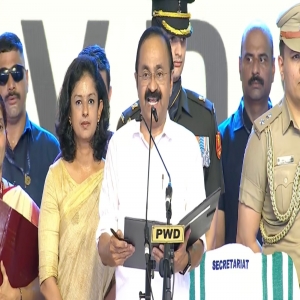
Against this backdrop, the resounding victory of the United Democratic Front (UDF), which won 102 out of 140 seats in the Kerala Assembly elections, offers the Congress and its allies an opportunity to develop an appealing alternative narrative and an effective governance model. The new Chief Minister, VD Satheesan, has instilled hope among the people of Kerala for a new model of governance that does not compromise the secular ideals of the Indian Constitution.
Kerala already enjoys significant advantages over many North Indian states in terms of the Human Development Index (HDI), healthcare accessibility, and female empowerment. The state's emphasis on wealth redistribution and public education has produced social indicators comparable to those of several developed countries.
Moreover, Kerala has a highly diverse religious demographic, with substantial Hindu, Muslim, and Christian populations, yet it has historically experienced far fewer instances of communal violence. Despite the recent rise of certain communal forces, Kerala continues to practice a form of secularism closer to the vision enshrined in the Constitution of India: there are no religious symbols, statues, or places of worship in government offices, railway stations, and other public institutions; no religious rituals associated with inaugurations of public institutions and government buildings; no political leaders assuming the role of priests in temples, mosques, or churches; and no systematic harassment of followers of any particular religion by the government.
The new government must build upon these strengths while responding creatively and effectively to challenges such as a strained economy, the slowest growth rate among the southern states, high youth unemployment, and massive financial liabilities, including unpaid contractor dues.
It is reassuring not only for the people of Kerala but also for all Indians that Chief Minister VD Satheesan has emphatically declared that there will be "no compromise" on secular values or against hate politics. "We will not allow Kerala to be divided. Future generations should live in harmony. We will oppose any attempt to destroy that spirit at any cost," he said. "This election verdict was Kerala's message to the country that we stand for secularism. We will not allow even a scratch on that idea."
This is indeed a bold statement by a Congressman and an excellent example not only for Congress leaders but also for leaders of other parties who claim to be secular.
The new government must remain aware that the BJP will leave no stone unturned to expand its political footprint in the southern states, particularly Kerala. This is a legitimate aspiration for any political party in a democracy. What remains problematic, however, is the BJP's strategy of communal polarisation through hate speeches and the creation of divisions among people based on religion. The UDF government must therefore remain vigilant against attempts to create enmity between Muslims and Christians in Kerala while simultaneously polarising Hindus by raising divisive issues.
The greatest challenge before the new government is rising youth unemployment and the large-scale outmigration of educated young people from Kerala to foreign countries. An estimated 2.5 lakh youth and students migrate abroad from Kerala annually, representing a sharp 92% increase in student emigration since 2018. Hence, the government's top priority must be employment generation that contributes meaningfully to economic growth. If the government implements the promises outlined in the UDF manifesto, it can significantly address Kerala's persistent youth unemployment problem, which stands at 18.2% among those aged 15–29, according to the Periodic Labour Force Survey (PLFS) 2025.
The UDF manifesto promises include schemes to establish 10,000 MSMEs (Micro, Small, and Medium Enterprises), set up global capability centres, develop and connect the coastal region with inland waterways, and emphasise skill training for unemployed adults. In addition, the new Chief Minister has several innovative ideas to reduce the outmigration of young people and harness Kerala's "demographic dividend" by establishing world-class healthcare and educational institutions in the state. Education and healthcare are Kerala's greatest strengths, and the state can certainly build its future success story around them. It is heartening to know that the new Chief Minister has already adopted many austerity measures and reduced government extravagance.
This is a golden opportunity for the Congress and the UDF to develop an alternative model of governance rooted in the core values of the Indian Constitution, offering a counterpoint to the Hindutva-driven Gujarat-UP model the BJP seeks to replicate across other states.
If these ambitious goals and aspirations are to be realised, there must be unity within the Congress Party and excellent coordination among UDF partners. This too is a major challenge, but one that is achievable under the dynamic leadership of the new Chief Minister.
Simultaneously, the national Congress leaders must address the leadership issues within the Karnataka government. If Congress cannot ensure unity and good governance in the states where it is already in power, voters in other states will have little confidence in electing the party. The BJP, in turn, will exploit this weakness as a major election issue against the Congress. Once the leadership issue is resolved and governance in Karnataka is improved, the Congress can focus on states going to the polls next year, especially Uttar Pradesh.
If the Congress fails to seize this opportunity, it will fail not only itself, but also democracy in India, the Constitution of India, and ultimately the people of India.
.jpg)
.jpg) Jacob Peenikaparambil
Jacob Peenikaparambil

.png) John Dayal
John Dayal
.jpeg)
.png) Joseph Maliakan
Joseph Maliakan

.png) Dr Arnald Mahesh SDB
Dr Arnald Mahesh SDB

.jpg) Jose Vattakuzhy
Jose Vattakuzhy
.png)

.jpg) Isaac Gomes
Isaac Gomes
.png)
.png) Robert Clements
Robert Clements