

.jpg) Thomas Menamparampil
Thomas Menamparampil
.jpg)
Trumpian Imperialism Put to the Test
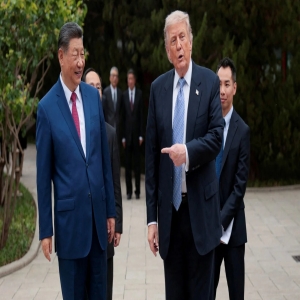
Donald Trump went to Beijing like a wounded soldier, seeking attention and assistance after his Iran misadventure, and returned almost empty-handed after what seemed an eager shopping expedition. He crossed the Strait of Hormuz, having temporarily set aside his arrogant posture, and came back looking more like a failed warrior than a triumphant emperor.
In 1956, Britain and France discovered during the Suez Crisis that they could no longer control the Suez Canal. They had ceased to be world powers. Today, the American Emperor too seems slowly to be discovering the limits of his ability to impose his will on the rest of the world.
The fortune the United States accumulated during the two World Wars through arms production, and during the Cold War through market expansion in the name of defending democracy, cannot guarantee eternal dominance. A multi-polar world is rapidly emerging.
Trump walked into the Iran trap of his own making and merely hastened that process, while blind supporters continued presenting his follies as shrewd strategies. Their "Just War" claims sound hollow under Trumpian imperialism. A moral voice alone carries weight; it rises from humanity's deeper perception of what is right and wrong. Pope Leo XIV gave ex
Diplomacy Reduced to Arms Sales
Henry Kissinger once joked that any problem with the Chinese could be solved if one drank enough "Mao Tai" and made sufficiently large purchases from them. This time, however, the Chinese themselves took the initiative, ordering 200 Boeing military aircraft from the United States. Trump, therefore, returned home with at least a "consolation prize."
Today's diplomacy increasingly revolves around arms sales because immense wealth circulates through military deals. This has been true not only of Trump and Bush, but also of Biden and Obama, Margaret Thatcher and François Mitterrand, and today of Rajnath Singh and Narendra Modi. BrahMos missile sales alone earn India millions. Western countries sell arms simultaneously to Iraq and Iran, India and Pakistan, Afghanistan and Ukraine, Israel and the UAE. India, too, sells BrahMos missiles to the Philippines and Vietnam.
While buying and selling weapons, ideological differences conveniently disappear. Marketolatry has replaced older religions. Market worshippers gradually become self-worshippers and, to safeguard their interests, often turn authoritarian. Dictators produce dictators. Arms strengthen dictatorships. Over time, authoritarian figures multiply at every level and reveal themselves in ever newer forms.
It Is Time to Re-think
Trump now appears to be contemplating yet another military adventure — perhaps an "Operation Sledgehammer" — as he returns to the very scene of his humiliation, having achieved little. The danger is that such weapons, once unleashed, cut both ways, provoke unexpected responses, and create crises in unforeseen places.
Instead of seeking a dignified exit, Trump seems eager to experiment with even more advanced weapons. Is this preparation for annexing Cuba, Venezuela, or Greenland? Or merely another opportunity to expose his misjudgements on a wider stage?
Narendra Modi's statement, "This is not the era of war," is often dismissed as Oriental idealism. At the same time, Brazilian President Luiz Inácio Lula da Silva's insistence that "War is not the answer" is mocked as Latin American timidity. Yet Buckminster Fuller himself observed that "War is the ultimate tool of politics." For Trump, however, it seems to have become a daily instrument for attracting attention.
Recently, Marco Rubio hinted in Munich that Western economic domination — a revised form of colonialism — must continue if Western civilisation is to survive. Was he defending Christian-inspired values, or merely promoting the market-centred collective interests of the West?
In reality, such assertions amount to little more than the defence of collective self-interest — what Aldous Huxley would call idolatry, the worship of the self. This mentality manifests in Trump's unilateral tariff wars, arbitrary sanctions, declarations of "unfair trade practices," and his disregard for institutions such as the UN and the WTO. Such attitudes urgently require re-evaluation.
Worship of Self-Interest
We should not imagine that authoritarianism exists only in one corner of the world. Nationalists, populists, and arbitrary decision-makers are multiplying everywhere today, marginalising democracy, independent thinking, creative reflection, intelligent criticism, innovative approaches, alternative opinions, shared reasoning, respectful dialogue, and persuasive politics.
Some exploit religion to promote their interests; others glorify the nation, a leader, a symbol, or their own self-image. Rivals are eliminated, military officers are dismissed, gifted individuals are sidelined, and critics and journalists are silenced. Flatterers are promoted, exclusivists advance, partisan judges are rewarded, and election manipulators rise in rank.
The defeat of Rodrigo Duterte and the departure of Viktor Orbán from prominence have shifted attention toward figures such as Xi Jinping, Vladimir Putin, Recep Tayyip Erdo?an, Donald Trump, and Narendra Modi. Since taking office in 2013, Xi Jinping has repeatedly removed officers and potential rivals in the name of fighting corruption, including senior military figures.
The Indian government's Enforcement Directorate, critics argue, has become similarly aggressive. Raids on offices and homes have become frequent. Action often intensifies against critics of the Prime Minister and opposition leaders, especially before elections. Filing multiple criminal cases against Dalit critics has become an effective means of intimidation. Himanta Biswa Sarma has repeatedly threatened critics with "a hundred cases."
Bulldozer Dictatorship
The Supreme Court has already described Yogi Adityanath's bulldozer demolitions as "lawless" and "inhuman," insisting on the importance of due process. Yet, bulldozer politics appears determined to stay. Others are learning from Yogiji — Himanta Biswa Sarma and now Suvendu Adhikari, among them.
A pharmacist in Kolkata reportedly described the bulldozer as "the symbol of new Bengal." Illegal structures, including five-storey buildings, are to be demolished. But who decides which buildings are illegal? Is there any genuine due process of law?
A reign of fear has begun in areas such as Tiljala, Kasba, Mominpore, and Ekbalpore — predominantly Muslim localities. During a visit to Assam for Himanta Biswa Sarma's oath-taking ceremony, Suvendu Adhikari referred to Sarma as his elder brother and promised to learn from him. What did he seem to learn first? The politics of bulldozing Muslim homes. Himanta himself pledged to continue evicting Muslims from their homes in Assam.
How different are these actions from those of Benjamin Netanyahu in Gaza, where Palestinian shops and homes have been demolished overnight? Majoritarian rule increasingly rests on "instant justice" delivered through arbitrary destruction. Cruelty inspires cruelty; insensitivity breeds insensitivity; heartlessness produces more heartlessness.
Meanwhile, silence in India grows louder. Academic freedom to evaluate such tragedies is suppressed, and judicial decisions appear increasingly managed.
Minorities Made Silent
Similar developments are visible in neighbouring Nepal. Houses have been bulldozed, prompting alarm from the UN Human Rights Council over the eviction of thousands from riverside settlements in the Kathmandu Valley. The Council called for consultations, safeguards, and humane preparations. Are such consultations held before Muslims are evicted in Assam?
Conditions are no better in Tibet or Xinjiang, where Tibetans and Uyghurs are silenced, "re-educated," and in many cases erased from public life. "Sinification" has become the policy — forcing minorities to become culturally Chinese.
Modi himself, during a visit to Norway, was questioned about press freedom and religious tolerance in India. He merely warned against "misinformation." Yet realities on the ground speak differently.
Minorities are increasingly made silent. Recently, cow vigilantes in the Kendrapara district of Odisha tortured two people and reportedly forced them to drink cow urine. Scholars discussing the incident concluded that rising political radicalisation is fuelling mob violence. We are equally aware of the displacement of tribals in Odisha's Kalahandi and Rayagada districts. In Raiganj, Bengal, Santal tribal icons were vandalised.
The exploitation of women continues unabated. A 30-year-old woman was gang-raped in a moving bus in Delhi. More than 1,000 rapes were reportedly recorded in 2024 alone. Such incidents have become horrifyingly normalised.
Double Standards
At international forums, Indian representatives often speak eloquently. Recently, India criticised irrational trade sanctions at a BRICS meeting and insisted that dialogue should replace sanctions.
Yet double standards remain evident. Dialogue is praised internationally, but minorities, Dalits, and tribals are seldom heard when governments seek to impose measures such as the Uniform Civil Code, recently approved by the Assam Cabinet. Congress, Raijor Dal, AIUDF, and tribal organisations have protested. Prayer-healing practices have even been restricted in Assam.
At Somnath, Modi declared that no power on earth could make India bow under pressure. Yet India has repeatedly adjusted its position under pressure from America, China, the UAE, Iran, Russia, and Israel whenever strategic necessities demanded it.
The RSS-BJP "double engine" appears remarkably skilled at sustaining double standards. As a secular ruler, Modi performed Maha Puja at Somnath Temple, blurring the line between state and religion in a manner reminiscent of Roman emperors. At the same time, while discouraging foreign travel due to the Iran crisis, he himself prepared for visits to the Netherlands, Sweden, and Norway.
Displays of religiosity continue multiplying. Himanta Biswa Sarma publicly seeks blessings from holy men before taking the oath. Rajnath Singh visits the Kamakhya Temple. Responding to Udhayanidhi Stalin and his criticism of Sanatana Dharma, RSS leader Dattatreya Hosabale declared Sanatana Dharma "eternal." But does this imply that caste hierarchy, too, is eternal? Udhayanidhi's critique centred precisely on inequality embedded within the system.
Meanwhile, 126 elected MLAs in Tamil Nadu across political parties reportedly face criminal cases. It is a moment demanding self-reflection from Indian politics as a whole.
BJP's "Washing Machine"
Perhaps the BJP's most remarkable skill is its ability to absorb and promote political defectors. Himanta Biswa Sarma in Assam, Suvendu Adhikari in Bengal, Biren Singh in Manipur, Manik Saha in Tripura, Pema Khandu in Arunachal Pradesh, and Samrat Choudhary in Bihar — all illustrate how easily former opponents are accommodated.
The BJP's so-called "double-engine washing machine" appears exceptionally efficient.
Election officials accused by critics of helping the BJP in Bengal were later appointed to influential positions. Rahul Gandhi described this phenomenon as "Chor Bazaar" — the larger the theft, the greater the reward. Even the subdued nature of victory celebrations in Assam and Bengal suggested discomfort. Allegations of electoral manipulation were too visible to ignore. Disputes over SIR exercises may take decades to resolve, leaving countless citizens uncertain of their citizenship status.
No one can indefinitely defend falsehoods of the kind George Orwell described in 1984: "War is Peace. Freedom is Slavery. Ignorance is Strength." Electoral foul play remains foul play, regardless of how often it is denied.
Oddities Multiply
Oddities continue multiplying in Hindutva India. Weddings in Rajasthan cost ?17 crore, while one million teaching posts remain vacant across India, as economist Prabhat Patnaik points out. There seems to be unlimited wealth for the super-rich because wealth taxation remains absent, but inadequate funds for education or healthcare.
Meanwhile, the rupee weakens further against the dollar. As Kristalina Georgieva observed, "Uncertainty is the new normal."
"It Is Frightening to Be Alive"
Few realise that more than 3,50,000 Russian soldiers may already have died in the Ukraine war. When Ukrainian deaths are included, the total death toll may exceed half a million. No true winners or losers emerge — only profits for arms manufacturers.
As writer Doris Lessing once remarked, "This is a time when it's frightening to be alive."
Iran's response to American threats startled the world: "We are ready." It was not merely missiles or military muscle that emboldened Iran, but national determination and willingness to sacrifice for its people. Certainly, apocalyptic convictions can nurture dangerous forms of Shiite radicalism, and societies must remain alert to that danger. Yet Iran also demonstrated that displays of brute force alone do not guarantee submission.
In this era of mounting tensions and over-assertiveness, humanity urgently needs reflection, re-evaluation, dialogue, reconciliation, collaboration, and communion. Only such efforts can create convergence of thought and committed human relationships. This was the path pointed to nearly a century ago by Pierre Teilhard de Chardin.
.jpg)
.jpg)
.png) Jacob Peenikaparambil
Jacob Peenikaparambil

.png) John Dayal
John Dayal
.jpeg)
.png) Joseph Maliakan
Joseph Maliakan

.png) Dr Arnald Mahesh SDB
Dr Arnald Mahesh SDB

.jpg) Jose Vattakuzhy
Jose Vattakuzhy
.png)

.jpg) Isaac Gomes
Isaac Gomes
.png)
.png) Robert Clements
Robert Clements