

.jpg) Mathew John
Mathew John
.jpg)
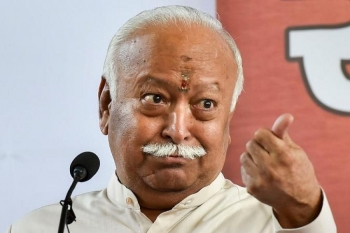
Words can heal or kill or deceive! Two news reports appeared recently side by side in a leading national daily. In one, the RSS chief Mohan Bhagwat waxed eloquent on the country’s rich ethos of accommodation and tolerance. In a stunningly secular message, he emphasized that the DNA of all Indians is the same irrespective of religion; that Hindus and Muslims are like two peas in a pod; that the unifying factor was nationalism; that those who lynch others are working against Hindutva.
The second story was a sharply dissonant and unsentimental contradiction of the mystifying homily by the archbishop of Hindutva. Speaking at a Mahapanchayat in Pataudi, Gurgaon to discuss religious conversion, love jihad and a law to control population, Haryana BJP spokesperson and Karni Sena President Suraj Pal Ammu, in a discourse that would put white racists to shame, called for Muslims to be thrown out of this country. The boor even launched a deplorable attack on arguably the most accomplished celebrity family in the country – the Pataudis, accusing them of being the standard-bearers of love jihad.
In a single day, the Indian citizen was confronted with two divergent versions of the hardwired philosophy of Hindutva – the refined, sophisticated veneer of tolerance and understanding that disguises a dark majoritarian agenda contrasted with the BJP spokesperson’s crude but candid outburst against Muslims in general. Whereas Ammu’s message was unmistakably clear, Mohan Bhagwat’s soothing words were, to quote Churchill, a riddle wrapped in a mystery inside an enigma!
A leading Muslim public intellectual was quick to shower Bhagwat with encomiums for “trying to change the Sangh’s attitude towards Muslims.” Though he certainly knows better, he called Bhagwat a beacon of hope for Hindu-Muslim relations for his consistent stance that in our democracy, there cannot be any dominance of Hindus or of Muslims.
In response to the positive spin on Bhagwat’s speech, one is tempted to ask the obvious question: Where was Shri Bhagwat all this time when Muslims lived in a chamber of horrors to the drumbeats of love jihad, lynching, arbitrary incarceration and pure hate; when, like never before, they have been segregated as “the other”?
Much has been made of Bhagwat’s unequivocal condemnation of mob lynching which, he asserts, is against Hindutva. But then, in sports, in music and for that matter in life, the timing of actions, chords and words is everything. Where was the sanctimonious Bhagwat when Mohammad Akhlaq, Hafiz Abdul Khalid, Pehlu Khan and scores of other Muslims were being lynched in the name of the cow? There was then no ex
Then again, isn’t Bhagwat going against the grain of Hindutva ideology? If, as perceived by some, Shri Bhagwat was ventilating not only his genuine belief in Hindu-Muslim brotherhood but also acknowledging that Muslims are equal citizens of this country on a par with Hindus, then he can justifiably be accused of committing blasphemy against the fundamental tenets of Hindutva, as conceived by V D Savarkar the progenitor and most forceful ideologue of political Hinduism. Savarkar’s conception of the Hindu Rashtra hinged on an implacable adversarial relationship with Muslims.
In 1937, even before the Muslim League resolved to have a separate homeland for Muslims of India, Savarkar propounded the two-nation theory on the grounds of “centuries of cultural, religious and national antagonism between the Hindus and Muslims…. there are two nations in the main – the Hindus and the Muslims – in India.”
Some time back, Ashish Nandy, the renowned social scientist, ascribed the BJP’s runaway victory in the 2019 Lok Sabha elections to the spread of supremacist, ethnocentric Hindutva through furtive but relentless RSS machinery that has captured the collective consciousness of the majority community. Over the decades, millions of young and old in Shishu Mandirs, Vidya Bharati schools and shakhas across the country have been tutored in a hyper-nationalism that is underpinned by an explicit anti-minority bias. The decades of indoctrination have come home to roost!
For those who believe that Bhagwat is leading an ideological transformation – a veritable perestroika, let’s survey what has happened in the last seven years when Bhagwat has been among the most influential voices in the country. Apart from lynching of Muslims, the country has become the Hindutva laboratory that has churned out anti-conversion laws, the CAA, the politics of hate to transfix Muslims to the wall.
Sadly, discounting the simple-minded who were beguiled by his appeal, the brute fact is that Bhagwat’s millions of followers were wise to his doublespeak and forked tongue and have ignored his insincere appeal in much the same way that they have disregarded our PM’s disingenuous slogan of Sabka Saath Sabka Vikas, Sabka Vishwas.
There has been no change of heart or thinking in the Hindutva fold but, of late, there has been a perceptible change in tactics. One observes a visible climb-down by a regime that two years ago thought it was God and behaved accordingly. Uncaring of history, precedent and humanitarian concern, the Modi government had abrogated Article 370, upheld the iniquitous CAA, used draconian laws to quell dissent, curbed freedom of ex
But things have changed dramatically in the last few months. Most significantly, the 56-inch chest has shrivelled in the face of methodically planned Chinese aggression that has already cost us hundreds of square kms of land. The criminal mishandling of the pandemic has turned us into the world’s pariahs. With international agencies questioning our human rights record and the curbs on freedom of ex
Of a sudden, we have an ingratiating Centre holding talks with the Gupkar Alliance which not long ago had been branded anti-national by the Government. The Home Minister, no less, recently wrote a lead article in a national daily extolling the virtues of democracy. Aha! Is Bhagwat’s sweet talk on communal harmony part of the dodgy healing and reconciliation efforts wrenched out of this Government?
Has this regime turned over a new leaf? The prophet Jeremiah’s warning bears recall: “Can the Ethiopian change his skin or the leopard its spots?”
(An abridged version of this article had appeared in The Telegraph)
(The writer is a former Civil servant)
.jpg)
.png) Cedric Prakash
Cedric Prakash
 ICPA
ICPA
 ICPA
ICPA
 ICPA
ICPA
 ICPA
ICPA
 ICPA
ICPA
 ICPA
ICPA
.jpg)
 A. J. Philip
.jpg)
.png) Jacob Peenikaparambil
Jacob Peenikaparambil
.jpg)
.png) John Dayal
John Dayal