

 A. J. Philip
.jpg)
A few years ago, I had the opportunity to learn first-hand how meticulous governmental scrutiny of finances can be in India. At that time, I was serving as the manager of a CBSE-affiliated school in New Delhi run by a non-governmental organisation. The Aam Aadmi Party government was in office in Delhi, and Shri Manish Sisodia was the Education Minister.
The government had insisted that private schools pay salaries and allowances to their employees in accordance with the recommendations of the Seventh Pay Commission. That, in itself, was not objectionable. Teachers deserve fair remuneration, and schools cannot indefinitely function by underpaying their staff.
The difficulty was that some schools, including ours, charged what could reasonably be described as the lowest possible fees. Raising salaries substantially without increasing fees was easier ordered than accomplished.
At the same time, the government ruled that schools wishing to increase their fees would have to obtain prior approval from the Directorate of Education. To examine whether schools genuinely needed additional revenue, several audit firms were appointed to scrutinise their accounts. In our case, the task was entrusted to a multinational firm.
Our accountant and I appeared before a young chartered accountant at the Directorate with our books of accounts. He was courteous but thorough. He went through the entries one by one and raised a number of queries, all of which we were able to answer satisfactorily. Then he came across an entry of ?32.
The accountant accompanying me could not immediately recollect what that figure represented. We assured the auditor that we would verify the matter and revert shortly. We subsequently discovered that the amount represented the balance left in a bank account that had been closed. There was nothing mysterious or irregular about it.
I do not think the young auditor suspected any wrongdoing. He was merely doing his duty. Yet the episode stayed with me because it demonstrated the extent to which the State could legitimately seek explanations even for a sum as insignificant as ?32.
Around the same period, I happened to witness another instructive example.
I was then serving as a member of the management committee of a club in Delhi devoted to promoting the Malayalam language and culture. Our treasurer happened to be an IAS officer attached to the Prime Minister's Office. In his official capacity, he dealt with government projects worth ?10,000 crore and above.
Yet, in the annual general body meeting of our modest club, he stood before the members and presented a statement of accounts whose total annual expenditure did not even exceed ?2 lakh. He patiently answered questions from members, explained entries and accepted observations with complete seriousness.
Watching a senior officer accustomed to handling enormous public expenditures discussing expenditures on tea, postage and cultural programmes worth a few thousand rupees each, I found it difficult to suppress a smile. But the incident illustrated an important principle.
Accountability does not depend on the size of an organisation or the volume of its transactions. Whether one manages crores or a few lakhs, one is expected to account for every rupee entrusted to one's care.
My acquaintance with church administration has taught me similar lessons.
I know something about the functioning of an Indian church headquartered in Kerala but having parishes spread across the country. All its constituent units operate under a common Permanent Account Number. Each parish, irrespective of its location, is expected to maintain accounts in accordance with prescribed procedures.
Every year seems to bring fresh compliance requirements. Trustees often find them burdensome, but ignorance is no defence. Once the PAN number is entered into the system, government agencies can obtain a fairly accurate picture of the church's financial condition, its receipts, expenditures, investments and liabilities.
For Christians, this has seldom been viewed as an assault on religious freedom. They are reminded of Christ's injunction: "Render unto Caesar the things that are Caesar's, and unto God the things that are God's." Paying taxes and obeying temporal laws are considered moral obligations.
The Bible also speaks about giving to God. The Hebrew concept of tithing required Israelites to contribute one-tenth of their produce and livestock for religious purposes. Scholars point out that the aggregate obligations under the Old Testament often amounted to much more than ten per cent, perhaps as high as 23 per cent, when provisions for festivals and assistance to the poor were included.
In practice, only a small minority of Christians today adhere strictly to these prescriptions. Nevertheless, the underlying principle remains significant: spiritual commitments do not absolve believers from civic responsibilities.
These recollections came flooding back to me when I read an open letter addressed by Shri Priyank Kharge, Karnataka's Minister for Information Technology and Home Affairs, to Shri Mohan Bhagwat, the Sarsanghchalak of the Rashtriya Swayamsevak Sangh.
Kharge, incidentally, is the son of Congress president Mallikarjun Kharge. In his letter, he sought what many organisations routinely provide: transparency, accountability and legal compliance.
He wanted to know the legal status of the RSS. Under what statutory framework does it function? Is it registered under any law? If so, under which enactment? If not, why not?
He further asked for disclosure of the organisation's sources of funding, donations, income, expenditures and assets. Finally, he suggested that the RSS should be subjected to the same standards of public scrutiny and disclosure that apply to other non-governmental organisations, companies, trusts and religious institutions.
Kharge argued that an organisation which conducts thousands of daily shakhas, organises public marches, and exercises considerable influence over national life cannot reasonably claim exemption from constitutional accountability. It operates in the public domain, mobilises citizens and shapes public discourse. Therefore, he contended, it should function within a clearly defined legal framework.
The response from Shri Bhagwat was entirely predictable. He dismissed the demand as politically motivated and reportedly compared the unregistered status of the RSS with that of religions themselves.
The analogy, however, is unpersuasive. Religions are systems of belief. The RSS is an organised body with a hierarchical structure, office-bearers, properties, activities and a nationwide network. To equate the two is to compare metaphysics with management. The argument is as thin as cigarette paper, to borrow a familiar British ex
My own first reaction on seeing Kharge's letter was that Shri Bhagwat would reject it outright. The RSS has long behaved as though it occupies a realm above ordinary institutional scrutiny. Whether justified or not, it appears to regard itself as an extra-constitutional moral authority rather than merely another voluntary association functioning under Indian law.
The reactions to Priyank Kharge's letter have, in some respects, been more revealing than the letter itself. One BJP leader and Member of Parliament even questioned Kharge's locus standi to raise such issues by alluding to his status as a member of the Scheduled Caste. Such an argument amounts to hitting below the belt.
In a constitutional democracy, the validity of a question depends not on the caste of the questioner but on the legitimacy of the question posed. Kharge has not demanded the heavens. He has merely sought compliance with the law.
To understand why the RSS is reluctant to subject itself to public scrutiny, one has to look at its history. The organisation originally had no constitution. It believed that a written constitution would inhibit its growth and limit its aspirations.
As Christophe Jaffrelot explains in his seminal work The Hindu Nationalist Movement in Indian Politics, "adopting a constitution would have meant surrendering a characteristic from which much of the RSS's strength was derived—its ability to function as an informal network of activists capable of penetrating almost every sphere of society. To acquire a constitution, he observes, would have meant accepting an 'official vocation,' thereby becoming merely one component of society rather than aspiring to mould the whole of it."
The assassination of Mahatma Gandhi proved to be a turning point. The government, led by Home Minister Sardar Vallabhbhai Patel, imposed a ban on the RSS. Keen to secure the lifting of the ban, the RSS entered into negotiations with the government. Patel insisted that the organisation should adopt a constitution. Its chief at the time, MS Golwalkar, accordingly got one drafted.
Even then, the document was more cosmetic than substantive. It did not embody democratic principles either in the selection of office-bearers or in the functioning of the organisation. Walter K Andersen and Shridhar D Damle, in their authoritative study The Brotherhood in Saffron, note that "the government objected to the draft because it contained no explicit rejection of violence, no affirmation of loyalty to the Indian Constitution or the national flag, no provision for publication of RSS rules and instructions, no requirement for a published audit of accounts and no democratic mechanism for electing office-bearers, particularly the Sarsanghchalak."
Patel, however, was anxious to end the impasse. After minor modifications, the draft was accepted, and the ban was withdrawn.
Golwalkar himself did little to encourage democratic functioning. He compared the office of the Sarsanghchalak to the legendary throne of King Vikramaditya, saying that even a shepherd boy seated upon it would think and act rightly. It was an evocative metaphor, but hardly one compatible with modern ideas of institutional accountability.
As Anderson and Damle point out, Golwalkar subsequently claimed that he had not sacrificed any aspect of the RSS identity. Internal democracy, though mentioned in the constitution, remained largely a dead letter.
Ironically, the post-ban period was financially difficult for the organisation. It reportedly struggled to support its full-time pracharaks and meet office expenses. Golwalkar even contemplated selling the Nagpur headquarters to discharge debts.
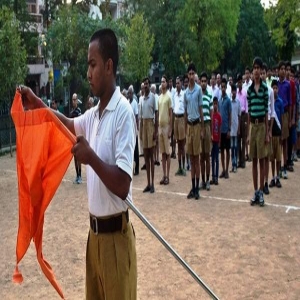
Traditionally, the RSS mobilised resources through the annual Guru Dakshina programme. Swayamsevaks offer contributions to the Bhagwa Dhwaj, regarded symbolically as their guru. They salute the saffron flag, place flowers at its base and deposit sealed envelopes containing their offerings.
There is nothing objectionable about voluntary contributions. In our church, too, one of the principal sources of income is the offertory made by worshippers every Sunday. The collection is counted in the presence of designated persons, entered in the books and reflected in the audited accounts. Transparency strengthens trust.
The difficulty with the RSS system is that it is unwilling to place its collections and expenditures under public scrutiny. Today, the RSS is not an obscure cultural association. It exerts enormous influence over public life. Its affiliates, including the BJP, possess assets worth thousands of crores. The RSS itself occupies a sprawling, state-of-the-art headquarters in New Delhi and enjoys access to the highest levels of government.
It was not very long ago that Mohan Bhagwat remarked that if required, the RSS could raise a force to defend the country's borders within three or four days. If that proposition were seriously accepted, one might even suggest, tongue firmly in cheek, that the Border Security Force could perhaps be disbanded and the exchequer spared considerable expense.
Equally noteworthy is the level of security accorded to Bhagwat. The State spends crores of rupees annually to protect him, providing security cover normally associated with the highest constitutional functionaries. Contrast this with the Vatican, where a Malayali bishop who recently stayed as a guest of Pope Francis recalled that the key to his room itself served as his identity proof. He was not asked for a passport, Aadhaar card or PAN number.
If the Indian taxpayer contributes substantially towards the protection and logistical arrangements of the RSS chief, is it unreasonable to expect the organisation he heads to disclose the sources of its income and subject itself to ordinary standards of accountability? One may also recall that for decades, the RSS neither hoisted the national tricolour nor adopted Vande Mataram or the national anthem as its own. It preferred its separate symbols and songs.
Priyank Kharge has, therefore, undertaken a formidable task. Persuading the RSS to accept scrutiny will not be easy. Yet, having entered its 101st year, the organisation has an opportunity to demonstrate magnanimity. It has little to fear. The Constitution of India, which it once viewed with reservation, is the very instrument that enabled its political offspring, the BJP, to capture power at the Centre and in many States.
An organisation that speaks so often of discipline, patriotism and national regeneration should have no hesitation in showing that it too is willing to live fully under the Constitution that governs every other institution in the Republic.
.jpg)
.png) Cedric Prakash
Cedric Prakash
 ICPA
ICPA
 ICPA
ICPA
 ICPA
ICPA
 ICPA
ICPA
 ICPA
ICPA
 ICPA
ICPA
.jpg) A. J. Philip
A. J. Philip
.jpg)
.png) Jacob Peenikaparambil
Jacob Peenikaparambil
.jpg)
.png) John Dayal
John Dayal