


 Pachu Menon
.jpg)
The phrase 'smelling a foreign hand' is a famous political idiom, most frequently associated with Indian politicians and government officials.
It became a staple in Indian political rhetoric during the latter half of the twentieth century. Leaders would invoke the 'foreign hand' to suggest that internal unrest, protests, or economic troubles were secretly being orchestrated or funded by rival foreign intelligence agencies trying to destabilise the nation.
In modern commentary, the term is frequently referenced by the media, political satirists, and columnists to critique how ruling parties deflect blame for domestic policy failure or grassroots public dissent.
Political commentators and analysts, however, suggest that this term be evaluated critically. The consensus is that the heavier a leader leans into 'foreign hand' conspiracies, the more likely it is that it signals an underlying bankruptcy of substantive arguments in their own backyard.
The 'invisible' foreign hand has been fingered for decades for stymying development in the country. But more than anything else, it has been the 'presence of mind' shown by the political class for tagging this 'phenomenon' with protests and agitations in the country that has been far more amusing.
Blaming domestic protests on an elusive 'foreign' hand is a classical political tactic used to dismiss legitimate grievances. This has been a global trend, and India has not been any different!
Ever since the phrase was used by former Prime Minister Indira Gandhi in the mid-1970s, the term 'foreign hand' has remained the favourite tool of paranoia-mongering in the country.
If one is to go by the contention that this famous 'ruse' in Indian politics is a recurring rhetorical device used by governments to attribute domestic dissent, protests, or clandestine machinations of outside powers, how could one explain the contagious phenomenon that has come to consume Indian politics in recent days?
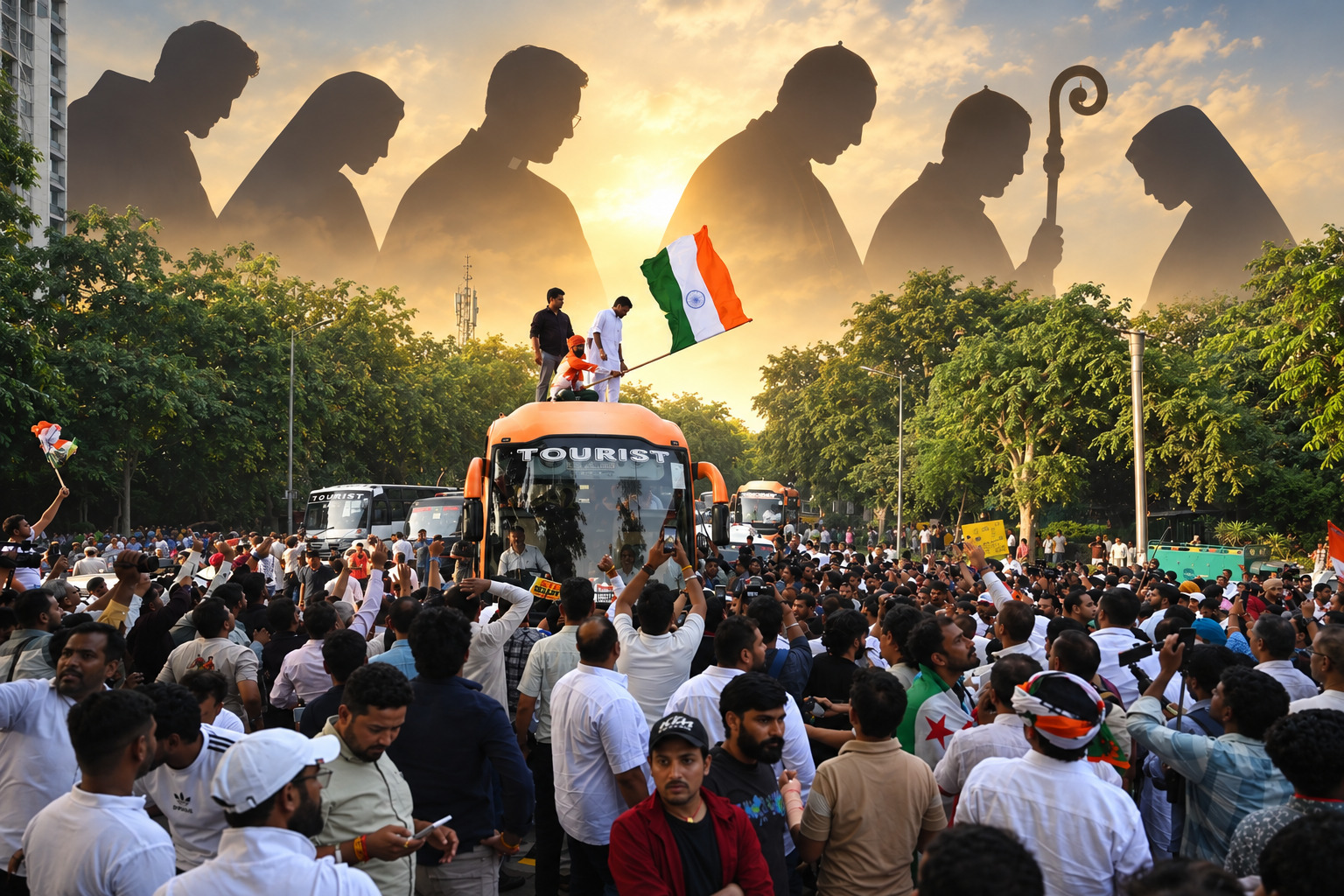
The genesis of the 'Cockroach Janata Party' as an Indian satirical political movement has apparently busted the myth of the 'foreign hand'. The meteoric rise of the CJP represents a uniquely Indian phenomenon, primarily driven by domestic socio-economic anxieties, and has completely debunked the trope of a 'foreign hand' orchestrating domestic dissents.
What we are seeing today is a broader shift in Indian political communication, in which digital-native audiences increasingly engage with politics through memes, digital activism, and irony rather than traditional speeches.
Often unfairly stereotyped as apathetic or unserious by older generations who evaluate them using outdated metrics, societal generalisations about younger demographics, such as Gen Z, clearly miss the mark.
For long perceived as a generation that wouldn't bother itself with the rigours of a system diluted by compromise, bureaucracy, and outdated traditions, they ultimately stepped up to rewrite the rules from within, sidestepping traditional institutions to build their own.
Indian youth unrest is a deeply documented phenomenon rooted in systemic cracks. While organic frustration drives much of this anger, experts observe that youth energy frequently manifests through decentralised digital activism or targeted online platforms rather than organised outside interference. This deep-seated anger is a direct reaction to domestic policies and broken economic promises.
A look at history reveals that youth activism has repeatedly catalysed critical movements and democratic changes. Young people have always been the driving force behind political transformation, using their energy and idealism to hold leadership accountable and demand systemic reform.
Today, the role of youth has evolved to heavily leverage digital platforms, social media, and grassroots mobilisation to drive reform.
However, constant youth agitations over the decades reflect systemic socio-political failures rather than changing societal values. The persistent cycle of the same demands highlights structural exclusion, unfulfilled basic needs, and ineffective democratic institutions.
It is exhausting to watch history repeat itself, especially when the same systemic, economic, or environmental struggles are passed down to the next generation. While some macro-level challenges persist across eras, each new generation does bring fresh tools, technology, and perspective to the table.
The CJP did not invent frustrated youth, but it made their frustration consumable. The Gen Z satirical movement is fighting contemporary manifestations of decades-old issues. However, the satirical digital movement has once again triggered the familiar foreign conspiracy rhetoric.
According to the 'National Herald,' Key figures in the ruling establishment and government circles have been quick to allege a 'foreign hand' and cross-border conspiracy behind the genesis of the viral CJP.
While supporters and youth advocates argue that these claims are merely an excuse by the ruling party to dismiss valid public anger over widespread unemployment and dodge accountability for recurring job crises and recruitment scandals, the establishment remains deeply suspicious of the movement's sudden, highly organised digital amplification.
However, by channelling the frustrations of millions of young Indians facing unemployment, rising inequality, and political alienation into a unified platform, the CJP has given voice to the youth.
But does the Cockroach Janata Party have the potential to become part of the country's political solution? As an article in the Times of India aptly put it, "While the CJP is highly effective at highlighting systemic failures and forcing national conversations, it remains to be seen if it can evolve from a carnival of online dissent into an institutional political solution."
Addressing the on-the-ground realities of communities requires looking past political rhetoric to focus on localised, people-centric action.
.jpg) Stanislaus Alla
Stanislaus Alla
.jpg) Stanislaus Alla
Stanislaus Alla

 Adv. Rev. Dr George Thekkekara
.jpg)
 A. J. Philip

.jpg)
.png) John Dayal
John Dayal
.jpg)
.png) Jacob Peenikaparambil
Jacob Peenikaparambil

.jpg)
 P. A. Chacko
.png)
.png) Robert Clements
Robert Clements