

.png) John Dayal
John Dayal
.jpg)
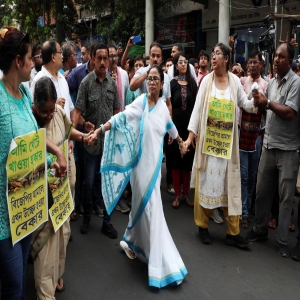
Mamata Banerjee, founder of the Trinamool Congress, former chief minister, terror of the CPM and nemesis of Narendra Modi, is today reduced to a street protester in the city she once commanded absolutely.
Recently, she was denied permission by the police to protest post-poll attacks on Trinamool Congress workers and leaders following the BJP's sweeping victory in the April-May assembly elections.
With still faithful old guards Firhad Hakim, Madan Mitra, Derek O'Brien, and Kalyan Banerjee at her side — and conspicuously absent most of the fresh faces who had won assembly seats on TMC tickets barely weeks before--she seemed a forlorn figure as if she sensed the new MLAs had already sensed which way the wind was blowing.
The BJP had secured 207 seats in the 294-member Assembly. Mamata Banerjee herself lost her Bhabanipur seat to Suvendu Adhikari, the man she had once cultivated and fielded — a former aide who became the state's Chief Minister, the state she had governed since 2011.
Political pundits have all but written her off, saying her defeat is not merely electoral, it is existential. And in the weeks that have followed, editorials have asked questions every politician in her shoes has asked, from Morarji Desai and Charan Singh to Sharad Pawar - does lone mother wolf Mamata Banerjee and her cubs in the Trinamool Congress, the party she founded and built into a dominant political machine, have any future leading up to 2029, or whatever date Narendra Modi and the RSS decide for their proposed "One nation, one election."
The collapse of TMC's organisational edifice after the May 4 results has been startling in its speed - fault lines within the party threatening to split it vertically. Bereft of strong ideological moorings, the TMC's fifteen years in power depended heavily on her shrewd dispensation of patronage, privileges and economic benefits to loyalists in exchange for unquestioning allegiance. As everyone in the state has known for the last decade, Mamata has given her supporters a free hand to profit from land deals, construction, educational institutions, hospitals, and business enterprises across a wide range of activities.
Without the "patronage economy" of power, the entire edifice of "Brand Mamata" is exposed for what political scientist Dwaipayan Bhattacharyya has called "franchisee politics," local entrepreneurs and strongmen using Mamata's image to build their own territorial power — maintaining loyalty upward while exercising considerable autonomy downward. The Indian Express described this through the Bengali formulation "didi's party, dada's dol" — Mamata's party, but the local strongman's group, making the TMC outwardly powerful, but also brittle.
It is the brittleness that is now on full display - in the Assembly, 58 of the 80 TMC MLAs elected in 2026 supported expelled colleague Ritabrata Banerjee as leader of the opposition in place of Mamata's nominee Sovandeb Chattopadhyay. Ritabrata Banerjee subsequently claimed that the number had risen to 64, calling his faction the "real TMC."
In Parliament, the haemorrhage was equally severe, with 20 rebel TMC MPs announcing their decision to merge with the Nationalist Citizens Party of India and back the BJP-led NDA in the Lok Sabha, with Kakoli Ghosh Dastidar claiming the faction constituted more than two-thirds of TMC's total Lok Sabha strength.
Mamata has moved the Calcutta High Court challenging the West Bengal Assembly Speaker's decision to recognise Ritabrata Banerjee as Leader of the Opposition, arguing that a person who has ceased to be a member of the party cannot claim leadership of the opposition benches based on support from certain legislators.
The High Court's ruling, whenever it comes, will determine whether Mamata retains the fig leaf of a formal opposition presence in the Assembly she once dominated. Even Kalyan Banerjee — among Mamata Banerjee's most loyal political associates for over two decades — publicly targeted her nephew and political heir Abhishek Banerjee, showing the depth of the crisis in the party.
Abhishek Banerjee, the TMC general secretary, is now the target of every grievance. Senior leaders, including Manoj Tiwary, Arunava Sen, Papiya Ghosh, and Kakoli Ghosh Dastidar, expressed dissatisfaction with what they described as his high-handed manner, deep-rooted corruption, and disconnection from public sentiment.
Pundits have noted that most dissidents continue to profess personal loyalty to Mamata while training their fire on Abhishek. This is partly tactical — it insulates the rebels from the charge of treachery while dismantling the family's grip — and partly reflects a genuine emotional attachment that significant sections of Bengal's voters still feel toward the Didi persona.
Suvendu Adhikari, the new Chief Minister, is not simply the BJP's man in Nabanna, but living proof that defection can be converted into supremacy. Once embedded in TMC's own rise, especially through Nandigram, he joined the BJP, defeated Mamata in Nandigram in 2021, became the state BJP's most recognisable face, and is now chief minister after the 2026 victory. His career trajectory sends a clear message: one can leave TMC, enter BJP, retain local networks, and be rewarded.
Adhikari knows TMC's internal architecture — which local leader matters, who commands booths, who controls a municipality, who can move a minority cluster, and who has coercive capacity.
News reporters at the grassroots say TMC supporters have been gathering regularly outside BJP party offices, wanting to be seen as part of the ruling clique, even as the BJP has officially refused to open its doors to turncoats. The BJP's formal reluctance is a negotiating posture, not a principled boundary - doors are not closed, they are half open.
Against this landscape of defection and decay, Mamata Banerjee has pivoted — not inward, but outward, perhaps calculating that Bengal may be lost for now, but the national stage remains open. There is a rumour of a possible strategic understanding between Congress and the TMC following a high-profile meeting between Sonia Gandhi and Mamata Banerjee in New Delhi — their first such one-on-one meeting in nearly five years, going beyond routine INDIA bloc coordination to focus on possibilities for a stronger, more unified opposition structure.
Reports have claimed Sonia Gandhi had offered Mamata the post of Congress National Vice President and Abhishek Banerjee the role of General Secretary, with Mamata reportedly asking for time to consider the offer. Other reports, however. claimed the discussions were focused on strengthening opposition unity rather than a formal merger. KC Venugopal subsequently dismissed merger talk, framing the conversations as alliance coordination.
Observers point out that Mamata Banerjee has never been more unpopular than she is now, and therefore, there is little reason for the Congress to willingly associate itself with her unpopularity when it might instead occupy anti-BJP space with a clean slate. Her own combative persona, which helped birth the TMC, would ultimately make any merger unworkable.
In an unprecedented development on June 9, 2026, the West Bengal CID searched Banerjee's residence along with the Trinamool office, claiming the search was in connection with a signature forgery case. While Trinamool leaders called it an act of political vendetta, the state government described it as a routine legal exercise. The CID search signals that the BJP-led state government intends to use the state's machinery against her, much as she used it against the Left and against BJP workers during her tenure. Bengal's political culture has a long memory for such symmetries, and they rarely end well for the party in power.
There is also the matter of what is called the "double split" within the TMC, with 20 rebel MPs merging with the Nationalist Citizens Party of India and aligning with the NDA at the national level, while the rebel MLAs led by Ritabrata Banerjee say they will retain a separate political identity within the West Bengal Assembly, claiming 65 MLAs in their camp.
There is, then, not one anti-Mamata bloc but two: one drifting toward the BJP, the other positioning itself as an autonomous alternative within Bengal's opposition space.
For the minorities of Bengal — the Muslims who formed the bedrock of the TMC vote, and the Christians who navigated the margins — Mamata's diminished power carries real consequences. She was never a champion of minority rights in the constitutional sense; her consolidation of Muslim votes rested on a transactional compact rather than any principled defence of secularism, but she was a bulwark against the BJP's majoritarian project in the state.
Her defeat opens Bengal to the same template of administrative and social pressure that minority communities in UP, MP, and Assam have experienced under BJP rule. The BJP's Bengal chapter, led by Adhikari, understands that a clean governance record over the next two to three years is its best insurance against any Mamata revival, and large-scale new jobs will seal her fate.
If the Suvendu Adhikari government delivers on jobs for Bengal's youth, industrial investment, and a measure of law and order without becoming visibly vindictive, the BJP can entrench itself in Bengal as durably as the Left once did. Bengal voters have sequentially punished the Congress, then the Left, and the TMC. The BJP cannot afford complacency.
For Mamata Banerjee, there seem to be three trajectories - the first is the return of the street-fighter, as she did from near-political obscurity after the 2004 collapse, using the Singur and Nandigram agitations to rebuild. The high point was the 25-day hunger strike.
Didi is still fighting, charging that 12 TMC workers have been killed since the Assembly elections and that thousands of party activists have been arrested or forced to flee their homes. The second is a negotiated national role within the INDIA bloc, short of merger. This requires Rahul Gandhi to accommodate her awkward personality and curb Abhishek, whose presence is now more of a liability than an asset. The third is if the BJP fails to deliver on its promises and meet the expectations of Bengali voters, which may pave the way for the return of Didi.
But Mamata Banerjee has no seat in Parliament, no seat in the Assembly, and is, for the first time since the 1980s, entirely outside elected office.
She must fight a by-election to return. Every day without a legislative platform is a day the narrative is written by others.
Mamata has, twice before, made something out of nothing. In 1997, when she walked out of Congress, most dismissed her. In 2006, when the TMC held only 30 seats, she was written off again.
History counsels against an obituary.
.jpg)
.png) Cedric Prakash
Cedric Prakash
 ICPA
ICPA
 ICPA
ICPA
 ICPA
ICPA
 ICPA
ICPA
 ICPA
ICPA
 ICPA
ICPA
.jpg)
 A. J. Philip
.jpg)
.png) Jacob Peenikaparambil
Jacob Peenikaparambil
.jpg) John Dayal
John Dayal