

.jpg)
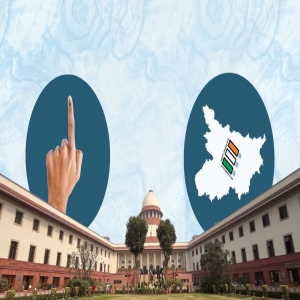
At its June 8 meeting, the INDI Alliance — comprising 23 political parties — adopted five resolutions. The most prominent was the decision to write to the Chief Justice of India (CJI) over what it describes as large-scale voter theft through the deletion of names from electoral rolls.
At first glance, the move appears entirely logical. If millions of voters are allegedly being removed, approaching the country's highest judicial authority would seem to be the obvious constitutional response.
Yet there is a fundamental problem with that assumption.
The Supreme Court is not hearing these concerns for the first time. It has already examined the legality of the Election Commission's Special Intensive Revision (SIR) exercises. It has already heard warnings from opposition parties, civil society groups, election rights activists, and constitutional experts regarding voter exclusion, documentation requirements, citizenship verification, and the risk of disenfranchisement. Most importantly, it has already ruled.
This reality fundamentally alters the meaning of the alliance's letter. The letter does not inform the Court, because the Court already knows. It is not alerting the judiciary to a previously undiscovered problem, because the judiciary has already examined the problem. The letter, therefore, serves a different purpose. It is not an appeal for awareness. It is an attempt to assign responsibility.
For much of the debate surrounding voter-roll revision, public attention has remained focused on the Election Commission. Yet the more consequential constitutional question may no longer concern the Election Commission alone. Increasingly, it concerns the Supreme Court's own choice of restraint, shifting the central constitutional debate.
The issue is no longer whether the Election Commission possesses the authority to revise electoral rolls. Though it may be subject to a review petition, the Supreme Court has effectively settled that question. It upheld the Commission's authority to conduct Special Intensive Revision exercises and accepted that electoral rolls can be subjected to large-scale verification.
What remains unresolved is whether the Court defined safeguards that must accompany that power — to ensure transparency, procedural fairness, inclusion rather than exclusion, and the protection of universal adult suffrage guaranteed under Article 326 of the Constitution. The Court answered the question of power. It did not fully answer the question of constitutional protection. The judgment was delivered on May 27, 2026 — six months after the Bihar elections concluded and a new government was formed.
The irony is that the Supreme Court itself recognised the tension. In its judgment, the Court acknowledged that two democratic concerns must be balanced: ensuring that electoral rolls contain only eligible voters, and ensuring that no eligible voter is excluded. Both were recognised as legitimate constitutional objectives, but, having identified the tension, the Court largely left its resolution to the Election Commission, despite petitions challenging the EC's methodology.
The practical consequences have been enormous. In Bihar, reportedly around 65 lakh names were removed during the Special Intensive Revision exercise. The Election Commission defended this as necessary to remove duplicate, deceased, shifted and otherwise ineligible voters. The Supreme Court did not stop the exercise. It did not question the Commission's authority. Nor did it invalidate the methodology. Instead, it largely confined itself to transparency and disclosure issues while allowing the exercise to proceed.
If Bihar established the precedent, West Bengal transformed it into a national political issue. Around 91 lakh names were reportedly removed from West Bengal's electoral rolls, affecting around eleven to twelve per cent of the electorate. The Election Commission maintained that these deletions involved duplicate, deceased, shifted or otherwise ineligible electors. More significantly, around 27 lakh names reportedly fell into the "logical discrepancy" category — a classification that became central to opposition concerns.
The controversy is no longer merely about numbers. It is about standards. Who created these standards? How were they applied? What safeguards existed against error? What recourse existed for voters excluded under such classifications?
In a country where parliamentary seats are often decided by a few thousand votes — sometimes by only a few hundred — any exercise affecting tens of millions of voters inevitably raises constitutional questions.
The argument is not that every deleted voter was eligible. It is that when exclusions occur on such a scale, constitutional scrutiny should become more intensive, not less. The broader the exercise, the greater the need for safeguards.
This is where the Supreme Court's own reasoning creates a dilemma.
The Court held that the determination of citizenship is not within the Election Commission's jurisdiction. Questions relating to citizenship are to be addressed by authorities acting under the Citizenship Act. Legally, this distinction prevents the Election Commission from functioning as a citizenship tribunal.
Politically, however, it raises an unavoidable question. If the Election Commission cannot determine citizenship, then on what basis are names being removed pending subsequent examination by competent authorities?
A person whose name disappears from the electoral roll may remain a citizen in law. Yet during an election, that person loses the ability to exercise the franchise. The constitutional injury occurs immediately, while the legal process follows later.
This is why the issue is increasingly described not as a citizenship dispute but as a disenfranchisement dispute. A right that cannot be exercised during an election is, for all practical purposes, denied. Behind every deleted name is a citizen who will not vote in an election that will not wait for them.
The controversy surrounding "logical discrepancy" deepened these concerns. Critics argued that voters were being excluded through standards that appeared uncertain, evolving or insufficiently explained. The debate, however, is not really about administrative efficiency. It is about constitutional accountability.
Who protects voters when such standards are applied incorrectly? Who ensures that exclusion does not become an unintended consequence of purification?
The Supreme Court recognised both concerns. Yet its eventual approach appeared to favour institutional discretion over judicial prescription. It accepted the Commission's authority and required transparency, but stopped short of laying down an elaborate framework for exercising that authority.
There is a counterargument, and it deserves to be stated plainly. Courts are not administrators. Judicial restraint in matters of institutional authority is not timidity — it is doctrine. The Supreme Court could reasonably argue that prescribing detailed safeguards for every Election Commission exercise would amount to judicial overreach, substituting the Court's judgment for that of a constitutional body specifically designed to manage elections. Separation of powers, on this reading, demands deference.
Yet that argument has limits that the scale of this exercise exposes. Restraint is defensible when the consequences of error are recoverable. It becomes constitutionally difficult to sustain when the injury is immediate, irreversible and affects tens of millions of citizens before any corrective mechanism can operate. The Court did not merely decline to interfere with a process. It declined to prescribe safeguards for a process it had itself identified as carrying the risk of excluding legitimate voters.
This is a distinction with a constitutional consequence. Deference to institutional authority is a principle. It cannot become a shield behind which the disenfranchisement of eligible citizens is allowed to occur without judicial remedy.
Nothing captures this tension more clearly than the reported observation that excluded voters could seek inclusion in future revisions. The issue is simple: a vote lost in one election cannot be recovered in the next. That remark came to symbolise excessive reliance on post-facto remedies for an immediate constitutional injury.
This is why the INDI Alliance's letter matters. It is not about expecting dramatic judicial intervention or altering Election Commission policy overnight. Rather, it changes the target of the debate.
The significance of the letter becomes even greater when viewed alongside the unresolved challenge to the altered process for appointing Election Commissioners. The Supreme Court's earlier judgment sought to reduce executive dominance in the appointment process. Parliament subsequently altered that framework, and the constitutional challenge remains pending. Meanwhile, the same Election Commission is exercising extraordinary authority over electoral rolls affecting tens of millions of voters.
The two issues are inseparable. An Election Commission conducting the largest voter-roll revision exercises in decades continues to operate under an appointment framework whose constitutional validity remains under judicial examination. The political perception is unavoidable: extraordinary power is being exercised while questions regarding institutional independence remain unsettled.
This brings us back to the recent remarks of CJI Surya Kant. Responding to concerns about the CJI's role as Master of the Roster, he observed that the position is often misunderstood and is only one among several responsibilities of the office. At one level, the statement was a reminder of constitutional limits. Courts do not administer elections, govern states or execute policy. The CJI was effectively emphasising that the judiciary is not the omnipotent institution many imagine it to be.
Yet, when read alongside the voter-roll controversy, the remark takes on a different significance. The judiciary appears increasingly conscious of its limits, while the opposition appears increasingly frustrated by them.
That frustration stems from a simple reality. The Court has not been a passive observer. It examined the legality of SIR. It recognised the tension between electoral integrity and voter inclusion. It acknowledged that citizenship determination lies outside the Election Commission's jurisdiction. It had repeated warnings regarding the risk of exclusion. Yet having done so, it ultimately chose restraint. That choice now lies at the centre of the controversy.
The debate is about whether the constitutional guarantee of universal adult suffrage received the level of judicial protection that such a vast exercise demanded. It is to place the judiciary within the chain of accountability — to argue that once a constitutional institution has examined a controversy, recognised its dangers and nevertheless permitted it to proceed, that institution becomes part of the story. That is the true thrust of the INDI Alliance's letter. It is no longer the Election Commission that stands at the centre of this controversy.
It is the Court that is in the dock.
.jpg)
.png) Cedric Prakash
Cedric Prakash

 ICPA
ICPA
 ICPA
ICPA
 ICPA
ICPA
 ICPA
ICPA
 ICPA
ICPA
 ICPA
ICPA
.jpg)
 A. J. Philip
.jpg)
.png) Jacob Peenikaparambil
Jacob Peenikaparambil
.jpg)
.png) John Dayal
John Dayal