

 John Dayal
.jpg)
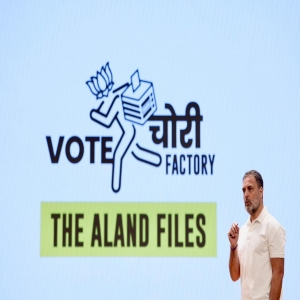
Leader of the Opposition and Jawaharlal Nehru clan scion Rahul Gandhi has put electoral integrity and constitutional democracy at the centre of national politics, but the Indian National Congress he leads, with party president Mapanna Mallikarjun Kharge, must show that it can defend these principles where the vote is cast, contested and counted.
Rahul Gandhi has spent the years since the Bharat Jodo Yatra mounting one of the most sustained political challenges to the Narendra Modi government, his indictment ranging from the proximity of corporate interests, particularly the Adani behemoth, to political authority, to the alleged capture of public institutions, and from doubts about electoral integrity to the defence of a Constitution that promises equal citizenship to all Indians.
These concerns surely go to the heart of the republic, and Rahul Gandhi has made them part of the national debate, compelling Prime Minister Modi, Home Minister Amit Shah and the ruling party to answer charges they might have preferred to ignore.
But even Rahul Gandhi's most ardent fans will admit a troubling gap between this argument's reach and the electoral fortunes of the party he leads.
Bihar in November 2025 supplied the harshest illustration when, after the 16-day Voter Adhikar Yatra, which began in Sasaram in August and which placed electoral rights at the centre of public discussion, the Congress won only six of the 61 seats it contested, compared with 19 in 2020, while the National Democratic Alliance took 202 of the 243 seats and left the Mahagathbandhan with 35.
The Congress response exposed a familiar divide as Mallikarjun Kharge and Jairam Ramesh continued to allege large-scale irregularities. At the same time, local assessments pointed to weak campaigning, inadequate attention to jobs and welfare, and a lack of sustained organisational presence after the yatra, making it clear that the gravity of an allegation cannot compensate for the deficiencies of the organisation that makes it.
The larger danger is that electoral-roll revision, the now suspicious SIR, becomes a procedural exercise whose consequences fall most heavily on those least equipped to negotiate the bureaucracy, robbing the vote of eligible citizens of the Minorities, Dalits, Other Backwards Classes and Adivasi communities who are particularly vulnerable as poverty, migration, insecure housing, weak documentation or limited access to remedies complicate the proof of eligibility.
These communities are not uniform, and aggregate figures do not establish that any one group has been disproportionately excluded everywhere, but the possibility demands disaggregated data, accessible appeals and close scrutiny of individual cases.
This is where the Congress's organisational weaknesses become a constitutional structural weakness: a national leader raises the alarm, a court can examine the law, and the Election Commission can defend its procedures. However, someone in the party structure at the grassroots must still identify the missing name, help the voter understand the process, submit the objection, and follow it to its conclusion.
The Congress has been forceful on New Delhi's streets in describing what it believes is wrong with the electoral system, but far less convincing in showing it has the machinery to monitor that system booth by booth.
The Special Intensive Revision of electoral rolls has brought these questions into sharp relief.
In Uttar Pradesh, the draft roll published in January 2026 contained about 12.55 crore electors, after nearly 2.89 crore names were excluded from the previous list of 15.44 crore. The final roll published in April held about 13.39 crore electors, a net reduction of about 2.05 crore after further deletions and the addition of about 84 lakh names during the claims and objections process.
In Karnataka, the final roll recorded a reduction of close to one crore electors compared with the pre-revision list. Still, these numbers do not exactly confirm how many eligible citizens were wrongly excluded.
The Election Commission still maintains that the exercise seeks to remove deceased, duplicate and shifted electors, which is a legitimate aim, since no democracy benefits from inaccurate registers, but a revision involving millions of names has to be judged not by administrative efficiency alone but by the fairness of its procedures and the adequacy of its safeguards.
The scale of the changes warrants public scrutiny, though without further evidence it does not prove partisan manipulation; the opposition and civil society must therefore establish where the process has failed, which citizens have been affected, and whether the remedies are adequate.
A Booth Level Agent, not the now notorious BLO of the government electoral office, is a party-appointed representative who helps monitor electoral rolls and raise discrepancies through the prescribed process.
The party BLA is not a substitute for the official Booth Level Officer and has no authority over the revision, but a trained agent can connect voters to the administrative machinery, identify errors, and ensure complaints are not abandoned.
The reported figures from Uttar Pradesh show a considerable imbalance. During the revision, the BJP appointed about 1.60 lakh agents, the Samajwadi Party about 1.42 lakh, and the Bahujan Samaj Party about 1.39 lakh, compared with roughly 49,000 for the Congress. However, these figures are a snapshot of appointments during the exercise, not a final statement of coverage.
Earlier figures from Bihar, which has 90,712 polling stations, showed a similar gap: about 8,600 Congress agents against more than 51,000 for the BJP.
The BJP's organisation is not infallible, since reports from Uttar Pradesh also identified polling stations without its agents, but an established network lets a party know what is happening on the ground and respond with evidence rather than conjecture.
The task is formidable: the 2024 general election was conducted across 10,52,664 polling stations, and a competitive campaign needs booth committees, local coordinators, and workers who remain active between elections.
The BJP's booth committees and page-level workers, called Panna Pramukhs, each responsible for a small group of voters, connect election-day mobilisation to the ordinary business of politics. Without the Rashtriya Swayamsevak Sangh's massive boots on the ground, the Congress cannot replicate this by announcing committees or organising another yatra.
The Congress sorely needs an organisation that works when Rahul Gandhi is elsewhere, and the cameras have departed.
The party has acknowledged this need through its Sangathan Srijan Abhiyan, launched after the Belagavi Working Committee meeting in December 2024, which seeks to strengthen the party from the district down to the block, mandal, and booth levels.
The restructuring matters only when appointments reflect competence, responsibilities are clear, workers are trained, and performance is assessed honestly. However, it seems posts are still filled to satisfy factions. Local workers will not accept responsibility for failure if a small group of leaders, who face few consequences for their own mistakes, keeps decisions on candidates, alliances, and resources.
This may well be tested in Uttar Pradesh, where the Congress won six seats there in 2024 in alliance with the Samajwadi Party, showing that the BJP can be challenged when opposition votes combine, but not pressuring the Congress to independently rebuild its strength.
Reports of heckling and disorder at the event marking Aradhana Misra's elevation as state president in October were damaging for a party urging its workers to accept discipline and renewal.
Alliances compound the difficulty, as seen in Bihar, where the Congress and the RJD contested against each other in several constituencies, and in Uttar Pradesh, where differences over seat-sharing with the Samajwadi Party have already revealed the limits of mutual confidence.
To negotiate credibly within the INDIA bloc, the Congress must show that it can deliver candidates, workers and votes.
The 2026 Assembly elections offered Rahul Gandhi both encouragement and a warning.
In Kerala the Congress won 63 of 140 seats, and the United Democratic Front returned to power after a decade; in Assam the Congress won 19 seats against the BJP's 82; in Tamil Nadu it won five as Vijay's Tamilaga Vettri Kazhagam emerged as a major force; and in West Bengal the BJP formed the government while the Congress won two.
Kerala shows that the party remains competitive where it has an established state organisation and a functioning alliance, and, without abandoning the constitutional critique, tied its campaign to employment, prices, public services and welfare.
The campaign against the Election Commission has moved from press conferences to public protest.
On October 6, opposition MPs marched towards the Commission's headquarters demanding the resignation of Chief Election Commissioner Gyanesh Kumar. Rahul Gandhi, Priyanka Gandhi Vadra and other lawmakers were briefly detained after the march was blocked.
The Congress is also planning a much larger demonstration at Delhi's Ramlila Maidan, reportedly projected to draw ten lakh people.
A target is just an announcement, but what matters more is what follows, since an organisation that reaches citizens in their neighbourhoods, checks their names on the rolls and pursues their grievances would be a more durable achievement than any rally.
The Legislative Council elections counted in October, which brought setbacks for the Congress including a damaging result in Karnataka where it governs, are no forecast for Assembly outcomes, but they show that parties must keep their relationships with voters even when the electorate is small.
The central task for Rahul Gandhi, Kharge and the state units is to bring the national argument and local capacity together.
If the Congress alleges that eligible citizens have been excluded, it must help establish who they are; if it demands accountability from the Election Commission, it must place documented cases before the proper authorities; and if it claims to defend the Constitution, it must build an organisation able to defend citizens' rights in practice.
Whether the Congress can turn the question it has put before the country into a durable movement will depend less on the next march than on the workers it has yet to train, the booths it has yet to cover and the citizens it has yet to reach.
.jpg)
 Jacob Peenikaparambil
John Dayal
.jpg)
 A. J. Philip
 Monsignor Susai Sebastian
.jpg)
 Joseph Maliakan

.jpg) Dr Mudita Menona Sodder
.png)
 Robert Clements
.jpg) Stanislaus Alla
.jpg)
 Cedric Prakash