
 Joseph Maliakan
.jpg)
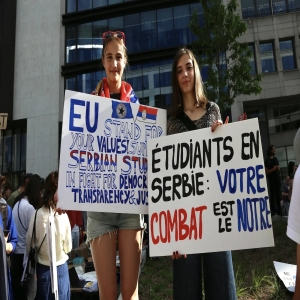
On Sunday, October 25, 2026, a movement of students and their allies, calling themselves the "Student List" (Studentska lista), unexpectedly won a majority in the Serbian Parliament in the election called by Aleksandar Vu?i?, who had ruled the country with an iron fist for the last 14 years. The "Student List" won 140 seats in a House of 250.
The student movement that ended Aleksander's authoritarian rule began with a building collapse. In November 2024, the new concrete canopy at the Novi Sad railway station collapsed, killing 16 people. It became a symbol of corruption, and the movement demanded that officials be held accountable.
Students hit the streets and held protest marches across the country. Farmers, teachers, lawyers, actors, and people from small towns soon joined them. They adopted strictly non-violent methods and kept demanding accountability and early elections.
When Aleksander called for elections, he first resigned as President to stand for Prime Minister. The students put up candidates who were mostly professors, doctors and teachers with no political past. Several established political parties stood aside, and the students' candidates won a majority.
The movement gained strength because of a clear grievance: sixteen deaths without any accountability, which gave moral strength to the students' movement. Second, they persisted: they carried on their movement continuously for two years. Third, people trusted the candidates the students put forward in the election. They had no political baggage, came from among themselves, and had unblemished character. In fact, during the two years, the student movement had reached out to the labouring people of Serbia, who gave strength to the "Student List."
Further, Serbia's proportional voting system allowed votes to translate into seats. The students have a very hard task ahead. They must now name a Prime Minister who can hold together a loose alliance and govern with a strong opposition and institutions carefully set up by the dethroned President, Aleksander.
The Serbian students had clear objectives. They declared that they wanted an end to corruption, press freedom, prosecution of the culprits behind the collapse of the Novi Sad railway station canopy and, ultimately, a new Serbia!
For the last two years, students continued to act without leaders, and all decisions have been made in plenary meetings, a horizontal, non-hierarchical form of decision-making. This has been direct democracy at its best.
The "Student List" that appeared on the ballot in the recent Serbian elections emerged from the massive protests known as "Students in Blockade," founded on September 9 with the slogan "Students are Winning!"
Its programme, the 11-point "Student Plan," centres on fighting corruption and organised crime and endorses new social measures in education, housing, and healthcare. It has been written in cooperation with experts in various fields, including farmers, doctors, teachers, and social and cultural workers.
The Student List offers lessons for progressive movements worldwide. Its success stems from rebellion, energy, persistence, solidarity, courage, humour, non-violence, aspirations, and strong bottom-up organisation.
In the October 2026 election in Brazil, despite opposition from President Donald Trump and his billionaire friends in the United States, President Luiz Inácio Lula da Silva won a fourth term in office in a dramatic comeback over his right-wing challenger, Flavio Bolsonaro.
Lula told his jubilant supporters that his victory was a "loss for negativity and lies." "Long live democracy," he added.
"This, my fourth term, will be the best of any President in the history of this country," the former metal worker told supporters. "It will be the one in which I listen most to the Brazilian people," he added.
Reacting to the result, US President Trump suggested that the election had been stolen but did not provide any evidence or details. "It looked very bad to me," he added.
Other world leaders congratulated Lula. Mexico's left-aligned President Claudia Sheinbaum said on X: "The people of Brazil won." Canadian Prime Minister Mark Carney noted that their two countries had already flourished under their partnership.
European Commission President Ursula von der Leyen said that "democracy and multilateralism" had won. Spanish Prime Minister Pedro Sánchez called it a "great victory."
South African President Cyril Ramaphosa called Lula's victory a win for the Global South and progressive forces worldwide.
Lula, who turned 81 on October 27, has been President three times: two terms from January 2003 to December 2010 and again from January 2023. He is the first Brazilian to win a fourth term. In his victory speech, Lula said that "Brazil will not accept being anyone's backyard!"
.jpg)
 Jacob Peenikaparambil
.jpg)
 John Dayal
.jpg)
 A. J. Philip
 Monsignor Susai Sebastian
Joseph Maliakan
.jpg) Dr Mudita Menona Sodder
.png)
 Robert Clements
.jpg) Stanislaus Alla
.jpg)
 Cedric Prakash