

I had been away from India for several months. After travelling through Indonesia, I finally landed in Bengaluru. There is always something comforting about coming home after being away for a long time: the familiar language, the familiar faces, the familiar traffic and that familiar Indian gift for communication, where an entire conversation can happen with a movement of the head whose exact meaning remains unavailable to the rest of the world.
I got into a taxi, tired, happy and simply enjoying the feeling of being back. We had hardly travelled any distance when the driver suddenly said, quite matter-of-factly, "Sir, jussht… reshttuuu… one minute."
Pure Kanglish. The grammar was Kannada, but the vocabulary, entirely English. Yet every Kannadiga would immediately understand the deeper meaning: "I need to pee!"
And so, he stopped the car. Not at a petrol station. Not at a restaurant. Not at a public toilet. Just by the roadside. He got out, walked a few steps and gave a small patch its own private monsoon.
I sat in the car, watched him, and smiled.
Ah! I am home!
It had taken India less than an hour to welcome me back.
Perhaps the irony was sharper because I had gone to Indonesia carrying a few prejudices of my own.
I confess this with some embarrassment. Even before landing there, the economist in me, an economist with absolutely no qualifications in economics, had already done his calculations. One Indian rupee suddenly became a surprisingly large number of Indonesian rupiah. Somewhere inside me, a small and completely undeserved sense of superiority appeared: Ah, their currency is weaker. This must be a poorer, less developed country.
Of course, that is economic nonsense. The number of units printed on a currency tells you very little about how developed, clean, or well organised a country is. But prejudices are prejudices.
There was another layer, more uncomfortable to admit. Indonesia has an overwhelming Muslim population, and I realised that I had also carried some of the stereotypes that float around in India about Muslims, hygiene and public cleanliness, assumptions formed less through genuine encounter and more through inherited prejudice, social media forwards, political narratives and the extraordinary confidence with which fake news travels.
Indonesia quietly dismantled both assumptions.
It did not do so through an argument.
It simply made me look around.
The roads in the places I travelled were strikingly clean. The countryside was even more impressive. Waste was visibly sorted in many places. I rarely encountered the stray plastic, torn bags and casually scattered rubbish that we have become so accustomed to seeing along many Indian roads.
Then came Jakarta, busy, crowded, noisy Jakarta. Yet even there, I found myself thinking somewhat reluctantly: this is cleaner than Mangalore, the city I now call home and usually consider quite clean.
There went my currency theory. There went another stereotype.
Travel has a nasty habit of embarrassing prejudice.
Indonesia kept doing this to me.
In Java, I was fascinated by how Islam lived alongside layers of older Javanese, Hindu, and Buddhist culture. I encountered mosques, churches and temples, heard words that sounded strangely familiar because of their Sanskrit roots, and discovered that stories of Ramayana and Mahabharata had acquired a distinctly Indonesian life of their own.
For an Indian traveller, Indonesia could therefore feel wonderfully foreign and strangely familiar at the same time.
And during those months, one other very ordinary thing repeatedly surprised me.
It was not the volcanoes. Not the islands. Not the beaches, mosques, temples, churches or even the food.
It was the toilets.
Yes! The toilets!
Years of Indian training had taught me to approach a public toilet with caution and reluctant bravery. Before entering, the mind begins its negotiations: Can I hold it till home? Should I risk this? How desperate am I? And once inside, the walls may offer anything from profound philosophies to phone numbers promising to meet your more intimate needs, and, of course, wild versions of the Kama Sutra.
In Indonesia, what repeatedly surprised me was precisely the opposite of my experience in India. The floor was clean. There was water. The walls were devoid of artistic ex
Perhaps Indian toilets are our unofficial national endurance test, especially for women, who seem to have already reached the advanced levels of endurance. For men, a bad toilet can still be negotiable. Biology has given us certain unfair advantages. All we need to do is unzip, find a sufficiently discreet corner and turn it into a toilet.
But a woman usually needs an actual toilet. For her, the absence of a clean and safe toilet is not merely an inconvenience. It becomes a question of privacy, dignity, clothing, hygiene and safety. Perhaps that is why something as ordinary as a toilet stayed with me.
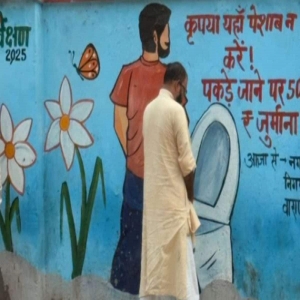
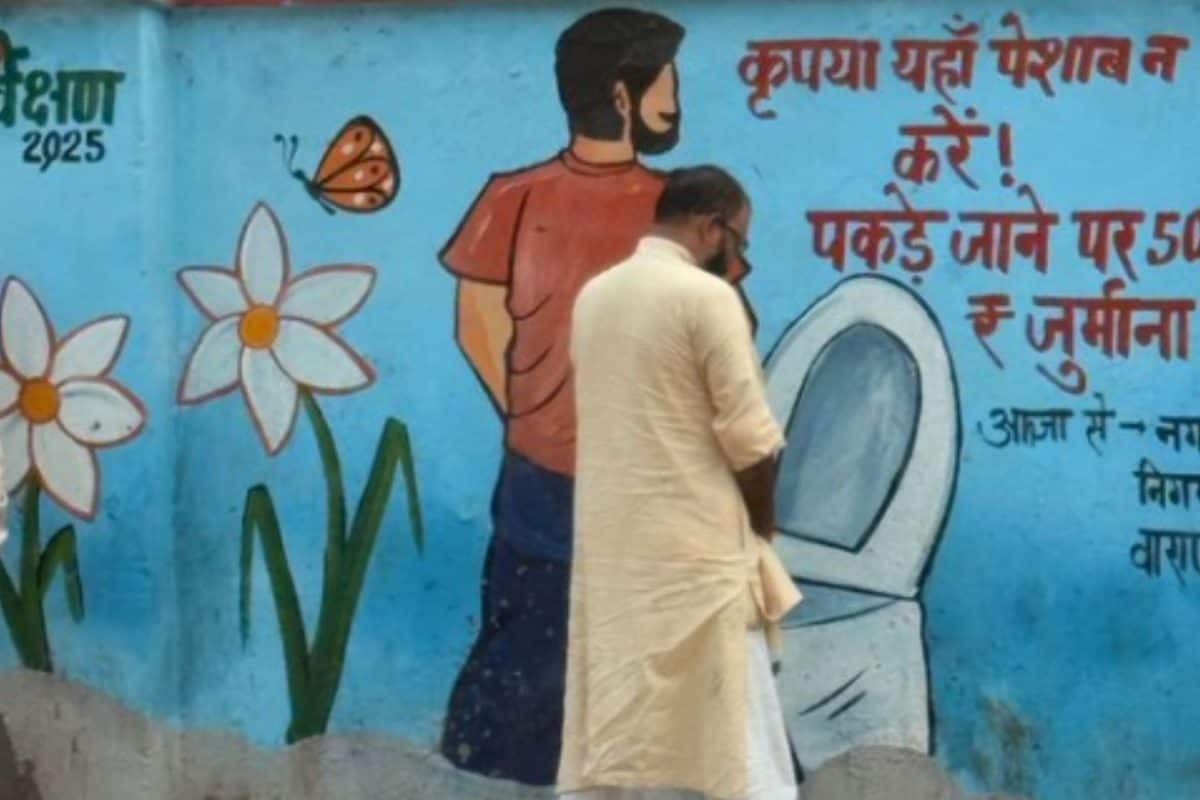
Then there are our unfortunate roadside walls, especially those standing alone in quiet corners. In India, solitude can be dangerous for a wall.
Every such wall sometimes seems to carry an invisible invitation: THIS IS A TOILET!
Occasionally there is an actual sign saying exactly the opposite: DO NOT URINATE HERE!
But below it there is often clear evidence that the instruction has been interpreted differently.
We have tried warnings, paintings, fences and threats. In one of our more imaginative innovations, we put religious images and sacred symbols on walls. Sometimes a compound wall resembles a miniature interfaith conference, all faiths united around one urgent prayer: "Not here, please."
Perhaps this should not surprise us. It is typically Indian to connect God and religion to almost everything. Politics? God. Elections? God. Cricket? At least one God is usually involved. Family disputes? Someone will eventually bring God into them. So why should sanitation be exempt?
Unfortunately, the urgent bladder remains stubbornly secular.
Then there are our railway tracks. For generations, they have also functioned as some of the longest unofficial public toilets in the country. As a train enters a city in the early morning, you can witness a peculiar Indian panorama: chai wallahs beginning their business, people brushing their teeth, people walking to work and, occasionally, people squatting beside the tracks attending to a deeply private activity in one of the least private spaces imaginable.
But here I need to issue a disclaimer. My intention is not to sound like the newly enlightened traveller who spends a few months abroad, returns home and announces that everything outside India is wonderful while everything here is hopeless. That would be arrogant and rather ridiculous. Nor is this an essay saying, "Look how clean they are; look how dirty we are."
India is certainly not the India of 20 years ago. Sanitation has improved, toilets have been built, awareness has grown, and many public spaces are cleaner than they once were. That progress deserves to be acknowledged. We have come a long way, but we still have a long way to go.
And I have seen only a small part of Indonesia. It too has its inequalities, dirty places and surely its share of dysfunctional toilets.
My simple question is: why do we struggle with something as ordinary as keeping a toilet, a wall or a public space clean? I have no grand sociological answer. What follows is merely my entirely unofficial, aggressively non-peer-reviewed attempt to understand.
For one, we have built toilets, millions of them, and that is an achievement worth acknowledging. But building a toilet and building the habit around it are two different construction projects. You can inaugurate the first with a ribbon and photograph it. Nobody comes to photograph the second.
A toilet is a structure.
A habit is a culture.
Many of us grow up in homes where the mess somehow disappears. Mother sweeps it, a domestic worker cleans it, someone, usually a woman, picks it up. We seem to unconsciously believe that dirt has a wonderful quality: leave it long enough and "somebody else" will deal with it.
Then step five feet beyond the gate, and the "somebody else" simply changes. Now it is the street sweeper, cleaning staff, rag picker or toilet cleaner. I throw the wrapper, spit on the wall or leave behind something considerably more biological, and somebody else will have to deal with it.
An uncomfortable history lies beneath that "somebody else." For generations, cleaning, sanitation and even the handling of human waste were pushed onto particular caste communities. Cleaning became associated not simply with work, but with caste and social status. And so comes the convenient logic: if the place is dirty, somehow the cleaner has failed. The person who dirtied it walks away remarkably innocent.
You see the same instinct on roads, buses, trains, stadiums and sometimes even when Indians travel abroad. Not because Indians are naturally dirty. Far from it. Many Indian homes are maintained with almost ceremonial cleanliness. But unfortunately, "somebody else will clean it" travels rather well with us.
Perhaps public cleanliness begins with a very small change in grammar: from "someone will clean it" to "why should I dirty it?"
But habits and culture are only part of the story.
Sometimes the toilet simply isn't there. And sometimes it exists but is effectively unusable. The door doesn't close. The latch is broken. The flush doesn't work. There is no light. There is no water. The tap has disappeared. The floor is flooded. Privacy is theoretical, and the smell has taken up permanent residence.
Eventually, the wall wins.
And that brings me uncomfortably back to my driver. It is easy for me to sit comfortably in the back seat and judge. But what did I know about his story? Taxi drivers, truckers, delivery riders, street vendors and others spend much of their day on the road, often with unpredictable access to a usable toilet.
Perhaps my driver had already postponed that "reshttuuu" several times. He too was simply a man with a bladder looking for a solution.
That thought punctured my moral superiority.
We are rather gifted at shaming problems we have not fully solved. We paint Yahan peshab karna mana hai. We add another coat of paint. We add sacred images. We bring several religions together around the same urgent prayer: Not here, please!
But perhaps the person standing there could reasonably ask one more question: Not here. Fine. But where?
Sometimes we don't need another lecture. We need another toilet. And water. And someone to maintain it. And yes, eventually, the habit that allows the person coming after us to use it too.
When none of these is fixed, our greatest national superpower takes over: Adjustment!
Adjust maadi! Adjust kar lo!
No seat? Adjust! No water? Adjust! No space? Adjust! No explanation? Adjust!
I genuinely admire this quality in us. Indians have an enormous capacity to improvise, accommodate, endure and somehow keep going.
But every strength has a shadow. Adjustment can become anaesthetic.
We adjust to the broken tap. We adjust to the pothole. We adjust to the overflowing drain. We adjust to the garbage. We adjust to the smell.
And if we adjust long enough, something that is wrong stops looking wrong.
Perhaps that is why I find something hopeful in the impatience of Gen Z. There seems to be a growing willingness to question, protest and demand accountability rather than simply adjust. But the real test is whether that concern goes beyond my exam, my future, my inconvenience, to include problems that rarely become hashtags.
This is also where travel becomes useful. Travel does not always teach us something entirely new. Sometimes it simply allows us to see again what familiarity had made invisible. You leave home, experience another way of doing something, and return. Suddenly your own country looks slightly different.
Not necessarily worse.
Not necessarily better.
Just more visible.
That is what Indonesia did for me.
I do not want India to become Indonesia. I do not want India to become Singapore, Japan, Europe or any other country. India has its own genius, madness, resilience, contradictions and beauty.
I simply hope we can become a slightly better version of ourselves.
Perhaps an India where a taxi driver does not have to scan the roadside when nature calls. Where a woman travelling alone does not have to plan her journey around the availability of a usable toilet. Where the person who cleans a toilet receives as much dignity as the person who uses it. Where a public wall is occasionally permitted the dignity of remaining simply a wall.
And somewhere underneath all of that is one very simple question: Do I care about the person who comes after me, whether it's a toilet, road, stadium, library or even home?
Perhaps that is what I brought home from Indonesia.
India is not a country I want to stand outside and judge. It is my home. It gave me my childhood, memories, friendships, languages, food, music, humour, arguments, faith, joys and even many of my frustrations.
For me, India is like a mother. And our relationship with mothers is complicated. You love your mother deeply. You are grateful to her. You defend her when somebody else criticises her. But occasionally you can still look around the house and say, "Maa... what is this?"
You don't say it because you have stopped loving her.
You say it because this is your mother and this is your home.
Perhaps patriotism works something like that too. We are very good at loving India loudly. We sing about her, defend her, celebrate her and become fiercely protective the moment somebody from outside criticises her. But perhaps love has another side besides praise.
It's called "TAKING CARE."
And perhaps, after everything she has given me, the least I can do is not throw the banana peel on her living room floor.
So when my taxi driver stopped the car and said, "Sir, jussht… reshttuuu… one minute," I looked away and smiled.
Looking back now, I smile at myself for being quick to judge.
Perhaps that was my loo-niversal truth: sometimes you travel far away only to see home more clearly.
.jpg)
 Jacob Peenikaparambil
.jpg)
 John Dayal
.jpg)
 A. J. Philip
 Monsignor Susai Sebastian
.jpg)
 Joseph Maliakan

.jpg) Dr Mudita Menona Sodder
.png)
 Robert Clements
.jpg) Stanislaus Alla
.jpg)
 Cedric Prakash