

.jpg) F. M. Britto
F. M. Britto
.jpg)
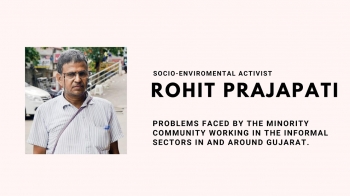
Since his father was an industrialist, Rohit Prajapati belonged to an affluent family. But the poor background of his mother’s family always moved him. So as a student he vowed to work for people’s welfare, and not for the promotion of his family.
After graduating in Mechanical Engineering from Vadodara, Rohit worked in five companies. Then he did his Master’s in Germany.
While working in a factory, Rohit came across a worker whose feet had been affected by chromium ulcer. He spent many nights speaking to the workers outside the factory. He learnt that most workers were affected by the pollution. His intestines got affected because he too drank the “multi-coloured” potable water.
From Vatva in Ahmadabad of the north Gujarat to Vapi in the south is known as the Golden Corridor in Gujarat. It is so called because of good transport and communication system and the availability of cheap and unorganized labour for the industries. In this 400 km long region there are over 50 industrial estates, some of them are chemical estates, spreading over a thousand acres.
But it is a dark and dangerous corridor for the people. Those who live in the estates and the surrounding villages face extreme pollution of air, water and soil, which adversely affect their health. Due to the pollution people were suffering from skin ailments, respiratory problems, headaches and other sicknesses. The Gujarat Pollution Control Board neither monitored nor informed the people about the pollution.
The workers and the adjacent villagers in the Golden Corridor estate felt helpless. So Rohit launched his NGO ‘Paryavaran Suraksha Samiti’ (PSS) to fight against the industrial pollution. Here he met Trupti and married her.
The PSS made aware people on the dangerous condition of indiscriminate industrialization. Rohit filed more than 100 RTI applications on industrial pollution and governance issues.
The son of the industrialist has exposed the false claims of industries on their safety measures. Due to his intervention, many factories got closed. The Supreme Court ordered the industries to meet the expenses of potable water supply to 26 villages in central and south Gujarat.
The PSS has been investigating pollution hotspots and its effects on the communities living around these estates. Besides, it also works with the tribals for their sustainable lifestyle, on alternative technology and Gandhian movement, and networking with other organizations.
Though one of his legs is affected by polio, the son of a wealthy industrialist bravely marches on taking the cause of the common people. While he and his family have been facing life threats from the industrialists, his wife, son, the workers and good-willed citizens back him in his crusade against industrial pollution.
“Stopping pollution is the best solution.”
.png) Cedric Prakash
Cedric Prakash
.JPG)
 A. J. Philip

.png) Jacob Peenikaparambil
Jacob Peenikaparambil
.jpg)
.png) John Dayal
John Dayal
.jpg)
 Pachu Menon
.png)
.png)
.png) Robert Clements
Robert Clements