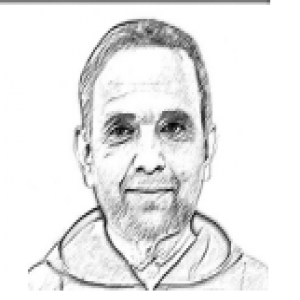


Fr Xavier Vadakkekara is no more. A personality who inspired scores and mentored many is gone. He lived a life unlike many others. In death, too, he took a different path by donating his body to the All India Institute of Medical Sciences, Delhi. A life without pretensions ended without any, in death too.
For me, it is goodbye to an unbroken relationship lasting over two decades with Xavier Achen (I called him so). A couple of years after he took over as the Editor of Indian Currents weekly in the latter part of the 1990s, we started working together in planning and bringing out the magazine, week after week, and it continued for almost a decade (it was an unofficial arrangement as I was working with The Hindu). After his stint in Indian Currents, I was associated with him through Media House and many other ways. Over the years, I realised his unorthodox, unparalleled ways of functioning as a communicator par excellence.
Though a multifaceted person, I would look at him as a media person. The rest is not my forte. His unusual ways of looking at issues and churning out stories/news made him a true communicator, and a true journalist. His style and functioning militated against the traditional ways of Church's communication. To cite an example, when he was the editor of Assisi magazine (in Malayalam), he ventured to expose the practice of exorcism by priests. He pieced together a few articles and caricatures on the issue. It became controversial, and he came into the line of fire of certain church authorities.
When he was the editor of Indian Currents, he conducted a survey among Church members, especially priests and nuns, as to who their preference was as the next Archbishop of Delhi when the incumbent person passed away. This was unheard of in the Catholic world in India, and it invited harsh criticism from various quarters. But Fr Xavier was cast in a different mould. Unmindful of the brickbats he got, he published the survey results. These are just a couple of examples of his nonconformist ways as a communicator.
Of course, he had to pay a price for his radical approach. He had to fight a few court cases for the stories he carried in both the magazines. But Fr Xavier was not to be cowed down by such pressure tactics. He was not ready to buckle under pressure, and that placed him on a higher pedestal.
His principle was clear. When you fight for a cause, there is no need to make compromises. When you are working with a mission, don't be deterred by controversies. Compromises weaken your position; being wary of controversies will hold you back from moving forward. His blurred eyesight could not hamper his foresight.
Fr Xavier was a trailblazer and mentor for many. At some point, he was wearing several caps at the same time. He was editor of Indian Currents and in charge of Media House (publishing house) and Jyoti Printers. Despite being visually challenged, he could do justice to all with aplomb.
Xavier Achen was one of the rare persons I have seen with incredible persuasive skills. He could nudge people to write, even to the extent of writing books. But for his persuasive skills, my book Editing Today: Rules, Tools and Styles would not have come out. He has helped many to become authors and writers.
He had a friend circle across the country that only a few could even aspire to make. But he never boasted of this; instead, he lived like an ordinary priest with his foot on the ground. I have personal knowledge of many who have been beneficiaries of his benevolent nature.
As I sit in my hometown, watching Xavier Achen's last journey online, my mind goes numb with 'flashback memories' of over two decades. It was on February 15, 2025, we had our last 'sit-together.' Apart from Xavier Achen, Dr MP Raju and Ms Celine Raju, Fr Babu Joseph, former spokesperson of CBCI, and Molly and I were at his 'last supper' in our flat in Delhi. In fact, Xavier Achen insisted on that 'get-together' before we left for our home town for a month. It was as if he knew what was going to come. He was right as usual, and we are left grieving at the loss of a wonderful friend and guide.
.jpg) Stanislaus Alla
Stanislaus Alla
.jpg)
.png) Cedric Prakash
Cedric Prakash
.jpg) Elsa Lycias Joel
Elsa Lycias Joel
.jpg)
 A. J. Philip
.png) Jacob Peenikaparambil
Jacob Peenikaparambil
.jpg)
.png) John Dayal
John Dayal
.jpg)
.jpg)
.png) Joseph Maliakan
Joseph Maliakan
.png)
.png) Robert Clements
Robert Clements
.jpg) Cedric Prakash
Cedric Prakash