

.png) Jacob Peenikaparambil
Jacob Peenikaparambil
.jpg)
Rajeev Chandrashekar, BJP President of Kerala, wrote an interesting article in The Indian Express (June 5, 2026) under the caption, "Magnifica Humanitas and MANAV: Creating a Shared Vision for AI." In this article, the author highlighted seven significant convergences between Pope Leo XIV's encyclical Magnifica Humanitas: On Safeguarding the Human Person in the Time of Artificial Intelligence and Prime Minister Modi's MANAV framework, as presented at the India AI Impact Summit 2026 and the AI Action Summit 2025. MANAV stands for M — Moral and Ethical Systems, A — Accountable Governance, N — National Sovereignty, A — Accessible and Inclusive, and V — Valid and Legitimate.
The central point of the article is that AI should serve human beings to enrich human life, not the other way around. The article concludes with the statement: "The moral resources for governing AI already exist — in Catholic social teaching, Indian philosophical tradition, and other civilisational ethics."
Rajeev Chandrashekar has made a commendable effort in his article to raise awareness about the responsible use of AI among developers, AI companies, and those responsible for governance, by highlighting the views of two prominent world leaders.
How Does Religion Become Divisive?
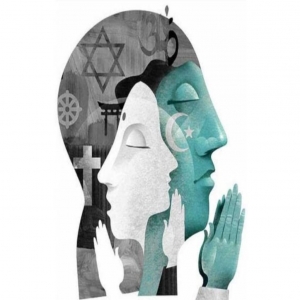
This write-up is not a critical analysis of Rajeev Chandrashekar's article. Rather, reading it prompted me to reflect on another equally relevant issue: the relationship between Religion and Humanity, particularly in the Indian context. Does humanity exist for religion, or does religion exist for humanity? Why do people fight and kill one another in the name of God and Religion? Why are hatred, revenge, and enmity spread in the name of religion? Why is religion used to divide people? While searching for answers to these questions, I was reminded of three ideas I have read about.
The first thought emerges from a song written by the Malayalam poet Vayalar Ramavarma. The English translation of the song is as follows:
Man created religions; religions created gods.
Then man, religions, and gods came together—
To divide the land and to divide human hearts.
As Hindus, as Muslims, and as Christians, we can no longer recognise one another.
India has turned into a madhouse!
Thousands upon thousands of human hearts have turned into weapon storehouses.
God dies in the streets while the devil laughs.
Where is truth? Where is beauty? Where is our freedom?
Where are our blood relations? Where is eternal love?
Where are the divine incarnations (Avatars) that are supposed to arrive once in a thousand years?
Man dies in the streets while religion laughs.
The second thought is related to a statement made by the main character of the Hindi movie Dharm, Pandit Chaturvedi, at the close of the film: "Religion is not simply rituals; it is duty and responsibility. It is unity and harmony. Rejecting discrimination is religion. Humanity is Religion." This statement unambiguously asserts that humanity is the greatest religion.
The third thought is taken from the book The Guru of Joy: Sri Sri Ravi Shankar, the Art of Living, written by Francois Gautier. According to the author, human beings have five major identities. First, all human beings are part of the Divine; second, they belong to the human race; third, they are either male or female; fourth, they belong to a particular nation; and fifth, they belong to a particular religion. If followers of different religions focus on the higher identities of humanity and the divine presence in every human person, conflicts among religions can be avoided. The ability to transcend lower identities and reach the highest identity will contribute to harmony and cooperation among the followers of different religions.
In the same book, the author cites the banana analogy and its peel, given by Sri Sri Ravi Shankar. Religiosity is like the banana peel, while spirituality is the fruit itself. He argues that people often hold on to the peel and throw away the fruit, thereby losing the essence. Ravi Shankar repeatedly teaches that love, compassion, service, and human values are more fundamental than sectarian differences and that spirituality transcends religious boundaries.
In other words, there is a difference between religiosity, which consists of rituals, prayers, dogmas, symbols, places of worship, statues, and pilgrimage centres, and spirituality, which consists of the practice of the core values taught by religions. This distinction is corroborated by Jesus' statement: "Not everyone who says to me, 'Lord, Lord,' will enter the kingdom of heaven, but only the one who does the will of my Father who is in heaven" (Matthew 7:21). The will of God is expressed through love, repentance, and a transformed life (James 1:22). If religiosity is practised sincerely and with a pure heart, it can become a means of spiritual growth. However, religiosity bereft of spirituality can lead to religious fundamentalism, conflict, and violence.
The implication of Vayalar Ramavarma's song is that religions are human creations and often become sources of conflict and division in society. Religions indeed arose from humanity's search for the meaning of life, the causes of suffering, death, and other existential questions. At the same time, the existence of different religions need not lead to conflict and violence. There could be other reasons for religion-based conflicts. Moreover, the existence of various religions is a reality that cannot be denied, and it is nearly impossible to imagine a world without religions.
Reasons for Religion-Based Conflicts
1. Deviation from Original Teachings: Almost all religions have, at different points in history, deviated from their original teachings. This has often been the primary reason for divisions within religions and the emergence of different sects.
2. Emergence of Fundamentalism: Religious fundamentalism often leads followers to regard their religion as superior to others and to attempt to impose their beliefs on others. Such attitudes naturally give rise to conflict and violence.
3. Politicisation of Religion: Political leaders sometimes use religion as a tool to polarise people to capture and retain power. For example, the BJP came to power in India through the Ayodhya Ram Temple movement, which centred on the demolition of the Babri Masjid and the construction of the Ram Mandir in Ayodhya. Thousands of people were killed, and property worth billions of rupees was destroyed during the Rath Yatra led by LK Advani and in the communal riots that followed the demolition of the Babri Masjid, including the Bombay riots and the Gujarat riots of 2002.
Even after the construction of the Ram Temple, the BJP continues to raise controversies related to temple-mosque disputes, in order, according to its critics, to divert public attention from governance failures and maintain political power. Prominent examples include the Gyanvapi Mosque dispute in Varanasi, the Shahi Idgah Mosque dispute in Mathura, the Bhojshala Complex dispute in Dhar, and the Shahi Jama Masjid dispute in Sambhal.
The politicisation of religion is also facilitated through hate speeches directed against Muslims and Christians, communally charged speeches by political leaders, including Prime Minister Modi, during election campaigns, attacks on Muslims by cow vigilante groups, and the harassment of Christians by right-wing groups with the support of anti-conversion laws.
4. Commercialisation of Religion: Turning religion into a business can also contribute to conflict and violence by transforming faith into a competitive market commodity that intensifies group rivalries and exploits social grievances. When religious identity is packaged for profit, power, or political leverage, it alters the very nature of spiritual practice.
Make Religion Human-Centric
The statement of Pandit Chaturvedi and the reflections of Sri Sri Ravi Shankar shed light on how religious conflicts can be reduced and peaceful coexistence among religions promoted. Jesus' final instruction to his disciples is also a profound ex
The following steps can help make religion more human-centred:
1. Give priority to spirituality—the practice of the core values taught by religions. These values largely promote humanity, love, peace, and harmony in society.
2. Encourage followers of different religions to focus on their shared human identity and the divine presence in every person.
3. Stop the politicisation and commercialisation of religion by isolating and rejecting leaders who divide society in the name of religion.
No religion teaches its followers to discriminate against, hate, or kill other human beings for the sake of gods, rituals, or religious symbols. The wisdom of Indian sages is reflected in the famous phrase "Vasudhaiva Kutumbakam," which means "The world is one family." It explicitly states that discriminating between "mine" and "thine" is the mindset of narrow-minded people.
The Bhagavata Purana (Book 3, Chapter 29, Verse 21) strongly rejects discrimination: "I am present in every living entity as the localised soul. If one treats others with disregard or discrimination, their temple worship and rituals are a mere mockery."
Those who practise politics in the name of religion violate the teachings of their own faith and reduce religion itself to a mockery.
.jpg)
.png) Cedric Prakash
Cedric Prakash
 ICPA
ICPA
 ICPA
ICPA
 ICPA
ICPA
 ICPA
ICPA
 ICPA
ICPA
 ICPA
ICPA
.jpg)
 A. J. Philip
.jpg) Jacob Peenikaparambil
Jacob Peenikaparambil
.jpg)
.png) John Dayal
John Dayal