

.png) John Dayal
John Dayal
.jpg)
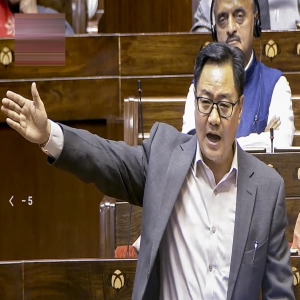
Kiren Rijiju is a compelling figure in the Bharatiya Janata Party's ministerial team, seated in the row behind Prime Minister Narendra Modi and Home Minister Amit Shah on the Lok Sabha's Treasury benches.
Born on November 19, 1971, to Nishyi Tribe parents of Nakhu village in West Kameng district of Arunachal Pradesh, a four-time Lok Sabha member from Arunachal West, and one of the party's most visible faces from the North-East, he is now Union Minister for Parliamentary Affairs and Minority Affairs.
His official biographical material states that he completed his schooling in Arunachal Pradesh, graduated from Hansraj College, University of Delhi, and earned a law degree from the Faculty of Law, University of Delhi. His father, Rinchin Kharu, was associated with the early legislative life of Arunachal Pradesh and is described in public profiles as the state Assembly's first pro-tem Speaker.
Rijiju's own political rise began in the BJP, and he first entered the Lok Sabha from Arunachal West in 2004. He lost in 2009, returned in 2014, and then became one of Narendra Modi's trusted ministers, first as Minister of State for Home Affairs, later in Minority Affairs, Sports, Law, Earth Sciences, and now Parliamentary Affairs and Minority Affairs.
Coming from a region where questions of ethnicity, tribe, religion, food habits, and cultural autonomy are not abstract, and where there are great anxieties about identity, migration, majoritarian nationalism, and religious freedom, Rijiju perhaps has a sneaking sympathy for other minorities.
In May 2015, after senior BJP leader and Muslim face Mukhtar Abbas Naqvi said those who eat beef should go to Pakistan, Rijiju responded from Aizawl: "I eat beef, I'm from Arunachal Pradesh, can somebody stop me?" adding India was a democratic country and that people should not be "touchy" about another community's practices.
His promotion to minister seems to have affected his instincts.
Rijiju, as a minister in New Delhi, has repeatedly used a language that dismisses minority anxieties rather than addressing them, his posture changing from defending cultural difference to defending the BJP government against charges of majoritarianism.
One of the earliest clear examples came in February 2017, when responding to allegations that the BJP was trying to turn Arunachal Pradesh into a Hindu state, Rijiju wrote that the "Hindu population is reducing in India" because Hindus do not convert people, while "minorities in India are flourishing." The statement turned a question about religious nationalism into a demographic claim, suggesting minorities were not vulnerable but privileged, echoing the Hindutva argument that Hindus are under threat despite being the overwhelming majority of the country.
The same year, Rijiju became one of the Modi government's strongest voices on the issue of the Rohingyas, a Muslim minority from Myanmar, some of whom had fled mass violence and persecution in their home country at the hands of the military junta and the Buddhist clergy and cadres aligned with it.
Human-rights groups urged India not to deport them, but Rijiju's response was blunt, telling activists that India did not need advice from them. "As far as we are concerned, they are all illegal immigrants. They have no basis to live here. Anybody who is an illegal migrant will be deported."
The New York-based Human Rights Watch noted that thousands of Rohingya in India were registered with the United Nations refugee agency, but Rijiju said India was not a signatory to the refugee convention.
The legal point about India not being a signatory to the Refugee Convention was technically correct, but severe, and a persecuted Muslim refugee population was reduced to illegality. He repeated that in Parliament.
The pattern continued through the citizenship debate. Rijiju was not the minister who introduced the Citizenship Amendment Act, 2019, but he was part of the government that created a religion-based citizenship route for Hindus, Sikhs, Buddhists, Jains, Parsis and Christians from Pakistan, Bangladesh and Afghanistan while excluding Muslims.
The government defended the law as protection for persecuted minorities from neighbouring Islamic states. Its critics saw it as the first explicit religious filter in Indian citizenship law. Rijiju's ministerial career cannot be separated from that policy environment.
His later tenure as Minority Affairs Minister brought the question closer to his desk, and in 2024 and 2025, Rijiju became the face of the Waqf Amendment Bill, in which the government said the amendments were necessary for transparency, efficiency, and protection against misuse in the matter of Muslim properties bequeathed as charity or for public use.
Muslim organisations and opposition parties argued that the law increased state control over Muslim religious property, introduced non-Muslim participation in Waqf administration, empowered government officials, and weakened community autonomy.
This was analogous to the argument the Christian religious leadership is correctly making in defence of properties created with charity donations through FCRA by foreign religious organisations and people.
For years, Hindutva groups had claimed that Waqf Boards had extraordinary powers to grab land, and by adopting that language in Parliament, Rijiju gave ministerial legitimacy to a campaign that many Muslims saw as part of a larger attempt to delegitimise their institutions.
In July 2025, Rijiju claimed that India was the only country where minorities received more benefits and protection than the majority community. AIMIM president Asaduddin Owaisi sharply replied that Rijiju was a minister, not a monarch, and that minority rights were constitutional guarantees, not favours.
Rijiju also linked minority safety to the Hindu majority in a 2025 interview, saying minorities enjoyed "absolute freedom and protection" in India because of the Hindu majority, and accused a "Left ecosystem backed by Congress" of spreading the claim that minorities were unsafe.
This shifted the basis of minority security from constitutional law to majority goodwill, a dangerous shift in a republic, as minorities do not live safely because the majority is kind, but because the law is impartial, police are accountable, courts are accessible, hate speech is punished, and political power does not target them.
In May 2026, Rijiju again raised questions about Muslim numbers when speaking at a National Commission for Minorities seminar on Parsis in Mumbai. He said that India's Muslim population may be almost equal to Indonesia's after the Census. Indonesia has the world's largest Muslim population.
In June 2026, Rijiju went further, when speaking in New Delhi, he rejected the perception that minorities face discrimination in India as "propaganda" and a "malicious campaign" to tarnish India's image, alleging that forces inside and outside the country were trying to create a negative perception about the treatment of minorities.
Rijiju's record is not a simple list of abusive statements. He is not always crude, and often his language is polished, administrative and framed as national defence, but beneath that vocabulary lies a consistent political move in which minority fear is recast as exaggeration; Muslim institutional autonomy is recast as misuse; refugees are recast as illegal entrants; demographic anxiety is invoked against minorities; and constitutional rights are presented as benefits given by a benevolent majority.
The contrast with his 2015 beef statement is striking when Rijiju sounded like a Northeastern tribal leader defending local food culture against North Indian majoritarian intrusion.
It recognised that India is not one culture, one diet, one religious imagination or one political vocabulary. But in later years, as Rijiju rose in the Modi government, that pluralist instinct seemed to give way to the language of centralised nationalism.
As human rights activists say, a Minority Affairs Minister must be more than a government spokesperson — he must be a constitutional listener, sensitive to the fear beneath the complaint, not merely one who attacks it as propaganda.
Rijiju represents a larger transformation in Indian public language in which minority rights are increasingly discussed not as constitutional safeguards but as concessions, and Christians and Muslims are expected to prove loyalty before being heard.
.jpg)
.png) Cedric Prakash
Cedric Prakash
 ICPA
ICPA
 ICPA
ICPA
 ICPA
ICPA
 ICPA
ICPA
 ICPA
ICPA
 ICPA
ICPA
.jpg)
 A. J. Philip
.jpg)
.png) Jacob Peenikaparambil
Jacob Peenikaparambil
.jpg) John Dayal
John Dayal