

.jpg) Lancy Lobo
Lancy Lobo
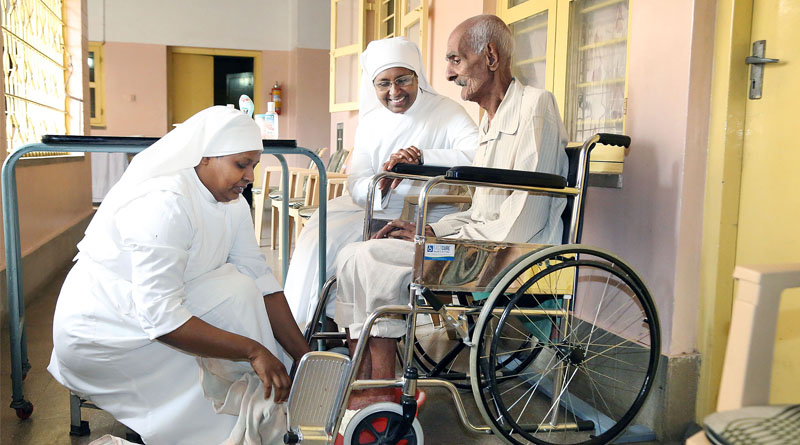
I bumped into two Little Sisters of the Poor from Bangalore who had come to Delhi to see the authorities at the State Bank of India headquarters with their files regarding Foreign Contribution Regulation Act (FCRA). Their files were not cleared and their communications were left unanswered causing them great anxiety. They were advised to rush to Delhi and personally meet the authorities concerned at the bank. The Ministry of Home Affairs (MHA) had made SBI the single central agency through which foreign funds should be channeled. But before coming to Delhi they had initiated a prayer service for nine days among their inmates to have their files cleared on their visit to Delhi. St. Joseph is their patron and he has never let them down, they said.
The Congregation of the Little Sisters of the Poor is an International Religious Congregation founded by St. Jeanne Jugan in 1839 in France, when she welcomed into her own home, the first poor old lady, blind and paralyzed. On 11th October 2009 she was raised to the altars and proclaimed as Saint of the Aged. After her example, her Sisters continue her mission of humble service to the Elderly Poor who are 65 years and above, men and women irrespective of caste, creed or religion, financially poor and in need of our Home, care and love, throughout the world.
Counting on the Heavenly Father’s care over His children, their Homes are run uniquely by public charity. Providence of God has been their support from the time St. Jeanne Jugan opened her door and gave up her bed for the poor. The Little Sisters of the Poor are dedicated all over the world with a desire to serve Christ in the poor and the suffering thus bringing about His Kingdom by a silent witness of prayer and service.
Their inmates are very poor, without any support, sick, and ailing. There are also divorced, separated and abandoned. Besides they have a day care centre where aged come in the morning and go back in the evening. They also have respite care centre where for a few days or weeks the elderly can spend time.
The routine of the Sisters consists of rising at 4.45 am, meditation and prayer at 5.15 am, 5.45 washing, cleaning the inmates, 6.30 am prayer and Mass. Then they serve breakfast to inmates. Only then they have breakfast.
They go for collection (food and money) from people of all religions. They go to the market on regular days and those who vend vegetables regularly give them free vegetables. During Covid-19, these vendors have reached vegetables to the Sisters. During Covid, Sisters would not proceed beyond the gate of the houses where they would be given collections.
Saint Mother Teresa spent couple of months after leaving the Loreto Sisters congregation and before beginning her work at Kalighat. Did she pick up anything from the Little Sisters? Yes, indeed. She has patterned her work after the Little Sisters homes. Cleanliness is what Teresa insisted in her homes picked up from the Little Sisters. Begging is another. It was said in the life of Mother Teresa that she went to beg from a Hindu trader with open palms. The trader spat on her palms. She responded saying that “this is for me but give me something for my people”. This statement struck like a missile in the heart of the trader and he apologized and promised to give continuously grains as donations to the Mother.
The above incident was a repetition of what the foundress Jeanne Jugan did when she was going for begging. When a man spat on her palms, Jeanne said, “This is for me, but give something for my people”. And the man had a conversion and he did donate her. No doubt Mother Teresa replicated it having read from the life of Jeanne Jugan.
The Little Sisters after their foundress Jeanne give much importance to satisfying the physical hunger of inmates who were deprived of food. St. Jeanne Jugan would say: “Never forget that the poor are Our Lord, take good care of them for it is Jesus Himself that you care for in them.” They are to put no long faces but smile at the aged. Many aged come with much anger, hatred, rejection and the Sisters lead them to reconciliation and prepare them for a happy death. Die with dignity and peace. Mother Teresa too emulated these traits and passed it on to her Sisters.
The Little Sisters given their nature of being pinned down to serve the needs of the inmates do not attend functions, and their home visits too are limited. Hasn’t Mother Teresa replicated this behavior for her Sisters?
I asked the two Little Sisters about any negative experiences they had while begging or collection times. They were rare but most people irrespective of religion gave them knowing what they did to the poor old people in their homes. However, “One person at the mandi market at Yeshwantpur flatly said, “I shall not give anything to you Christians.”
They had a few negative experiences for instance in Guntur where someone was eyeing a piece of their land. A goonda was sent to frighten the Sisters. “I have killed so many people,” he said. But when he saw the noble work of the Sisters, he melted and offered a feast to the entire establishment.
Sometimes when the Sisters go for collections or begging they are asked to provide an admission in the catholic schools. It is difficult for the Sisters to convince the donors that they have no schools. The donors think all congregations of Sisters are interconnected and they should be able to provide them admissions.
Is the Social Welfare Department of the government cooperating? Not necessarily. The Department has been implementing Senior Citizen’s Welfare Act, with reference to Running Home for the Aged Section 19 of the Senior Citizens Act, 2007 and other rules. The Sisters run their mission in donated homes, but the regulations of the Department force them to reconstruct, renovate the homes as per rules such as, specified stair case, ramp, space for each resident, menu, rules for salaried and non-salaried persons, keeping daily records, death certificates and so on. Every three years one has to renew the registration certificate for the home from multiple departments such as Fire, Food, Hygiene and Sanitation, and Health departments.
While these are for the wellbeing of the inmates, the Sisters face concrete problems for their implementation while dealing with departmental heads. Much time goes into these chores while the Sisters wish to spend more time in serving the aged. There is much cold shouldering by some officials of the Departments. Restructuring and rebuilding the homes according to the rules and regulations of the Department needs much finances which the Sisters find difficult to garner.
There are young visitors who come voluntarily to serve the inmates. They undergo behavioural and attitudinal change. Young relatives also come to visit the inmates. Many keep in touch with the aged homes.
These days, children put their parents in well-to-do homes for the aged by paying hefty sums of money. A few congregations of Sisters run such houses. However, the Little Sisters of the Poor have continued to serve the abandoned, the poor, and helpless persons.
The government, instead of appreciating that these Sisters who do the work which is rightly that of the government, at times makes it difficult for them to operate their homes. The religious hatred entering into the social fabric has also cast its shadows on the support system of these homes.
Valson Thampu, the former principal of St. Stephens, Delhi, and Chottebhai, former president of Kanpur Catholic Sabha, have observed that Christians must raise funds from within the country and also from Christians who are better employed and are better educated. Can our Christians proudly own up the works undertaken for the poor and the abandoned?
It is unfortunate that the work of Little Sisters as also the work of other Christian organizations is not sufficiently known, appreciated or owned by Christians leave alone by non-Christians. In rough contemporary times when missionaries are discredited and conversion is weaponised it is good to uphold our credentials.
.jpeg)
 A. J. Philip
.jpg)
.png) Jacob Peenikaparambil
Jacob Peenikaparambil
.jpg)
.png) John Dayal
John Dayal
.jpg)
 Pachu Menon
.jpg)

.png)
.png)
.png) Robert Clements
Robert Clements
.jpg)