

 A. J. Philip
A senior lawyer from the Supreme Court sent me on Thursday, a poem on WhatsApp. Now, this lawyer is not just anyone—he's someone who closely examines landmark judgments, particularly from the Constitution Bench, to assess the socio-political leanings of judges.
He is certainly not someone who rushes to conclusions or dramatises issues. Plus, the septuagenarian is a master of prose, not poetry, making it somewhat surprising to receive a poem from him at this stage in his life. I called him up to verify the matter, and we spoke until the Uber driver dropped me at my flat. From our conversation, it became evident that the poem wasn't his original work—he had simply forwarded it.
Fortunately, I didn't need to search the vast expanse of cyberspace to locate the source of the poem. Another friend sent me a link to the poem, published on 'Leaflet: Constitution First,' a website that is painstakingly updated daily. There, I found the poem titled "A prime-time visit," written by Raju Z Moray, a lawyer-poet whose book 'Tales of Law and Laughter' was recently released.
In the interest of public discussion, I am quoting the poem in full here, hoping the poet won't object, as my purpose is to draw more attention to this critical piece:
"When Big Boss went
To Big Chief's house
Big Chief welcomed him
Along with his spouse
It seems the cameramen
Were stationed in-house
Why should anybody have
Any grievance or grouse?
Gauri-Ganesha were happy
And so was their mouse!
"We, the people, now know
That all is so good and well
What did bonhomie achieve?
Shortly prime-time shall tell
Executive and the judiciary
Are now bonding so well
While Big Boss folds hands
Chief's wife shakes the bell
Is this separation of powers?
Looks like… What the hell!"
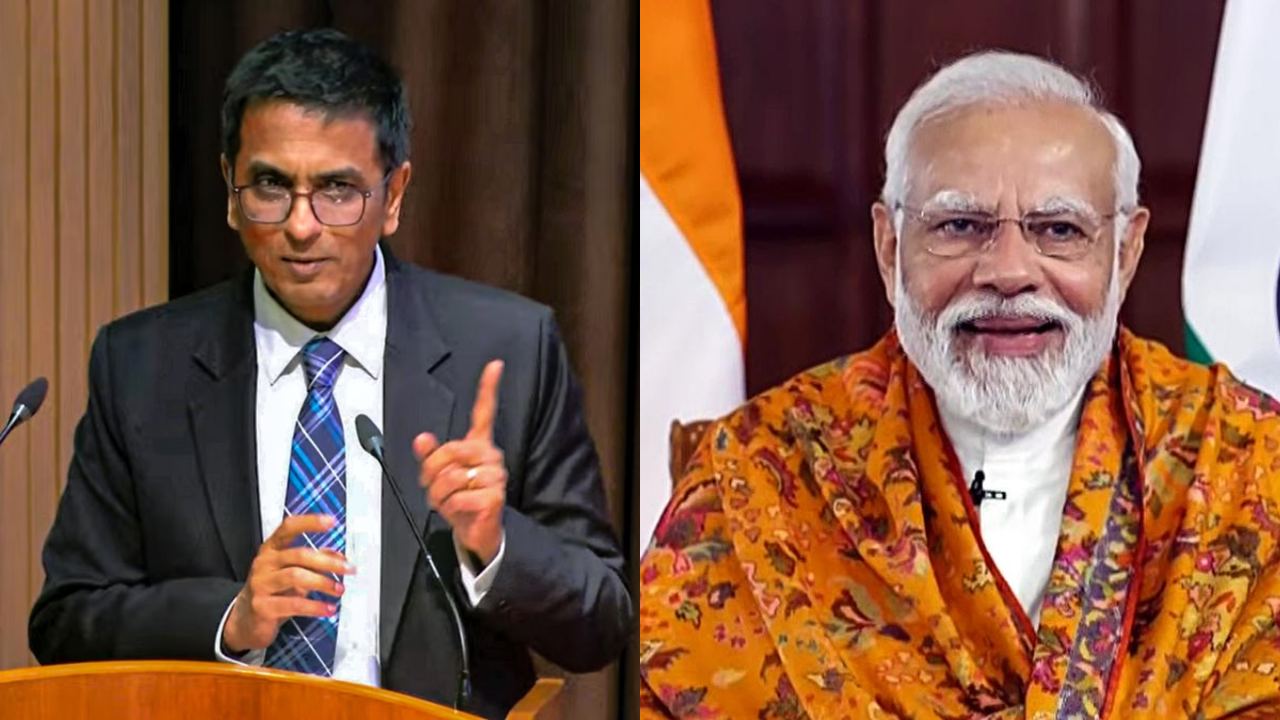
To use a colloquial phrase, anyone who has ever eaten rice, wheat, or cereals understands who the poet is referring to. Newspapers, yesterday, were filled with reports and photographs of the Ganesh Chaturthi celebrations at Chief Justice of India DY Chandrachud's residence.
Being from Maharashtra, where Ganesh Chaturthi is celebrated with fervour, the Chief Justice has every right to observe this tradition. In fact, in my younger days, Ganesh Chaturthi was not celebrated in Kerala. Similarly, 'Raksha Bandhan' was unheard of, not because Malayali men didn't care for their sisters, but because these North Indian customs had not yet made their way to Kerala. It was the arrival of the RSS in Kerala in the early 1970s that introduced these festivals from North India to the state.
Modi, despite being busy solving global crises like the war in Ukraine or the political situation in Bangladesh, found time to have a Maharashtrian dress tailored, complete with a matching Maharashtrian cap, for his visit to Justice Chandrachud's house. He does, however, have a peculiar reservation about wearing a green cap—representing greenery and environmental sustainability—without which India could become a desert like the Thar.
I find it amusing that 'Thar' is also the name of a popular four-wheel-drive vehicle favoured by rich youngsters who, instead of driving it in the deserts, dangerously race it on the roads of Delhi.
On my visit to Vikaspuri yesterday, my driver had to carefully navigate waterlogged roads to prevent our vehicle from plunging into what seemed like a lake. It's worth noting that the 'Thar' has a practical use even in Delhi, where the Lieutenant-Governor and the elected AAP government are at loggerheads, with the former quoting Supreme Court orders to prevent the latter from functioning properly.
It's hard to believe that the Prime Minister, whose enormous electronic banners erected for the G-20 Summit in New Delhi still glow at night in different corners of the capital, could be accused of gatecrashing. My son and some of his friends used to boast about attending wedding receptions uninvited, enjoying the food—especially the ice cream—and leaving unscathed.
However, the idea of Modi gatecrashing seems improbable. A well-dressed intruder might easily blend into the groom's or bride's party at a wedding, but Modi is no intruder. He must have been invited by the Chief Justice himself, and the presence of cameramen recording the event only supports this theory.
It is almost impossible for any photographer to get near Modi without his security team intervening. This suggests that the entire affair was carefully choreographed, and Modi played his role to perfection.
By now, Modi has become well-versed in playing both ceremonial and religious roles, as evidenced by his performance as the "chief priest" during the inauguration of the new Parliament building and his role in the 'Pran Prathishta' ceremony in Ayodhya, where he infused life into the idol of Ram Lalla.
According to Hindu tradition, however, a temple cannot be consecrated until it is fully completed. Yet, no one dares to question Modi, the 'Hindu Hriday Samrat.' I had believed that the Ram temple was nearing completion and that Modi was in a hurry to capitalise on it for the upcoming Lok Sabha elections. Only when I saw it did I realise that at least 75 per cent of the work remains unfinished.
Now, some of my readers might ask: why should we be concerned about the Prime Minister attending a private ceremony at the Chief Justice's house? After all, they are both public figures entitled to personal lives. However, judges are bound by a strict code of conduct. They must refrain from socialising with litigants and, as a general rule, avoid attending public events such as weddings. Their reserved behaviour is not due to antisocial tendencies but rather the constraints of their profession. If a judge were to be on a first-name basis with someone whose case is before them, doubts could arise about the impartiality of their ruling, particularly if it favours their acquaintance.
Anna Chandy, India's first female judge of a High Court, provided a poignant example of this principle. When she was the vacation judge at the Kerala High Court, she was set to hear an appeal from the Catholic Church against a district judge's ruling. That judge had sentenced Father Benedict to death for the alleged murder of Mariakutty at Madatharuvi in Ranny.
Chandy, a Catholic, chose not to preside over the case. Instead of recusing herself, she went on leave shortly before her retirement. Father Benedict was later acquitted by the High Court. He was represented by the celebrated Advocate ASR Chari. Had Chandy heard the case and acquitted Father Benedict, her impartiality might have been questioned. Her decision was guided by the famous dictum: "Justice must not only be done but must also be seen to be done," a principle laid down by Lord Hewart, once the Lord Chief Justice of England.
Long before Lord Hewart's time, Julius Caesar set the standard with his remark, "Caesar's wife must be above suspicion." Caesar divorced his wife Pompeia on the grounds that her conduct at a party raised suspicions, even though no wrongdoing was proven. The message was clear: those in positions of authority should avoid even the appearance of impropriety.
I was shocked when Modi allowed a photograph to be taken in which he had one arm around Mukesh Ambani and the other around Ambani's wife. Public perception matters, and such a photo suggests an undue level of familiarity between the Prime Minister and one of India's wealthiest industrialists.
Similarly, Modi's image appeared on Page One advertisements for an app owned by the Chinese. Contrast this with Jawaharlal Nehru, whom Modi frequently criticises. Nehru never allowed industrialists to come close to him, recognising the importance of maintaining a public distance from big business.
Why, then, is the PM's visit to Justice Chandrachud's house so troubling? The answer lies in the relationship between the judiciary and the executive. The government is the largest litigant in India. Most cases filed in court are against the government. Judges must maintain an arm's length relationship with the executive to ensure the integrity of the judiciary.
The late Arun Jaitley, once the law minister, decried the tendency of judges to thrust their bios into his hands in the hope of securing post-retirement positions. Jaitley, a member of Modi's party, highlighted the fact that several former Chief Justices had accepted lucrative post-retirement roles. One former CJI, whose ruling benefited a prominent individual, was appointed a Governor, while others have become chairpersons of various commissions. One judge, accused of attempting to sexually exploit a female employee, was later rewarded with a seat in the Rajya Sabha.
Justice Chandrachud, however, is someone I have great respect for. He and his wife adopted two disabled children, and they have cared for them with utmost love and dedication. His father, YV Chandrachud, was also a former Chief Justice of India. I have read several of Justice Chandrachud's judgments, which are impressively written and often reflect a deep academic rigour, no doubt a result of his PhD from a prestigious global university. I attended the last VM Tarkunde Memorial Lecture at the India International Centre, where Justice Chandrachud delivered an exceptional speech. It was the first time a sitting Chief Justice had done such an honour.
However, judges' command of the English language and deep knowledge of the law do not necessarily make them great judges. If their ideas reveal a bias or illiberal mindset, no amount of eloquent prose will impress anyone.
During a visit to the Somnath Temple in Gujarat, the Chief Justice was quoted as saying, "I was inspired this morning by the 'dhwaja' (flag) at Dwarikadhish Ji, very similar to the 'dhwaja' I saw at Jagannath Puri. But look at the universality of this tradition in our nation, which binds all of us together.
"This 'dhwaja' has a special meaning for us. And that meaning is: there is some unifying force above all of us, as lawyers, as judges, as citizens. And that unifying force is our humanity, which is governed by the rule of law and by the Constitution of India."
He spoke of the unifying force of the Puri temple, where the tour guide asked me to wait outside until the Hindus in the group returned from their "darshan" only because I did not hide the fact that I am a Christian. Until I heard Justice Chandrachud, I had thought it was the national flag that inspired people. Does he know that the flags of various religions and castes have different colours, and they do not replace the tricolour which every Indian, from snow-capped Himalayas to sea-lashed Kanyakumari, holds close to his chest?
His visit to Ayodhya reminded me of an incident narrated by Prof Omchery NN Pillai. At that time, Prof Pillai was the Chief PRO of the Food Corporation of India. The FCI chairman was P Ramachandran, the only South Indian in Morarji Desai's government. While on an official visit to Kochi, Ramachandran expressed a desire to visit the Guruvayoor temple. On the way, he encountered several obstacles, including a political rally that trapped his vehicle.
By the time he finally reached Guruvayoor, the sanctum sanctorum had closed for the day. The temple authorities suggested he stay the night, have a 'darshan' early the next morning, and then proceed to the airport. However, Ramachandran refused. Why? He believed God would not approve of him using official resources for his 'darshan'. Many years later, he visited Guruvayoor at his own expense and had a 'darshan' of Lord Krishna.
The Chief Justice would have done well to visit the plot of land given to the Muslims for the construction of a mosque at Ayodhya. After all, he was one of the judges who delivered the famous Ayodhya verdict. I wish he had also remembered the famous adage, paraphrased here: "The Chief Justice should be above suspicion."
.jpg)
.png) Cedric Prakash
Cedric Prakash
 ICPA
ICPA
 ICPA
ICPA
 ICPA
ICPA
 ICPA
ICPA
 ICPA
ICPA
 ICPA
ICPA
.jpg) A. J. Philip
A. J. Philip
.jpg)
.png) Jacob Peenikaparambil
Jacob Peenikaparambil
.jpg)
.png) John Dayal
John Dayal