

.png) John Dayal
John Dayal
.jpg)
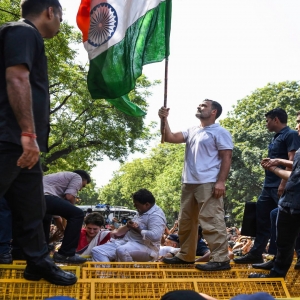
As Leader of the Opposition, Rahul Gandhi waves the national Tricolour from atop police barricades, and Union Cabinet ministers celebrate Prime Minister Narendra Modi's dubious silver jubilee—13 years as Gujarat chief minister and 12 as prime minister; it is being brought home to the people of India that something dangerous has threatened the delicate balance between the four pillars on which constitutional democracy has survived and even thrived in India.
No crisis since the Emergency of June 1975 has shaken the foundations of democracy as the present one has.
Indira Gandhi suspended the Constitution's guarantees by a proclamation under Article 352, jailed her opponents, censored the press, and through the 39th Amendment tried to place the Prime Minister's election beyond the reach of the courts. But without a formal emergency, the Modi government seems to have eroded, if not ended, the balance of power between the Executive, the Judiciary and constitutional bodies such as the Election Commission.
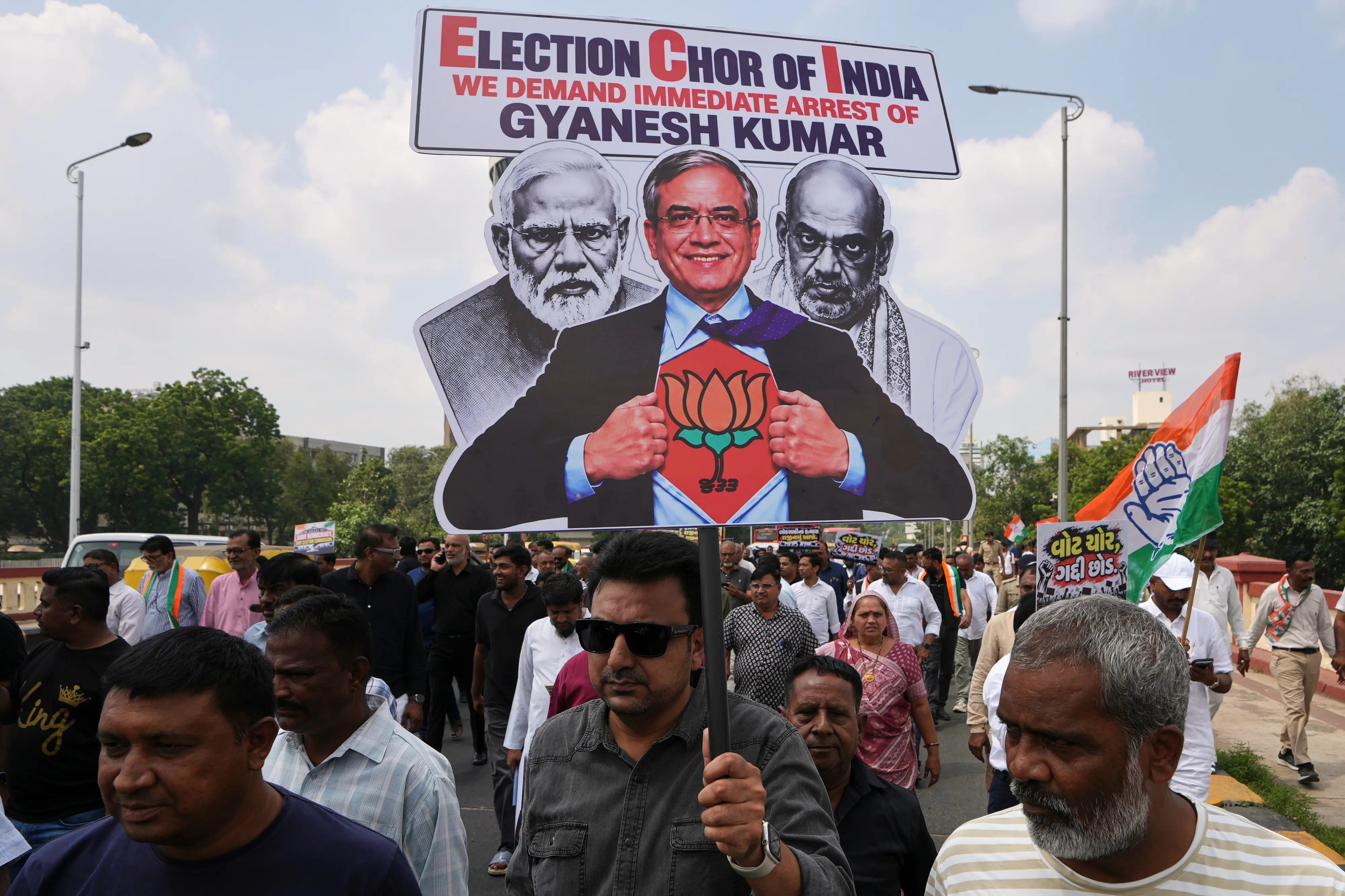
Recent exposés have cornered Chief Election Commissioner Gyanesh Kumar, accused of helping the BJP-RSS win the Bengal and Bihar assembly elections by robbing many voters of their franchise through doctored electoral rolls.
They have also cornered the Chief Justice of India, whose office agreed to an extraordinary discussion with a joint parliamentary committee on One Nation One Election, which the government proposes to bring in at the Winter session of Parliament in November. Senior Advocate Kapil Sibal held a press conference blowing the matter up, and within hours both the government and the Court said no such meeting would take place.
Eventually the Court also put Kumar in the dock and said it had not cleared the changes he had made to the all-important "Form-6," which in effect make it easier to delete names from the electoral rolls.
The committee under Babasaheb Bhimrao Ambedkar believed that the separation of powers among the Court, Parliament, and the Executive could hold together a society of unparalleled cultural, ethnic, linguistic, and religious diversity. It therefore built the Republic as a web rather than a hierarchy, in which strong opposition and elections by an Election Commission free of the reins of the Prime Minister's office were balanced by a judiciary as guardian of the Constitution.
On Tuesday this week, some 50 Members of Parliament, led by Rahul Gandhi and Priyanka Gandhi Vadra, sat for eight hours in the grounds of Akashvani Bhawan because the police would not let them walk 300 metres to the Election Commission, and were then removed by force, detained and named in a police complaint.
From that scene, Rahul, long reviled by the Sangh as an effete "Pappu," has emerged as a people's leader and a defender of constitutional values. Even if he converts this into victory in the next general election, rebuilding the tattered fabric will be neither easy nor quick, and his first hurdle would be the Election Commission itself, even if the Prime Minister persuades Kumar to resign quietly in the next few days.
The exercise to make the Chief Election Commissioner perhaps stronger than the President of India, and above all immune to future prosecution, began in March 2023, soon after a Constitution Bench in the Anoop Baranwal case directed that until Parliament legislated, commissioners would be chosen by the Prime Minister, the Leader of the Opposition and the Chief Justice.
A servile Parliament promptly replaced the Chief Justice with a Cabinet minister, which turned every selection into a foregone two votes to one, in this case Modi and Amit Shah, and then added a clause barring civil and criminal proceedings against serving and former commissioners for their official acts for as long as they lived.
Gyanesh Kumar was appointed under that law in February 2025 over Rahul's written dissent, and the challenge to the statute has still not been heard on its merits.
Kumar's tenure has been consumed by the Special Intensive Revision of the electoral rolls, which began in Bihar, spread across the country, and has struck some 13.3 crore voters from the draft rolls.
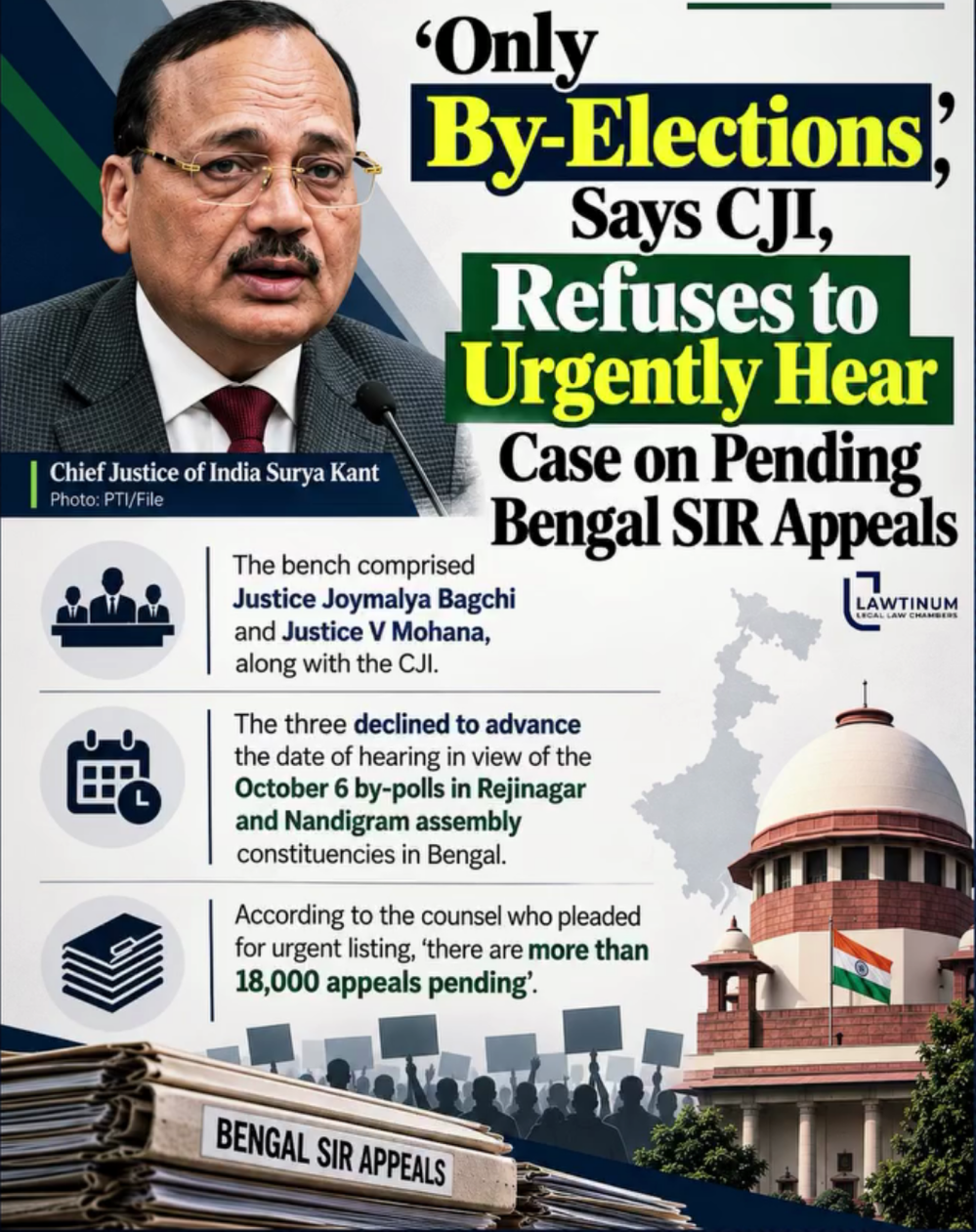
The Commission calls this the "removal of dead," "duplicate," and "ineligible entries," yet in West Bengal only one in 50 of some 38 lakh appeals against exclusion had been decided by August, and in more than nine in ten decided cases the voter was restored.
The Indian Express has reported that the other two commissioners, Sukhbir Singh Sandhu and Dr Vivek Joshi, recorded at least 14 objections over ten months to decisions Kumar took alone, including centralising the roll database, altering Form-6, and appealing against voters whom tribunals had already restored.
The law requires the Commission to decide by majority, and on Monday this week a bench led by Chief Justice Surya Kant said it could annul decisions that were neither unanimous nor by majority, though it declined to suspend Kumar.
Parliament should have been the place to argue this out, but from the Budget Session onwards the government was in no mood to discuss anything. On February 3, the Speaker suspended eight opposition members for the rest of the session. On February 5, the Motion of Thanks was adopted by voice vote without the Prime Minister's reply, for the first time since 2004, after Speaker Om Birla said he had asked Modi to stay away for fear that Congress members might approach his seat.
A resolution moved by some 118 opposition members to remove the Speaker, accusing him of espousing the ruling party's version on every contested matter, was defeated by voice vote on March 11. On April 6, Birla and Rajya Sabha Chairman CP Radhakrishnan refused, without reason, to admit notices signed by 193 members of both Houses to remove the Chief Election Commissioner, so that no committee of judges and a jurist ever examined the charges. The Lok Sabha has had no Deputy Speaker since 2019, although Article 93 requires one.
Similarly, the Tenth Schedule, written to prevent defections, has become a means of managing them, as was seen when 20 Trinamool Congress members broke away to a little-known party that now supports the ruling alliance.
Petitions for their disqualification were filed on June 19, the Speaker issued notices only on August 5, and on September 23 the Supreme Court called the delay a red flag while declining to fix a deadline.
The Supreme Court remains the institution citizens turn to when others fail. Chief Justice Kant said last month that the Judiciary cannot seek public confidence by placing itself beyond scrutiny, and that trust is earned when those who lose still believe the process was fair.
The Court's own record puts those words to a severe test. In May this year it upheld the revision in Bihar after the exercise had already spread far beyond that state, and in November 2025 a Constitution Bench answering a presidential reference held that courts could not fix time limits for Governors sitting on state Bills, which in practice hands the Union a veto over state legislation.
Citizens also notice a former Chief Justice accepting nomination to the Rajya Sabha after a favourable judgement, and another receiving the Prime Minister at a private religious ceremony in his home.
At the centre of this arrangement sits Modi, who has made a virtue of answering to no one, presiding over what a law scholar has called the killing of a constitution by a thousand cuts.
He has not taken questions at an open press conference in India in twelve years of office; the Enforcement Directorate pursues opposition politicians with an energy that tends to subside when they change sides, and when the Supreme Court rules against the Executive, the government legislates around the judgment, as it did over the Election Commission and over control of Delhi's services.
The voters denied the BJP a majority of its own in 2024, yet defections have since swollen the ruling alliance, and the government behaves as though the arithmetic had never changed.
Muslims and Christians watch anti-conversion laws spread through BJP-governed states and places of worship become the subject of litigation and demolition; Bengali-speaking Muslims have been pushed across the border; and the National Human Rights Commission has had its international accreditation deferred over concerns about political interference.
Dalits, Adivasis and migrant workers, least able to produce the documents the revision demands, fear they will be the first to vanish from the rolls, and international indices such as V-Dem now classify India as an electoral autocracy.
Into this vacuum, Rahul has stepped with a conviction his critics did not expect. The man long caricatured as a reluctant dynast walked some four thousand kilometres from Kanyakumari to Kashmir in 2022 and 2023, crossed the country again from Manipur to Mumbai in 2024, and took his oath in the eighteenth Lok Sabha holding a copy of the Constitution.
As Leader of the Opposition, he has made the integrity of the rolls, the independence of the Commission, and the rights of Dalits, Adivasis, and minorities the centre of his campaign, carrying it from the floor of the House, where he is so often interrupted, to the barricades on Parliament Street.
The BJP says he is Indira Gandhi's grandson, and the irony is real, but he has said plainly that the Emergency was a mistake, and that a leader who now demands the restoration of the safeguards his grandmother suspended is making the argument the country most needs to hear.
Whether he can turn the crowds into a coalition capable of governing, and whether his allies will accept his leadership, are questions only the coming years will answer.
Restoring the balance will be harder than it was in 1977, because the Emergency's damage was done by proclamation and could be undone by repeal, while the present damage has been done within the forms of law, through the use of constitutional powers to defeat the purposes for which they were granted.
 Adv. Rev. Dr George Thekkekara
.jpg)
 A. J. Philip
 John Dayal
.jpg)
.png) Jacob Peenikaparambil
Jacob Peenikaparambil
.jpg)
 P. A. Chacko
.png)
.png) Robert Clements
Robert Clements
.png) Cedric Prakash
Cedric Prakash