

.png) Jacob Peenikaparambil
Jacob Peenikaparambil
.jpg)
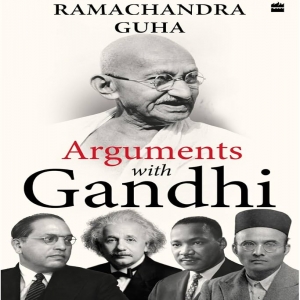
In a recent interview with journalist Karan Thapar for The Wire, historian Ramachandra Guha, speaking about his newly launched book Arguments with Gandhi, said that Mahatma Gandhi is becoming relevant to India once again through the Gen Z movement. Guha pointed out that recent youth-led mass movements in contemporary India have unexpectedly mirrored the classic Gandhian approach to non-violent protest. Gen Z has adopted the tools of non-violent resistance (satyagraha), organising peaceful sit-ins and fasts and, in some instances, absorbing state repression without responding with physical retaliation.
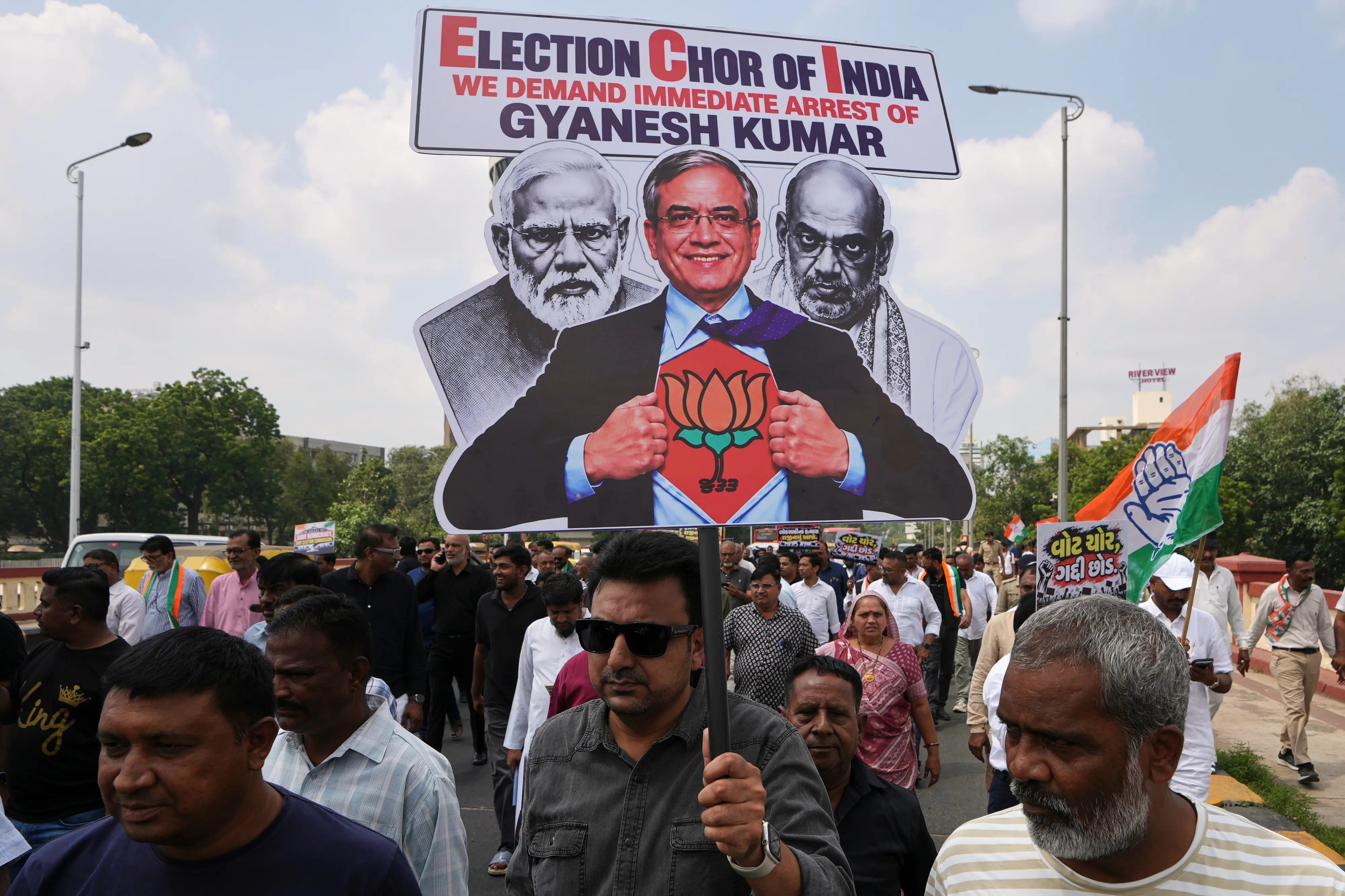
Some political parties have attempted to portray Gandhi and Ambedkar as being opposed to each other. Gen Z, however, seems to recognise that the two leaders' approaches complement each other. During the agitation against Chief Election Commissioner Gyanesh Kumar in Mumbai on October 2, CJP founder Abhijit Dipke made a fascinating and thought-provoking statement. In a video post, he described Mahatma Gandhi as the SOUL of India, BR Ambedkar as the BACKBONE of India, and Jawaharlal Nehru as the MIND of India. "You can never become like them," he told Narendra Modi.
Ramachandra Guha expressed a similar view while speaking at The Indian Express's Idea Exchange. India does not need a modern-day Gandhi, Guha said; rather, it needs a synthesis of the ideas and values of Gandhi, Ambedkar, Nehru, Rabindranath Tagore and Kamaladevi Chattopadhyay.
The RSS-BJP combine has made sustained efforts to diminish the place of Mahatma Gandhi, the Father of the Nation, and Jawaharlal Nehru, one of the principal architects of post-independence India, in public memory. They have also tried to elevate Hindutva ideologues such as VD Savarkar, Shyama Prasad Mukherjee, and Deendayal Upadhyaya. Some Hindutva extremists have even gone to the extent of glorifying Nathuram Godse, the assassin of Mahatma Gandhi.
Some textbooks have also reduced or removed references to Gandhi and Nehru, raising concerns that the younger generation may become disconnected from two major figures of the freedom struggle who played important roles in shaping modern India. Examples include changes to Class 12 textbooks concerning Gandhi's assassination by Nathuram Godse, his efforts to promote Hindu-Muslim unity, the hostility he faced from Hindu extremists, and the subsequent temporary ban imposed on the Rashtriya Swayamsevak Sangh (RSS).
When political parties, including the Congress, failed to effectively resist attempts to make Gandhi and Nehru less relevant in public discourse, young people associated with movements such as CJP have sought to bring Gandhi back into the contemporary socio-political landscape. While opposition parties have often struggled to hold the government accountable, youth-led movements inspired by Gandhian methods have demonstrated the power of peaceful collective action and public mobilisation.
Generation Z's efforts to improve the quality of government schools and to challenge government apathy toward basic services, especially for the most neglected sections of society, also seem in tune with Gandhi's priorities. Gandhi consistently placed the welfare of the poor and the marginalised at the centre of his social and political vision.
If Gandhi is to be reimagined for the present generation, however, Gen Z will need to go beyond what it has already begun. Its intervention is needed in confronting online violence, reducing the widening gap between the rich and the poor, challenging the exclusion of disadvantaged sections of society, and addressing the consumerism that contributes to inequality and environmental destruction.
Violence today is not confined to physical attacks. It also appears in abusive comments, trolling, cyberbullying, communal hatred, misogynistic language, political intimidation and deliberate misinformation. Social media often rewards outrage rather than reflection. A person can damage another person's dignity with a few words typed behind a screen.
Gandhi's concept of ahimsa challenges this culture of aggression. For Gandhi, non-violence did not mean remaining silent in the face of injustice. It meant resisting injustice without hatred or physical violence. Gandhi showed that people can oppose injustice firmly without dehumanising the opponent.
For Gen Z, therefore, Gandhian non-violence could mean refusing to participate in online hatred, verifying information before forwarding it, disagreeing without abusing others, defending vulnerable people and responding to provocation with dignity.
For Gandhi, the spinning wheel was more than a tool for producing cloth. It represented self-reliance, dignity of labour, economic justice and resistance to an exploitative economic system. These principles can be expressed through contemporary technology.
Gen Z can transform Gandhi's idea of swadeshi into responsible consumption, support for local entrepreneurs, ethical business practices and sustainable production. In a world dominated by global brands and aggressive advertising, choosing what to buy—and what not to buy—can become a moral decision.
The smartphone, too, can become a modern charkha. Gandhi used simple means of communication to mobilise millions. Gen Z can use Instagram, YouTube, podcasts, WhatsApp and other digital platforms to mobilise people for social causes. A short video exposing an injustice, an environmental protection campaign, or a digital movement against hate can reach millions within hours. The technology is new; the purpose can remain Gandhian.
Gandhi described his life as an experiment with truth. This idea is especially relevant in an age of artificial intelligence, deepfakes, manipulated videos, and misinformation. Millions of messages circulate every day, but information alone does not automatically produce wisdom. False information can influence elections, provoke communal tensions and destroy reputations.
A Gandhian approach would require young people to become seekers of truth rather than passive consumers of information. Before forwarding a sensational message, they can ask: Is it true? Who produced it? What evidence supports it? Who benefits if I believe it? Truth in the digital age requires digital responsibility.
Another area Gen Z needs to focus on, if it is to reinvent Gandhi, is protecting the earth from the devastating effects of climate change. Gandhi's observation that the earth has enough for everyone's need but not for everyone's greed has acquired new significance in the age of climate change. Extreme weather, pollution, water scarcity, biodiversity loss and ecological destruction are no longer distant possibilities. They are present realities.
Gandhi's simple lifestyle, criticism of excessive consumption and emphasis on harmony with nature can provide an ethical framework for today's environmental movement. Gen Z can reinterpret simplicity not as poverty but as conscious living. Sustainable fashion, reduced waste, public transport, renewable energy, responsible food choices, and protecting natural resources can become contemporary ex
Another area Gen Z needs to focus on is the exclusion of large sections of people from the vision of Viksit Bharat. Gandhi's idea of sarvodaya—the welfare and uplift of all—can be reinvented as a commitment to inclusion. Development cannot be measured only by economic growth. It must also be measured by whether the weakest and most marginalised have dignity, opportunity and a voice in society.
The reinvented Gandhi may appear as a young environmental activist protecting a forest; a student refusing to spread communal hatred; a content creator challenging misinformation; an entrepreneur creating employment ethically; a young woman fighting gender discrimination; a volunteer working among marginalised communities; or an ordinary citizen choosing dialogue over hatred.
Gandhi may not return as a single extraordinary leader. He may return through millions of young people who practise truth, non-violence, simplicity, justice, compassion and service in their everyday lives. If Gen Z can translate these Gandhian values into the language of the digital age, Gandhi will not merely remain a figure in history. He will be reinvented as a living force for building a more just, peaceful, inclusive and sustainable India.

 Adv. Rev. Dr George Thekkekara
.jpg)
 A. J. Philip
.jpg)
.png) John Dayal
Jacob Peenikaparambil
John Dayal
Jacob Peenikaparambil

.jpg)
 P. A. Chacko
.png)
.png) Robert Clements
Robert Clements

.png) Cedric Prakash
Cedric Prakash