

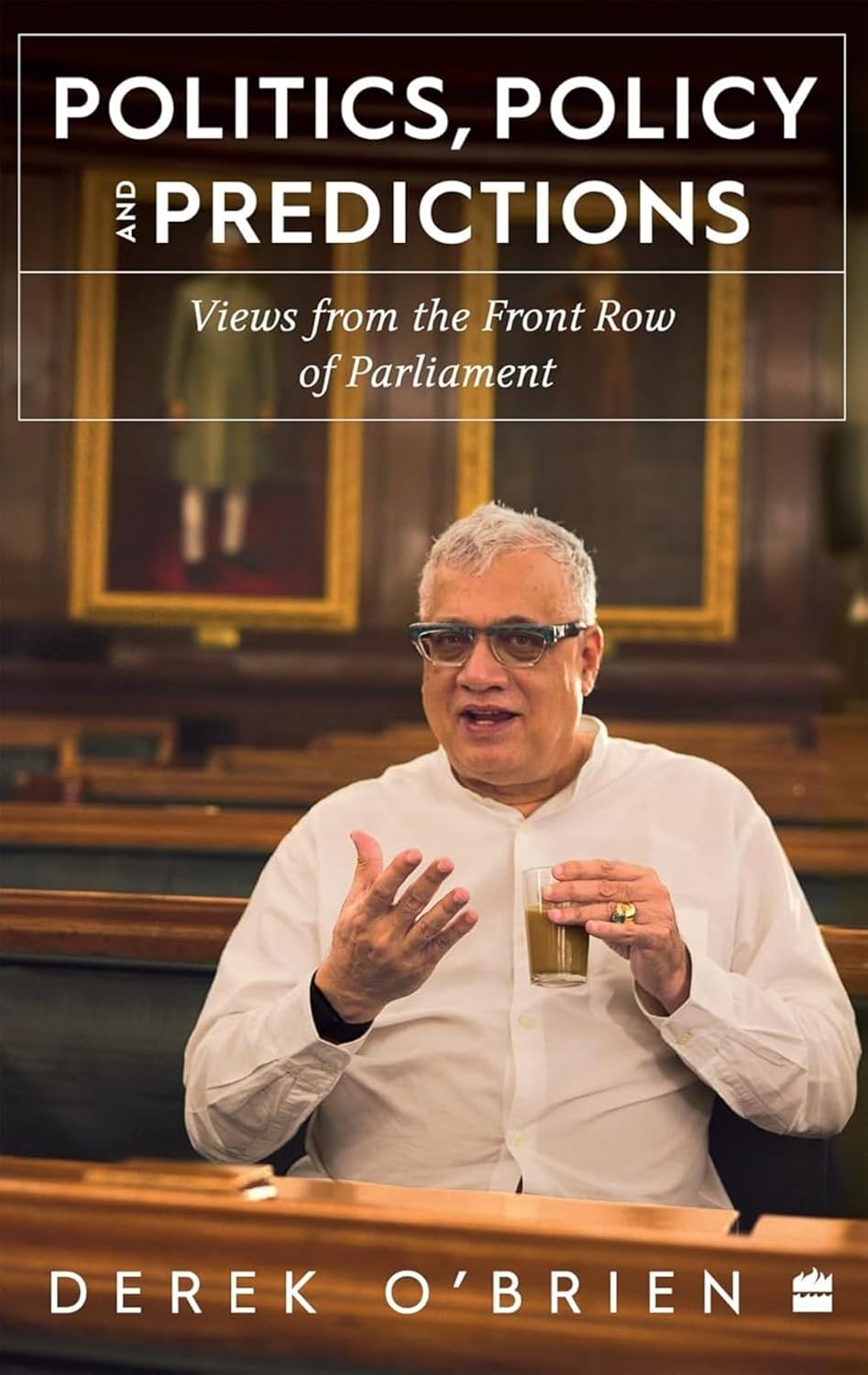
The book "Politics, Policy and Predictions: Views from the Front Row of Parliament" by Derek O'Brien, Rajya Sabha MP and leader of the All India Trinamool Congress Parliamentary Party, throws light on issues plaguing governance in the country. Arranged in 68 succinct chapters across six sections, the book takes readers into vital areas of governance where the rot has set in, largely because of rulers' lack of empathy and indifference to people's lives.
The book lays bare how the government sells dreams and makes promises to ordinary people to garner votes and cling to power. He cites several examples to substantiate his argument. There was the promise of affordable air travel, encapsulated in the assertion that even "people in chappals" would be able to travel by air; instead, air travel has become increasingly unaffordable. The promise included doubling farmers' incomes by 2022, but it has not happened even now; in fact, their hardships have increased amid declining incomes and rising production costs. The lives and livelihoods of tribals and forest dwellers have been adversely affected, with more than 1,000 projects reportedly receiving forest clearance during 2022–24, many of them benefiting corporate interests. The government had also promised to create one crore jobs per year, but unemployment has continued to skyrocket.
The empty promises did not end there. There was the assurance that black money stashed abroad would be brought back, but the opposite happened – more people fled, taking people's money out. The government provided LPG connections to millions of women under the Ujjwala scheme, but repeated increases in cooking gas prices made refilling cylinders increasingly difficult for many beneficiaries. Almost every promise comes wrapped in one slogan: "Modi's guarantee." But with a long list of promises left unfulfilled, those guarantees have lost credibility.
The author's observation that "India is failing its youth" seems almost prophetic in light of Gen Z protests, which in recent months have taken to the streets in several cities, reflecting growing discontent among young people.
Several chapters are devoted to explaining what Mr O'Brien sees as the ills afflicting Indian federalism: the overbearing and expansive powers exercised by Governors; the Centre's intrusion into the financial powers of the States; and the proposed move towards One Nation, One Election. These are among the many issues he examines in his critique of how the federal system functions.
The author targets the Modi government's increasing reliance on cess, which the Centre collects and which is not part of the divisible pool shared with the States. He argues that this has enabled the Centre to reduce, in effect, the States' share of the divisible pool of Central taxes. He sees a similar tactic in replacing the colonial-era sedition provision in the Bharatiya Nyaya Sanhita with a new, vaguely defined offence; although the word "sedition" has disappeared from the statute, a provision with similar potential implications has returned in a different form.
Mr O'Brien exposes the undemocratic 'short-cuts' the government resorted to in enacting laws. Some bills, allotted several hours for discussion, were passed in a few minutes. The government's policy seems to be 'legislate first, discuss later,' and he calls it 'cowboy legislation.'
A number of 'undemocratic' methods have undermined Parliament's functioning. He points to the inclusion of non-Money Bill provisions in Finance Bills, thereby bypassing parliamentary scrutiny of important measures; the expunging of portions of Opposition MPs' speeches from the records of the House; the failure to provide proper data sought by MPs; the delayed circulation of the list of business; and the passage of Bills without adequate scrutiny or reference to parliamentary committees. He points out that the proportion of Bills referred to committees has fallen sharply: "From seven out of ten bills being sent for scrutiny to committees, now only about two out of ten bills are subjected to the same treatment."
Facts and figures are aplenty to disprove several claims about the implementation of various government programmes flagged as flagship schemes. To cite one example of incredulous corruption, he refers to the 7.5 lakh beneficiaries of the Ayushman Bharat who were linked with a single cellphone number – 9999999999, yes, you read it correctly. The same applies to Beti Bachao Beti Padhao, PM Poshan, Jan Dhan Yojana and Accident Insurance, Minority scholarships, and many more.
The author does not mince words about what he sees as the Modi government's lip service to women's empowerment. Written before the political controversy in Parliament in April this year over linking women's reservation with the proposed Delimitation Bill, 2026, the book discusses the passage of the Women's Reservation Bill in the special session of Parliament in September 2023 and questions the government's commitment to implementing it, pointing out that the reservation could take effect only around 2034. He cites statistics to highlight the inadequate representation of women in public life.
The government's failure to uphold women's dignity and rights is exposed through many examples: the alleged sexual harassment of women wrestlers and what he sees as the government's failure to do justice to them; the apathy towards ASHA workers; the horrific stripping and parading of women in Manipur and the delayed response of the State and Central governments to the violence; and cuts in MGNREGA funding, a scheme that provides an important source of income for women workers. And the list goes on.
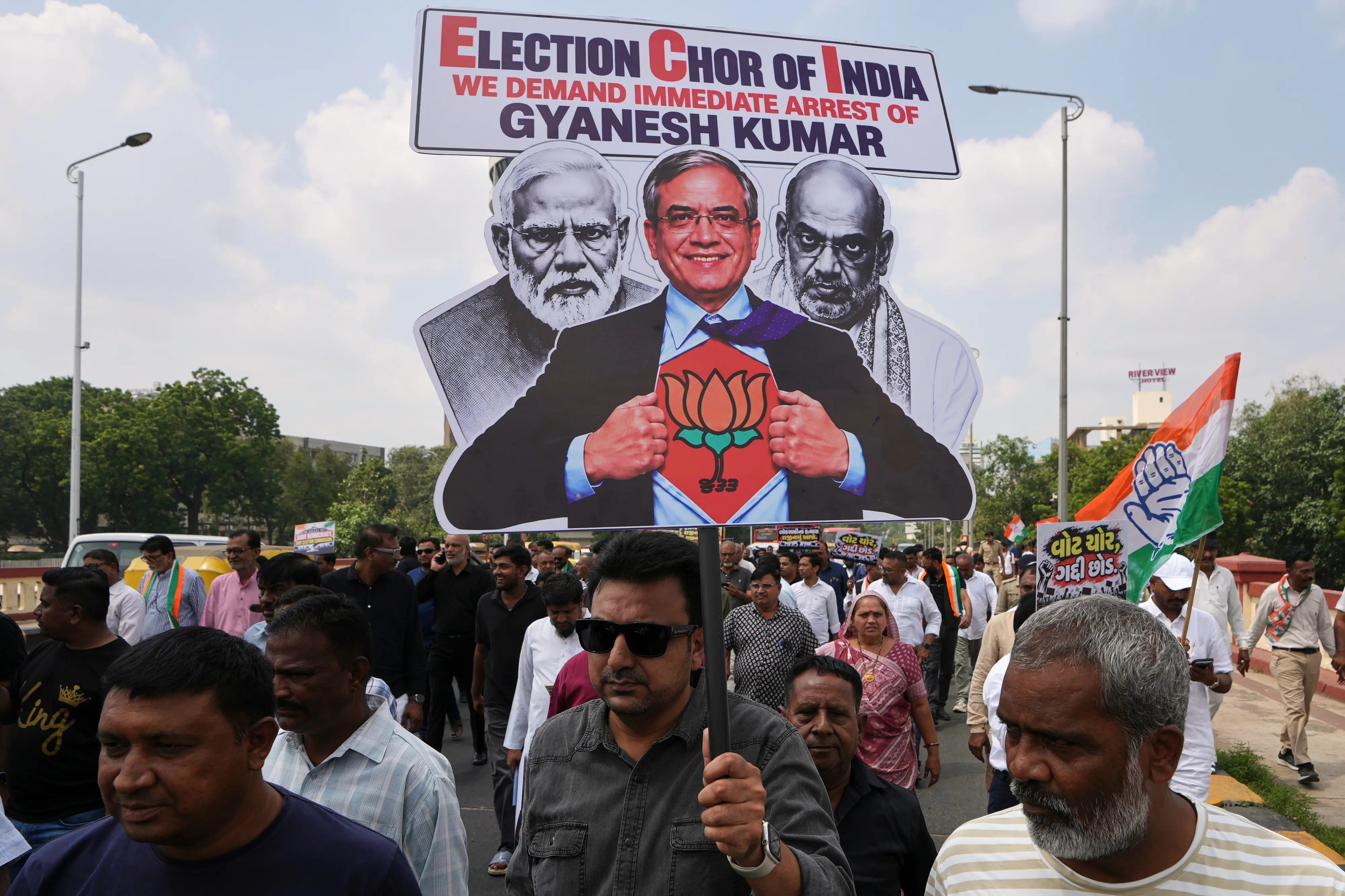
The chapter on the Election Commission and the questions posed to the "neutral" umpire is particularly timely amid the ongoing protests and debate over "vote chori" allegations involving the Chief Election Commissioner. The author questions the changes in the selection process, arguing that they favour government nominees for the posts of Chief Election Commissioner and Election Commissioners. He concludes: "The ECI, by acting as an agent of the central government, is undermining its own legitimacy and the foundation of Indian democracy."
In one of the chapters, Mr O'Brien urges the Church leadership to speak up against the injustices against the Christian community. He takes umbrage at the declaration of Christmas Day as Good Governance Day; the use of the FCRA against the Church and its institutions; anti-conversion laws; and increasing attacks on Christians and hate speech by Sangh Parivar leaders. He warns that silence from Church leaders could amount to complicity in such actions.
At the end of the book, there are excerpts from the speeches of Rahul Gandhi, leader of the Opposition in the Lok Sabha; Abhishek Banerjee, leader of the Trinamool Congress in the Lok Sabha; Mallikarjun Kharge, leader of the Opposition in the Rajya Sabha; Akhilesh Yadav, the Samajwadi Party leader in the Lok Sabha; and Supriya Sule, the Nationalist Congress Party leader in the Lok Sabha.
The 300-plus-page book has been published by HarperCollins.
Publisher: HarperCollins Publishers India
Publication date: April 5, 2026
Language: English
Print length: 304 pages
ISBN-13: 978-9365691108

 Adv. Rev. Dr George Thekkekara
.jpg)
 A. J. Philip
.jpg)
.png) John Dayal
John Dayal
.jpg)
.png) Jacob Peenikaparambil
Jacob Peenikaparambil

.jpg)
 P. A. Chacko
.png)
.png) Robert Clements
Robert Clements
.png) Cedric Prakash
Cedric Prakash