

The unfolding scandal over India's electoral machinery is disturbing not because of any single act by the Election Commission of India (EC), but because of a chain of connected developments and the Commission's cumulative actions — made worse by its own admissions. Taken together, these developments demand full accountability across the spectrum, change and reversal of all decisions regarding the SIR.
The chain of events took a particularly disturbing turn in 2023, when Parliament replaced the Chief Justice of India on the committee the Supreme Court had provisionally prescribed for appointments with a Union Cabinet Minister nominated by the Prime Minister, while also granting the three Election Commissioners immunity from prosecution for acts done in official duty.
Both these changes face legal challenge on constitutional grounds. Not even the President of India enjoys such immunity. Extending it to the Election Commissioners raises the question of whether Parliament anticipated wrongdoing by those it was protecting.
Soon after, in the 2024 Lok Sabha election, the BJP fell short of a majority and became dependent on allies. The Special Intensive Revision (SIR) appeared without public or parliamentary discussion, ostensibly to remove aliens. The stated objective was to exclude those ineligible to vote and include those entitled to vote. But when an entire electorate is subjected to such a revision, the manner, timing, legal basis, technology and safeguards against wrongful deletion become critical.
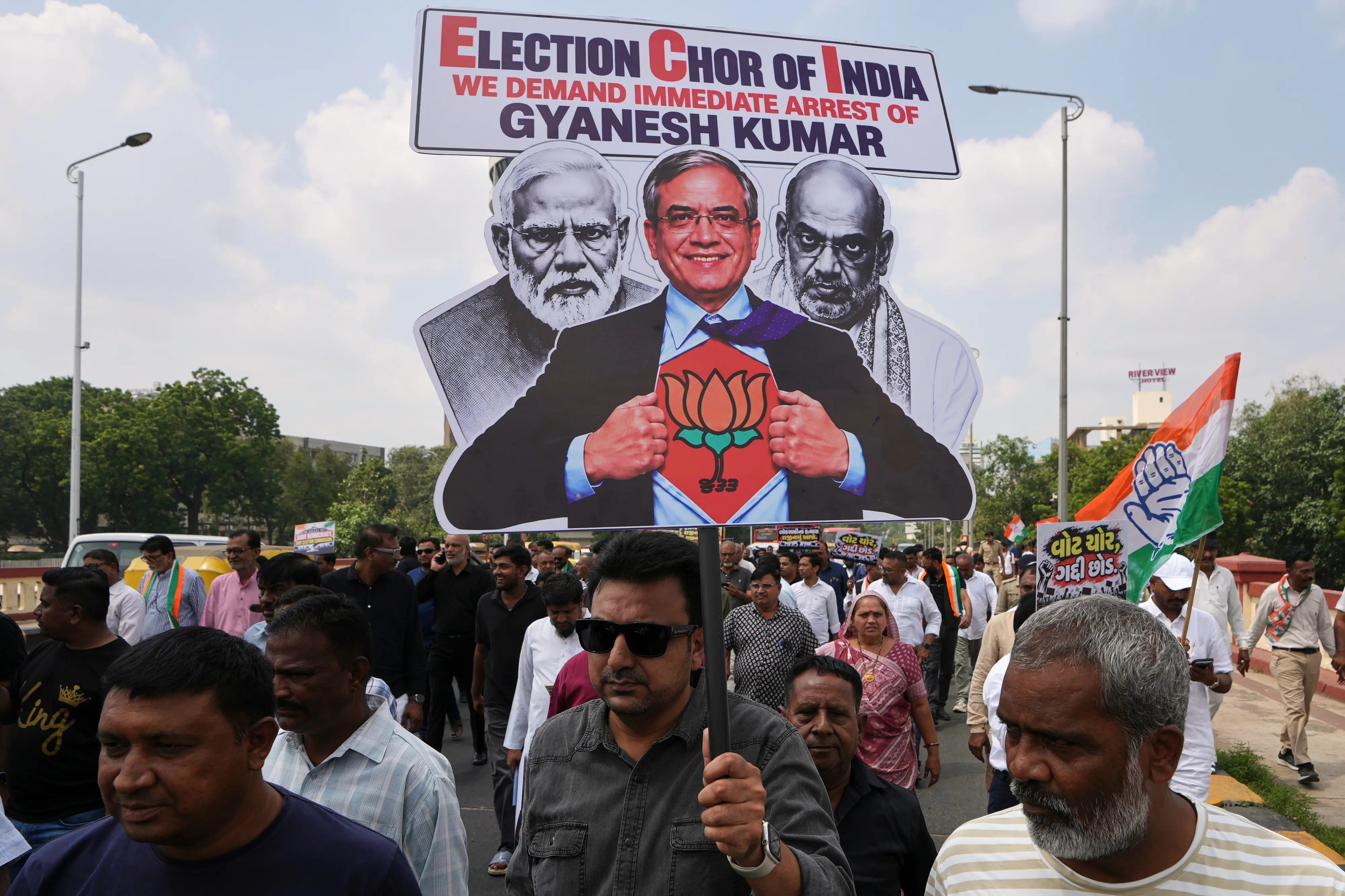
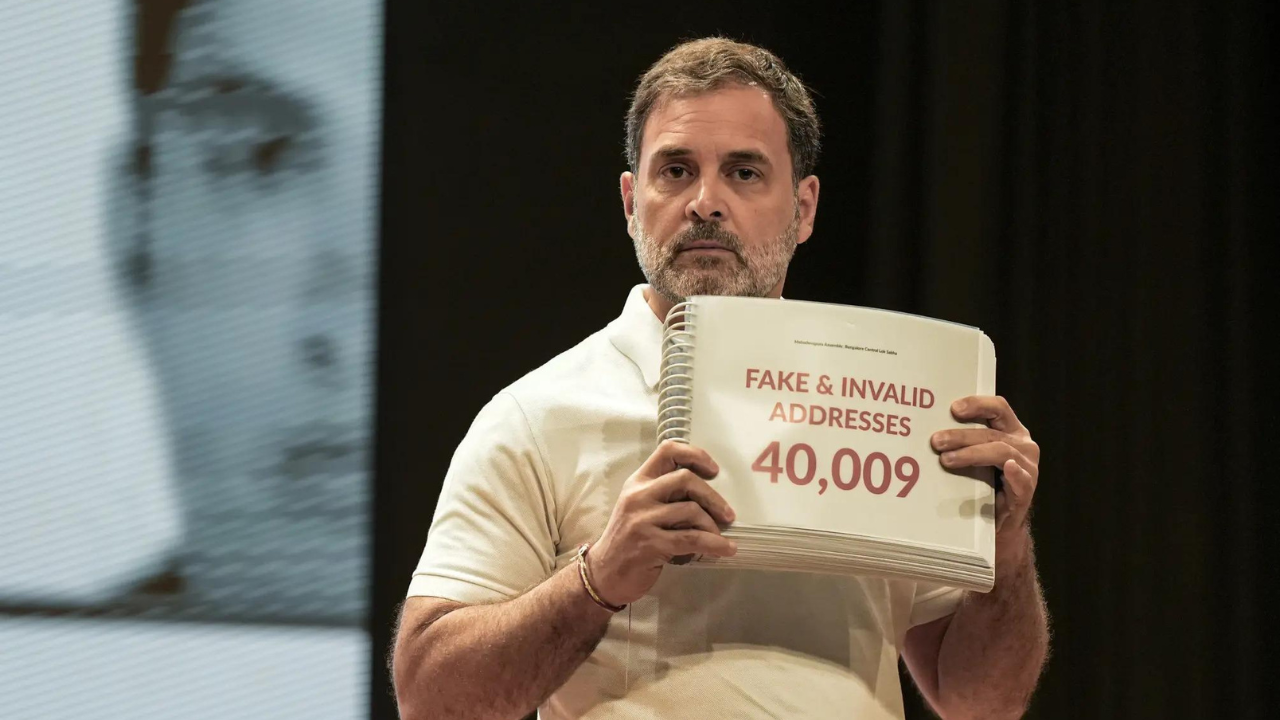
Maharashtra has already produced an extraordinary development, with Rahul Gandhi alleging that roughly 30 lakh voters were added to the rolls after the BJP's poor Lok Sabha showing in the state and its near-landslide Assembly win; similar questions arose in Madhepura and Haryana. In Bihar, the SIR initially excluded roughly 65 lakh electors from the draft roll for not submitting the Enumeration Form. In West Bengal, around 60 lakh electors were flagged for "logical discrepancies," and about 27 lakh were deleted, prompting the Supreme Court to direct that tribunals headed by retired High Court judges hear deletion appeals. The scale of the exclusions was extraordinary.
The most disturbing disclosures came from file notings by two Commissioners, documenting serious disagreements over how the electoral machinery was being run.
Election Commissioners Sukhbir Singh Sandhu and Vivek Joshi formally objected at least 14 times since October 28, 2025, to decisions on voter registration, deletion, restoration, appeals and control of the electoral database — sometimes noting decisions taken without their knowledge and at other times questioning their legal authority, with their objections copied to CEC Gyanesh Kumar.
Their objections matter because the CEC has no superior vote over the other Commissioners; the three have an equal say in the Commission's decision-making. The issue is no longer whether individual decisions were right or wrong. It is whether the constitutional body authorised to make decisions affecting the electoral rolls did so through a process that complied with the law.
This issue becomes particularly stark in the case of Form-6, required for inclusion on the roll. A new clause obliged first-time applicants to establish that a parent or grandparent appeared on the 2003 roll. Though not formally mandatory, applicants could not proceed without answering it — turning a straightforward application into a herculean exercise in documentary reconstruction, especially for citizens unable to trace their forebears' registration.
Joshi recorded on May 16 that Form-6, a statutory form, could not be changed without amending the rules. It was changed anyway. Who authorised it? Sandhu called the change "unauthorised and illegal" and demanded its immediate withdrawal.
Joshi warned of the "gradual centralisation of the electoral roll database." Electoral Registration Officers (EROs) are the statutory authority at constituency level, yet they could no longer restore or delete voters.
The episode highlights something more disturbing: statutory authority existed on paper while centrally controlled software determined whether it could be exercised.
Equally troubling: 16.10 lakh appeals sought deletion of voters whom judicial officers had already included. Sandhu asked who had authorised and filed them.
The two Commissioners then wrote to Cabinet Secretary TV Somanathan, the country's senior-most civil servant, who reports directly to the Prime Minister — yet no intervention from him has been publicly evident.
The Commission first responded to the exposé with a press note, then, on September 26, made a striking U-turn: a review of ECINET, greater flexibility for field officers, advance circulation of agendas, issuance of minutes, and an assurance that Commissioners' directions would be meticulously complied with.
It also insisted that the June 24, 2025 SIR order had unanimous Commission approval, even though an RTI response cited by activist Anjali Bhardwaj showed no record of any such decision. Nor did the Commission answer who authorised the Form-6 change or the 16.10 lakh West Bengal appeals.
Corrective action cannot be confined to the future. The Commission promises a special enrolment drive for those left out — but what of those never restored, those whose lives were devastated, including several BLOs who reportedly left suicide notes blaming the rush and pressure of the SIR exercise, and, crucially, elections already held on rolls produced through a process now under serious question?
Centralisation raises the stakes further: past elections have seen turnout jump sharply after voting closed, sometimes a day or two later. This does not by itself prove manipulation, but if the electoral database was centrally controlled in ways that could override statutory officers, all aspects of ECINET demand forensic scrutiny.
Who authorised the nationwide SIR remains unresolved. An RTI query revealed that the Commission took no decision to launch a nationwide SIR in 2025 and held no files, studies, or analysis behind the "independent appraisal" cited to the Supreme Court as its basis. That question cannot be settled by the very institution accused of centralising control.
Senior Supreme Court lawyer Balraj Singh Malik has called it a conspiracy involving the Commission, the Court and the government; MP Sanjay Raut has accused Amit Shah directly of orchestrating it. These are allegations, not established facts. Yet the evidence now emerging from within the Commission makes the unanswered questions harder to dismiss.
The timing of the notings and the letter is suspicious and self-indicting. The Commissioners' first noting specific to voter addition and deletion was on May 16, 2026, while their letter to the Cabinet Secretary was sent only on July 29, 2026. This was well after the SIR and Assembly elections in Bihar and West Bengal had been completed. Why was the matter escalated so late? Why didn't the two Commissioners take a majority decision and overrule Gyanesh Kumar's decisions?
Senior Supreme Court advocate and MP Kapil Sibal and psephologist and activist Yogendra Yadav, citing the U-turn press note, told 4 PM News and the Ajit Anjum News channel respectively that they believe the display of unity by the three Commissioners on September 26 and the ensuing press note could have been issued under instructions from outside the Commission.
The issue, then, is no longer whether voters were wrongly deleted, Form 6 improperly altered, or the Commission dysfunctional. It is whether those entrusted with the electoral rolls were making decisions in accordance with the constitutional and statutory framework.
The Election Commission's September 26 press note, by announcing corrective measures while leaving the central questions of authority unanswered, is tantamount to an admission of serious wrongdoing while seeking absolution. That leaves the Supreme Court's role, and the Commission's, open to scrutiny for their omissions.
The Court's position that it cannot interfere with the Commission's internal functioning in relation to SIR merely because the EC is a "constitutional institution" is untenable. Constitutional independence cannot mean constitutional immunity. The Supreme Court is itself constitutionally empowered and, in the interests of democracy, required to scrutinise whether those powers are being exercised within the law and whether constitutional guarantees are being protected.
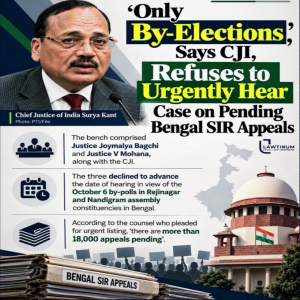
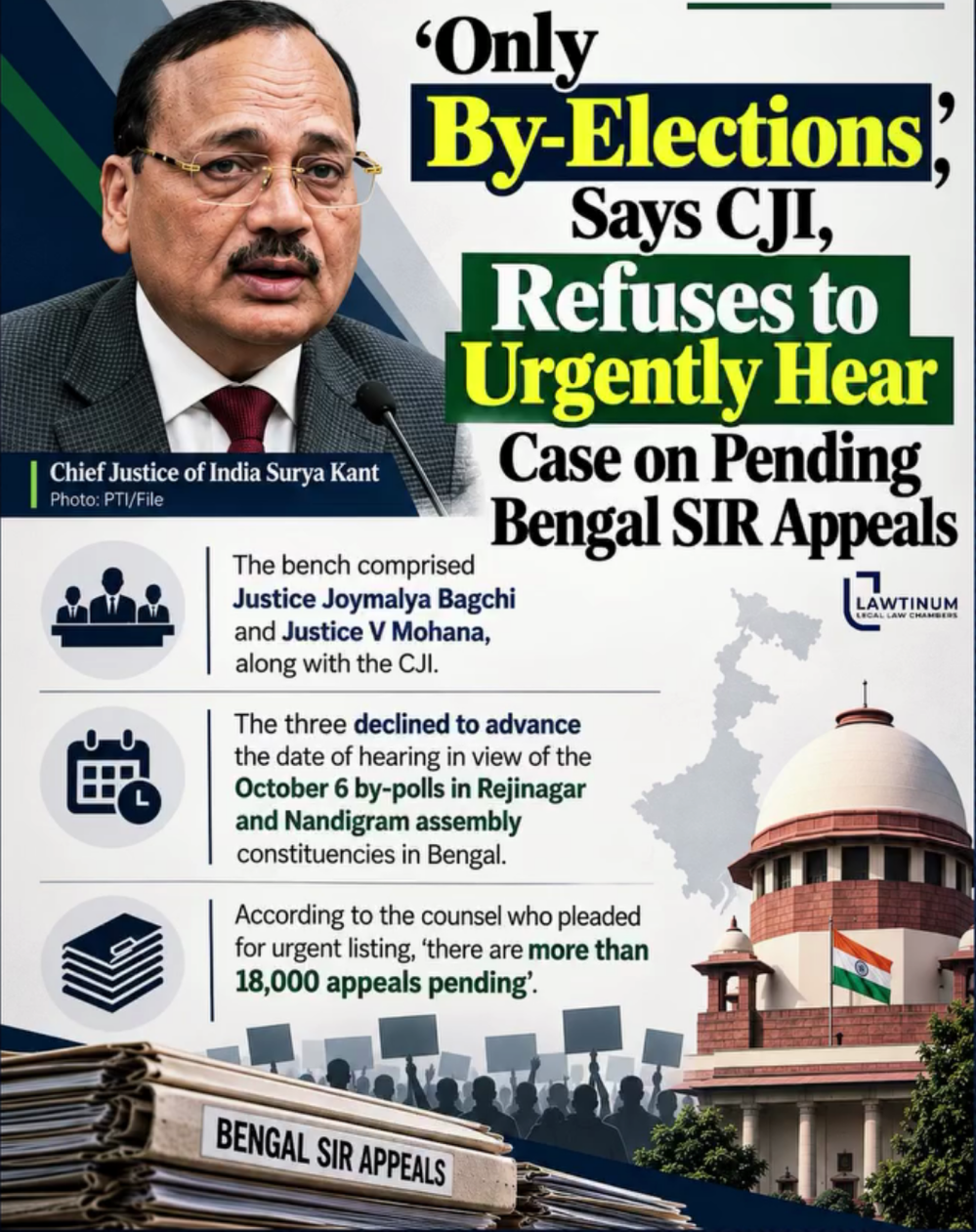
When millions faced exclusion, judicial scrutiny had to extend to the larger question of electoral integrity. A court's observation that an excluded voter can simply "vote next time" adds insult to injury when elections have already been held on the disputed rolls. Nor can the CJI Surya Kant-led Bench's observation that "these are only by-elections, that's all" be ignored when it declined to urgently hear a case concerning pending electoral-roll deletion appeals ahead of the October 6 bypolls in West Bengal.
The proposed review therefore cannot be an internal or narrow exercise that excludes other institutions, including the Supreme Court. An institution cannot credibly investigate or review its own conduct when its own Commissioners are among those who have raised the allegations. The review must therefore examine not only the Commission's conduct, but also who exercised authority, how that authority was exercised, the role of other institutions, and whether outside interference occurred.
The review cannot be confined to future electoral rolls. If the SIR was conducted without lawful authority, through a compromised process, on a database whose integrity cannot be established, or under external influence, the SIR must be scrapped, and the rolls produced through it restored or reconstructed through a lawful, independently supervised process.
The same inquiry inevitably extends to elections conducted after the SIR began. The Commission's own September 26 statement, by acknowledging the need to review ECINET, ensure its legal compliance and restore greater discretion to statutory field officers, raises a fundamental question about the reliability of rolls produced or altered through that system. The validity of elections conducted on those rolls cannot simply be presumed.
The larger issue, therefore, is not merely about correcting the rolls for the next election or doing away with the present Commission. It concerns the chain of connected developments and the cumulative, unexplained, and unjustifiable actions of the Commission that have brought the electoral machinery to this point.
Collectively, all the factors pointing to widespread electoral fraud demand full accountability across the political, institutional, and judicial spectrum, and the change and reversal of all decisions regarding the SIR.
.png) Cedric Prakash
Cedric Prakash
.JPG)
 A. J. Philip
.png) Jacob Peenikaparambil
Jacob Peenikaparambil
.jpg)
.png) John Dayal
John Dayal
.jpg)
 Pachu Menon
.png)
.png)
.png) Robert Clements
Robert Clements