

 A. J. Philip
.JPG)
It is not the rich or the educated who have kept Indian democracy thriving. It is, more often than not, the poor. Let me begin with an anecdote.
This happened in the 1990s. I was then an editorial writer with a national daily. About a dozen of us had assembled for the editorial conference, where subjects were discussed and assigned to writers.
It was election day in Delhi. I asked a mischievous question: "How many of us have voted today?"
Nobody could lie. Anyone who had voted would have an indelible mark on the forefinger. Only two or three could show their fingers.
Think about it. All of us were educated. Given a chance, we could have written a thunderous editorial about declining voter turnout and the dangers it posed to democracy. Yet most of us had not bothered to vote.
The irony has stayed with me. In the 1970s, I was the BHEL correspondent of The Hitavada in Bhopal. BHEL had a sprawling township, and I covered several State and national elections there. I noticed something curious.
The lowest polling was usually recorded at the booth serving senior company officials, including the Executive Director and general managers. The highest polling was recorded at booths serving workers, people living in tenements and those in nearby slums. This was not peculiar to BHEL or Bhopal.
In Kerala, proudly described as India's most literate state, the pattern is much the same. On election day, the poor are often the first to queue outside polling stations. The rich and educated arrive leisurely, if they arrive at all.
There are many reasons. The poor have a greater stake in government. If a government school or hospital is bad, the consequences are immediate for them. The rich can send their children to private schools and go to private hospitals.
The affluent can live in gated colonies with private security, generators and elaborate water-purification systems. The poor have to depend on public services. The government, therefore, matters much more to the poor.
That may explain why the decision to give every adult citizen the right to vote was among the most revolutionary decisions taken when India became a Republic in 1950. The voting age, initially 21, was later reduced to 18.
There were sceptics. How, they asked, could an illiterate person be expected to exercise discretion in voting? The question ignored India's own electoral history.
Elections had existed in princely India, but the franchise was severely restricted. In Travancore, elections were held from 1922, but voting was largely limited to people who paid a specified amount of tax or were graduates. In effect, political power was concentrated among the educated and the relatively affluent.
Universal adult franchise changed all that. That is why I once questioned the decision to invite a plane-load of priests and religious heads from Tamil Nadu to the inauguration of the new Parliament building in Delhi. My objection was not to their religious identity. It was about democratic symbolism.
Would it not have been more appropriate to invite 100 elected panchayat and municipal representatives? They might not have arrived in silk robes. They might not have had impressive titles. But they were elected representatives of the people.
Since the first general election in 1951-52, electoral rolls have been revised repeatedly. Names of dead people have to be removed; new voters have to be added; people move, and addresses change.
There is nothing wrong with cleaning electoral rolls. In fact, accurate rolls are essential to free elections. But cleaning the rolls and making it difficult for legitimate voters to remain on them are two different things. That distinction has become particularly important in the controversy over the Special Intensive Revision, or SIR.
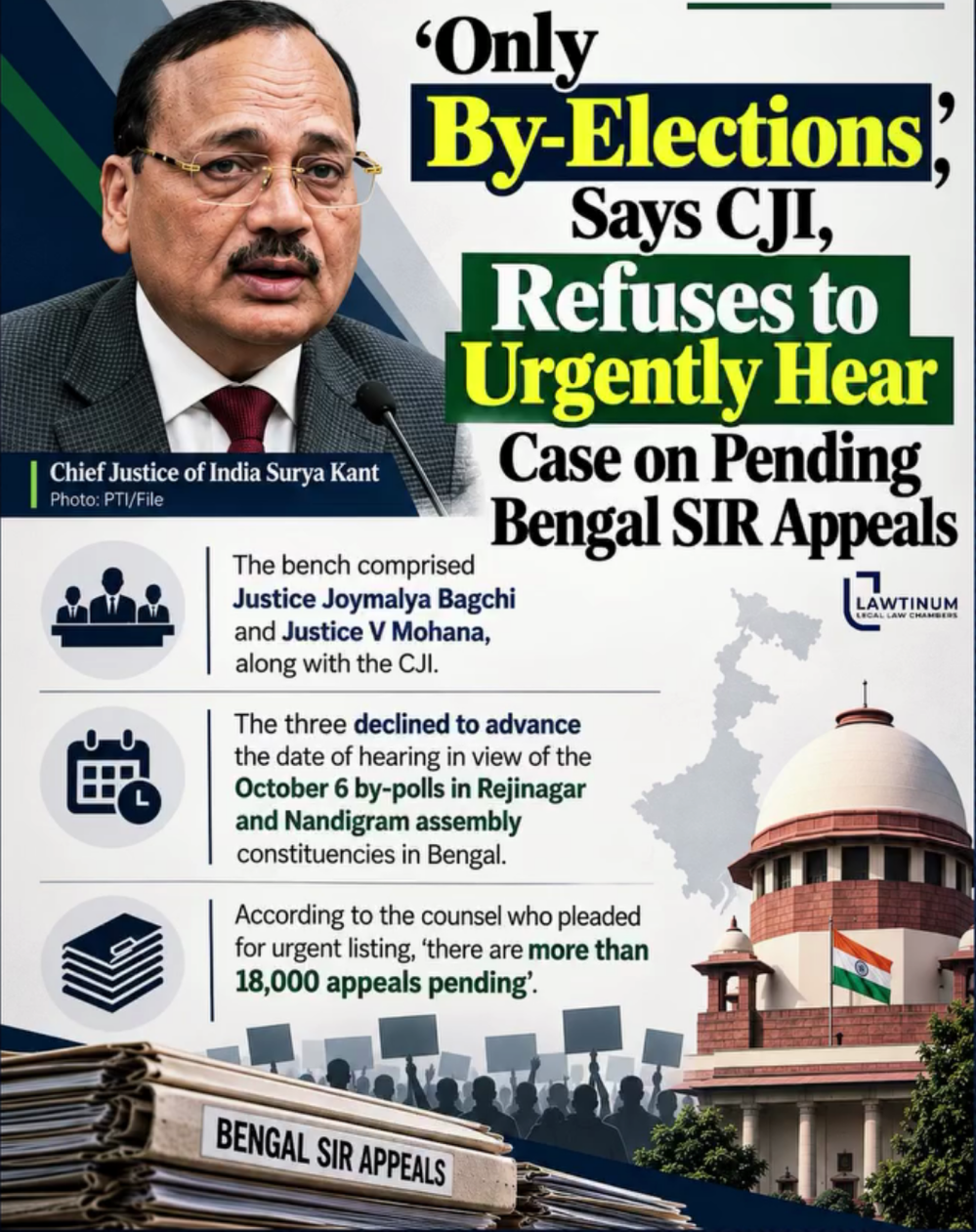
The Supreme Court's May 2026 judgment records that the Election Commission decided to use the 2003 electoral roll in Bihar as probative evidence of eligibility, with people absent from that roll required to produce prescribed documents.
The exercise has since spread widely. According to The Indian Express, more than 13 crore names had been deleted from draft rolls across 30 States and Union Territories by September 2026. Delhi's draft roll showed a 32.8 per cent reduction, and Maharashtra's a 21.1 per cent reduction.
The Election Commission says the exercise is intended to identify dead, duplicate, shifted and otherwise ineligible voters. It has also now launched special campaigns to help eligible people whose names were left out of the draft rolls get them restored.
That is welcome. But the scale itself raises a basic question: who bears the burden when the paperwork becomes complicated?
Not the millionaire. Not the retired bureaucrat with a cupboard full of documents. Not the person who can hire a lawyer or make a telephone call to somebody who knows somebody.
It is the migrant worker, the domestic worker, the tenant, the landless labourer, the elderly person and the family that has moved repeatedly in search of work.
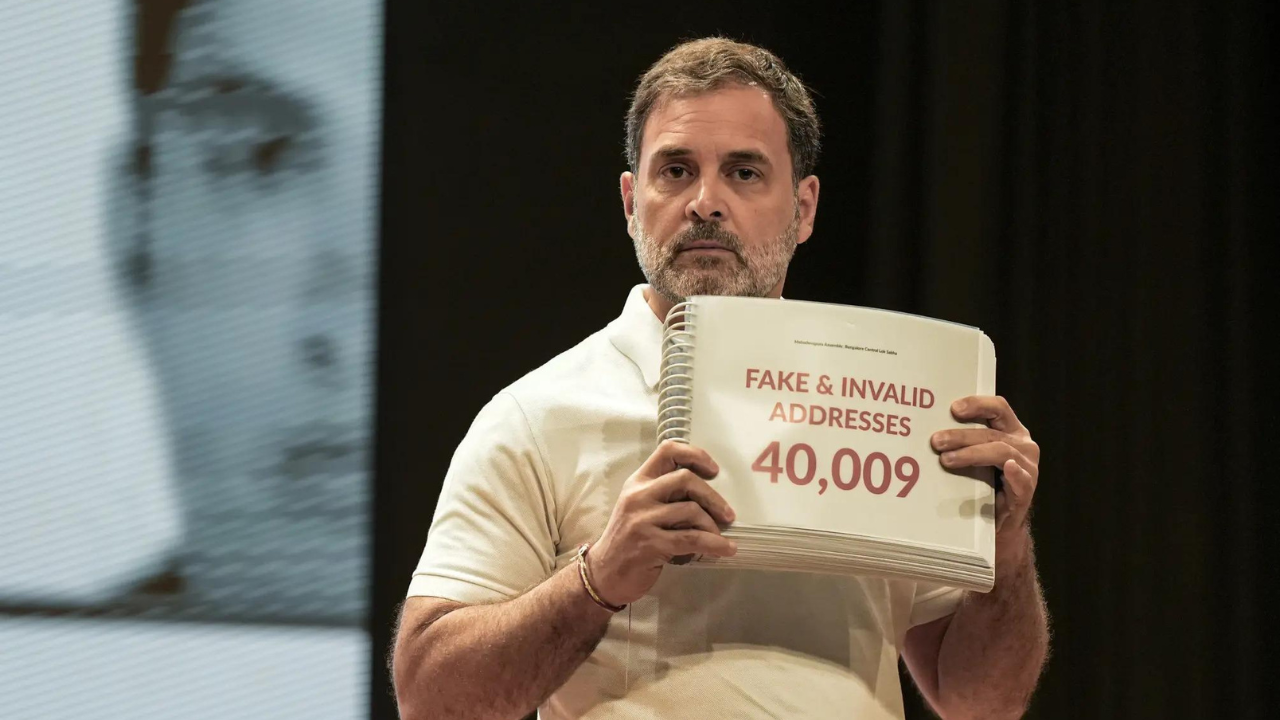
There have always been allegations about electoral rolls. Claims have been made that migration from Bangladesh influenced electoral outcomes, but allegations are not evidence. The same electoral system has produced victories for different political parties at different times.
The BJP's victory at the Centre in 2014 and its subsequent victories, including in Assam, demonstrate why sweeping claims about defective rolls require evidence rather than political assertion.
The more important issue is institutional. The 2023 law governing the appointment of the Chief Election Commissioner and other Election Commissioners replaced the earlier arrangement in which the Prime Minister, Leader of the Opposition and Chief Justice of India were to form the selection committee. Parliament replaced the Chief Justice with a Union Cabinet Minister nominated by the Prime Minister, giving the government two members on the three-member panel.
There is also the question of immunity. The 2023 law provides protection from civil and criminal proceedings for present and former Election Commissioners for acts done in the discharge of official duties.
Independence and accountability must coexist. An Election Commissioner should not be frightened of the government. But neither should the office become so insulated from scrutiny that voters cannot question how their constitutional right is administered.
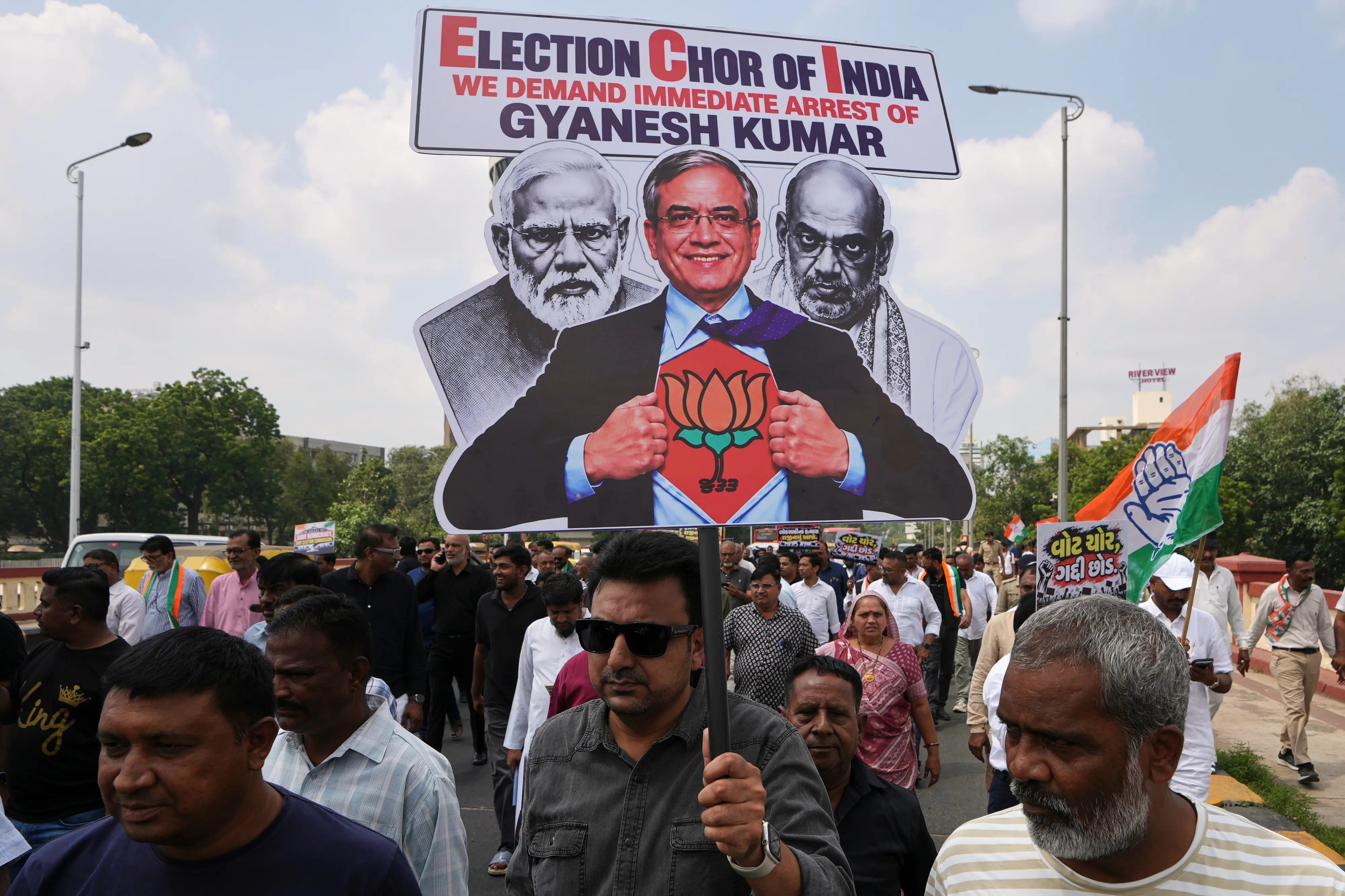
The controversy deepened after The Indian Express published an investigation by Ritika Chopra. It reported that Election Commissioners Sukhbir Singh Sandhu and Vivek Joshi had formally objected at least 14 times over ten months to decisions and orders which, according to their objections, were taken without their knowledge.
The issues reportedly included voter additions and deletions and electoral software. The Commission has said its decisions were ultimately unanimous and described the disagreements as part of its internal deliberative process.
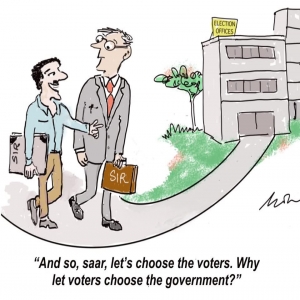
My friend and former editor of Reader's Digest, Mohan Sivanand, once produced a cartoon that captured the anxiety perfectly. Two Election Commission officials are walking towards the Commission office. One tells the other: "Let us choose the voters. Why let voters choose the government?" It is funny because it is frightening. And frightening because it is funny.
The real danger is not that officials literally decide who should vote. It is that a system can become so complicated that the practical effect is to exclude people who cannot navigate it.
I experienced a small version of this myself. When SIR began in Delhi, I was in Kerala. Better late than never, I returned to Delhi in time to deal with it. An election official gave me the forms.
I soon discovered that I could not fill them properly because I did not know in which booth in New Delhi I had voted in 2003. This was embarrassing.
I am reasonably educated and reasonably familiar with technology. I am also a journalist who has spent much of his life dealing with documents. Yet I was defeated by a question concerning something I had done more than two decades earlier. Fortunately, an expert helped me find the details.
Then came another surprise. In the 2003 electoral roll, my name appeared with initials. In the later roll, it appeared in full. Worse, my first name was spelt incorrectly.
The official advised me not to correct the spelling but to reproduce it exactly as it appeared in the earlier roll. So I did.
The system seemed to be saying: "Your name is wrong. But please write it wrongly in exactly the same way so that we can establish that you are the same person." I complied.
Then my SIR clearance was put on hold because my name in 2003 and my name in 2024 were different.
Fortunately, the official dealing with my case was kind. He took my photograph and certified that the two names referred to the same person. I then filled out another form to have the spelling corrected. I was told that I would have to provide proof. I am still waiting to see what proof will be required.
If this is my experience, imagine the plight of someone who has never possessed a birth certificate, has moved from village to village for work, whose parents are dead and whose family has no idea where they voted in 2003.
That is where the problem becomes serious. The poor have historically been the most reliable participants in Indian elections. Yet they may be the least equipped to prove their eligibility through a maze of documents and old electoral records. That is the paradox we should not ignore.
A clean electoral roll is necessary. But an electoral roll is not more important than the voter. Democracy should ideally prevent exclusion before it happens.
India's poor have never needed much encouragement to vote. They have stood in queues under the sun. They have walked miles to polling stations. They have carried children with them. They have voted even when governments disappointed them. They have changed governments. They have defeated politicians who thought themselves invincible.
They have not always voted according to the expectations of intellectuals. That is precisely the point. Democracy does not require voters to pass an examination before voting. It requires voters to be allowed to vote.
The Election Commission's constitutional responsibility is therefore not merely to produce a technically perfect electoral roll. It is to ensure that the process of producing that roll does not inadvertently exclude legitimate citizens.
There will always be some dead names. There will always be some duplicate names. There will always be people who move. There will always be clerical mistakes. There will always be somebody whose name is AJ Philip in one document and Philip AJ in another. That is the nature of administration.
The answer cannot be to make the citizen repeatedly prove his existence. The answer must be to make the system intelligent enough to distinguish between a fraudulent voter and a genuine voter who happens to have inadequate paperwork.
The Election Commission must be seen as independent by the government, the Opposition, the rich, the poor, the majority and minorities. Above all, it must be trusted by the voter. Especially the voter who has nothing except his voter ID or Aadhaar card to establish that he belongs to the Republic.
The affluent citizen can survive a bureaucratic mistake. He can hire a lawyer, produce documents and make telephone calls. The poor cannot. If his name disappears from the electoral roll, he may simply disappear from democracy. That is why the most important test of electoral reform is not how convenient it is for officials. It is how difficult it is for the poorest legitimate voter.
The constitutional functionaries entrusted with conducting elections must remain accountable to the constitutional promise of universal adult franchise.
Election Commissioners should never become handmaidens of any political establishment. Their loyalty must be to the Constitution and, above all, to the voter. Unfortunately, they have failed in that duty and, in doing so, undermined the very democratic process they are meant to protect. They deserve to go.
Let it be remembered, it was not the Election Commissioners who kept Indian democracy alive. It was the ordinary voters—especially the poor and the marginalised—many of whom the Commission sought to disenfranchise on technical grounds.
.png) Cedric Prakash
A. J. Philip
Cedric Prakash
A. J. Philip
.png) Jacob Peenikaparambil
Jacob Peenikaparambil
.jpg)
.png) John Dayal
John Dayal
.jpg)
 Pachu Menon
.png)
.png)
.png) Robert Clements
Robert Clements