

.png) John Dayal
John Dayal
.jpg)
They are all honourable men and women, but all too often they, their children, and sundry other kin find themselves in a conflict of interest not only with the law but also with the nation and the Constitution they are sworn to protect.
Justice Satish Chandra Sharma heard Election Commission matters in the Supreme Court while his elder son, Siddharth Sharma, was standing counsel for the Commission in the Madhya Pradesh High Court.
The sons are not arguing those Supreme Court cases themselves, but a curative petition has been filed on the appearance of bias. However, the reporting does not establish actual bias; the smoke has insinuated fears of a fire.
Many of the Election Commission's legal issues are in the High Courts or the Supreme Court, and hiring a senior judge's sons would seem like a coup of sorts.
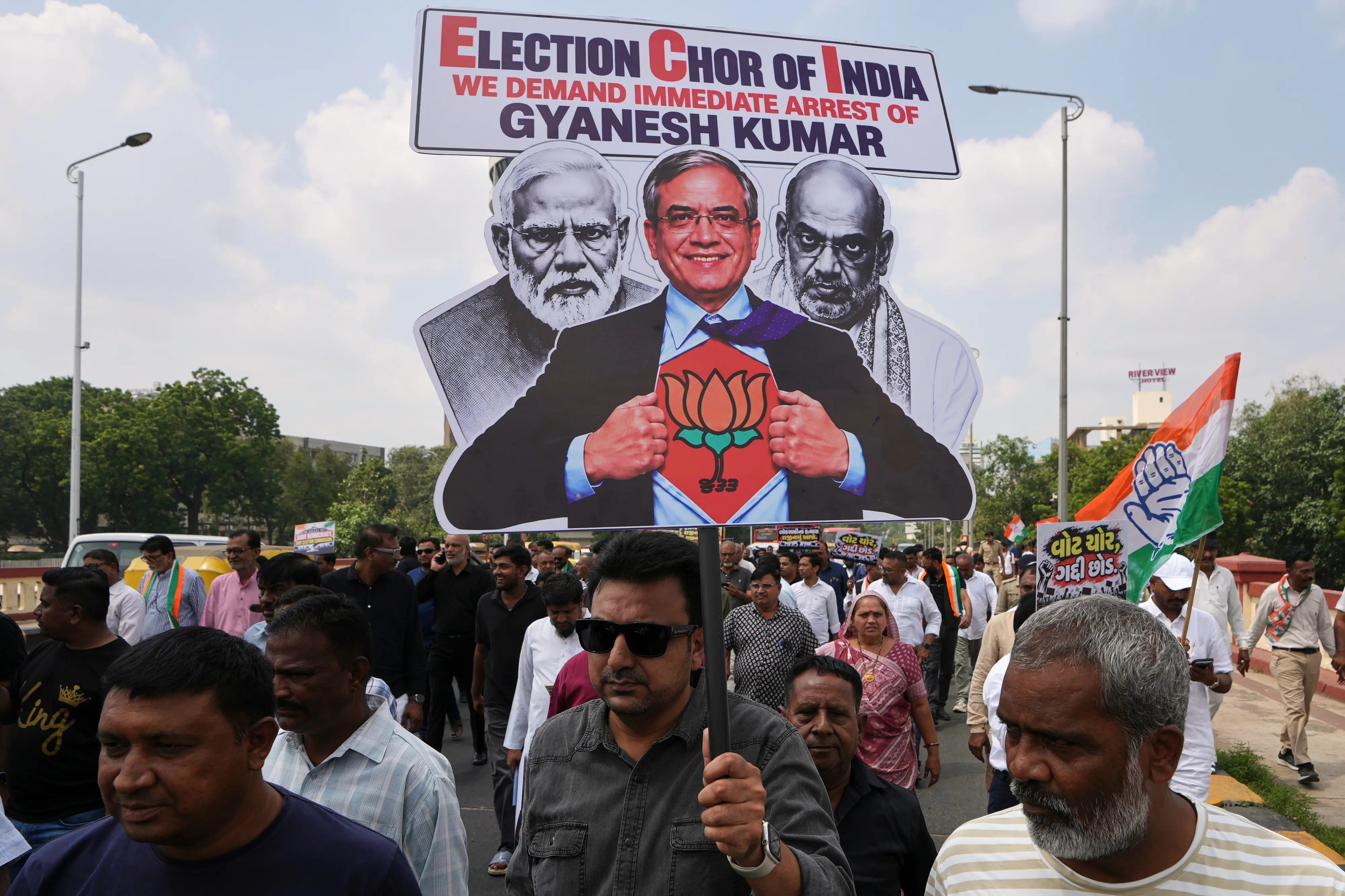
Chief Election Commissioner Gyanesh Kumar knows the importance of kinship in government, with his own immediate family's sprawling network now well-documented - two daughters, two sons-in-law, a brother and a brother-in-law across the powerful IAS, IPS and IRS networks.
In September 2026, Justice Satish Chandra Sharma of the Supreme Court sat on the two-judge bench that heard challenges to the Chief Election Commissioner and Other Election Commissioners (Appointment, Conditions of Service and Term of Office) Act, 2023, and on a bench that heard a petition filed by Noida District Magistrate Medha Roopam.
The Madhya Pradesh High Court's website records that his elder son, Siddharth Sharma, enrolled in 2017, has been standing counsel for the Election Commission of India before that High Court since July 2024, and is also standing counsel for the Central Board of Direct Taxes and the Income Tax Department.
The apex judge's younger son, enrolled in 2020, is standing counsel for the Madhya Pradesh Public Service Commission, and no one seems to know whether these professional connections were disclosed to the parties.
On September 23, the bench split: Justice Dipankar Datta saw flaws in the 2023 law that a division bench could examine; Justice Sharma held that the challenge had to go to a Constitution Bench.
A curative petition filed by Dr Jaya Thakur seeks recall of that order on the ground of a "reasonable apprehension of bias and propriety," arguing that appearance of bias is enough to vitiate the proceeding.
The wire service LiveLaw questioned whether a judge can be expected to decide against an entity on whose panel his child's practice depends.
The other half of the same episode is bureaucratic: Medha Roopam is the daughter of Chief Election Commissioner Gyanesh Kumar, a 1988-batch IAS officer of the Kerala cadre, and is a 2014-batch IAS officer of the Uttar Pradesh cadre and District Magistrate of Gautam Buddha Nagar.
Medha's husband, Manish Bansal, is also a 2014-batch IAS officer of that cadre and District Magistrate of Agra. Kumar's younger daughter, Abhishri, is an Indian Revenue Service officer; her husband, Akshay Labroo, is an IAS officer posted as District Magistrate in Srinagar. Kumar's brother, Manish Kumar, is an IRS officer, and his sister's husband, Upendra Jain, is a 1991-batch IPS officer who has served at Additional Director-General rank in Madhya Pradesh.
Published family profiles put the circle at four IAS officers, one IPS officer and two IRS officers, besides a large number of doctors - a map of how the office that conducts elections sits inside a kinship network already distributed across the civil services the Commission must, at moments, rely upon or scrutinise.
India's three principal institutions of state power — the higher judiciary, the Indian Administrative Service, and the Indian Police Service — were designed as "meritocracies," the cream of the brainy cream, with the Union Public Service Commission boasting the toughest examinations in the world.
In the Supreme Court, the collegium system was created to insulate judicial appointments from executive interference.
Sardar Patel conceived the All India Services as a national steel frame, with officers deliberately posted outside their home states so no local elite could capture a state bureaucracy.
In practice, however, all three have become what may be called kinship economies: systems in which family networks, inherited social capital, and generational advantage reproduce themselves efficiently, while the language of merit is retained as a public justification.
The most visible form of kinship capture is in the higher judiciary.
An investigation by ThePrint, published in April 2025, examined the 687 sitting permanent judges of India's 25 High Courts as of March 15, 2025.
It found that at least 102 judges are directly related to sitting or retired judges, and that another 117 come from families in which parents or immediate relatives were lawyers - over 32 per cent of all High Court judges.
The concentration varies by court. In the Kerala High Court, 48 per cent of judges come from legal backgrounds. In the Punjab and Haryana High Court, the figure is 39 per cent.
A separate report drawing on the same March 2025 data noted multi-generational judicial families, such as Justice Vishal Mishra of the Madhya Pradesh High Court, who is the brother of former Supreme Court judge Arun Mishra and the son of former High Court judge Hargovind Mishra.
The term "uncle judge" was formalised in the Law Commission of India's 230th Report, "Reforms in the Judiciary: Some Suggestions."
The report observed that judges whose kith and kin practise in a High Court should not be posted in the same High Court, drawing an analogy with the rule that government officers are not posted in their home districts.
It also noted that a person whose near relation is or was a judge, a senior advocate, or a political figure "stands a better chance of elevation," and that "there is no dearth of such examples."
The collegium system, created by the Second Judges Case (1993) and entrenched by the Third Judges Case (1998), vests appointment and transfer powers in the five senior-most judges of the Supreme Court.
Justice Ruma Pal described it in 2011 as "possibly the best-kept secret in the country." Justice Chelameswar boycotted collegium meetings in 2016, citing the process' secrecy.
In 2018, the Union government flagged 11 of the 33 names recommended by the Allahabad High Court collegium as relatives of sitting or retired judges.
In August 2025, the collegium recommended elevating Justice Vipul Pancholi to the Supreme Court, superseding three senior women judges.
Justice Nagarathna, the collegium's lone woman member, formally dissented, reportedly flagging regional imbalance and seniority concerns. Her dissent note remains confidential; the public learned of it through a media leak.
The caste dimension compounds the concern. Of 849 High Court judges appointed since 2018, only 33 belong to Scheduled Castes and 17 to Scheduled Tribes — roughly 5 per cent for communities that together constitute over 24 per cent of India's population.
Of 221 names approved by the collegium between November 2022 and May 2025, only eight candidates belonged to Scheduled Castes and seven to Scheduled Tribes.
Senior advocate Gopal Sankaranarayanan has opposed a blanket bar, noting that the Kanias, Chandrachuds, Bhagwatis, Venkataramaiahs, Khannas and Chaglas produced outstanding judges, and that if a choice must be made between an equally meritorious relative and a non-relative, the non-relative should be preferred.
The Supreme Court's own data says that of 221 High Court appointments approved between November 2022 and May 2025, only 14 — about 6 per cent — were related to sitting or retired judges.
The First Generation Lawyers Association, founded in 2023, has challenged two practices in the Delhi High Court: chamber allocation rules that automatically pass chambers to spouses and children of existing allottees, and the Union government's empanelment of over 650 lawyers as government counsel, some enrolled as recently as 2024.
The IAS and IPS differ from the judiciary in one crucial respect: entry is through the UPSC Civil Services Examination, with over a million applicants competing for roughly 1,000 to 1,200 seats.
Kinship operates upstream—through coaching, social capital, and the transmission of aspiration across generations.
Data compiled by the Lal Bahadur Shastri National Academy of Administration shows that since 2014, at least 50 per cent of officer trainees have fathers in government service.
Figures by year: 2014, 60 per cent (171 of 285); 2015, 57 per cent (200 of 350); 2016, 55 per cent (208 of 377); 2017, 57 per cent (212 of 369); 2019, 51 per cent (166 of 326).
A family from Naharsinghpura village in Rajasthan's Sawai Madhopur district has produced six IAS officers across two generations, including both parents and two cousins.
The Mishra family from Pratapgarh, Uttar Pradesh, produced four siblings in the civil services: Yogesh Mishra (IAS, 2013), Madhavi Mishra (IAS, 2014), Lokesh Mishra (IAS, 2015) and Kshama Mishra (IPS, 2015).
The coaching industry is said to be the commercial engine of this reproduction.
The UPSC coaching segment is valued at over 3,000 crore rupees; the broader coaching sector is estimated at over 50,000 crore rupees and projected to exceed 1.5 lakh crore by 2030.
Foundation course fees have risen from about 1.2 lakh rupees per annum in 2019 to 2 lakh rupees today, excluding rent and food. Aspirants in Delhi report monthly expenses of 20,000 to 25,000 rupees.
For the judiciary, commentators have suggested mandatory anti-nepotism disclosures for elevation candidates; a bar on appointing relatives of sitting judges to the same High Court, as the Law Commission recommended; public disclosure of collegium resolutions with reasons; and an All India Judicial Service examination.
For the civil services, the UPSC could publish data on parental occupation, as LBSNAA already compiles internally; coaching marketing could be regulated to curb misleading success-rate claims; and free and low-cost preparation resources could be expanded to reduce the financial barrier to entry.
Not that these measures would, of course, eliminate kinship, as kinship transmits advantage in every profession — law, medicine, business, politics, even journalism.
.png) Cedric Prakash
Cedric Prakash
.JPG)
 A. J. Philip
.png) Jacob Peenikaparambil
John Dayal
Jacob Peenikaparambil
John Dayal
.jpg)
 Pachu Menon
.png)
.png)
.png) Robert Clements
Robert Clements