

.png)
I have seen
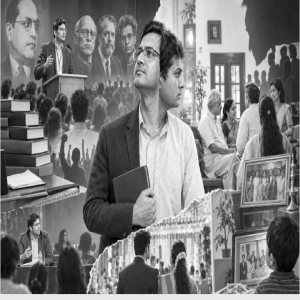
the professional anti-caste intellectual.
S/He arrives.
S/He speaks.
S/He refers to Ambedkar.
S/He cites John Rawls.
S/He quotes Michael Foucault.
S/He invokes Habermas.
S/He discusses Gramsci.
S/He condemns Brahminism.
S/He explains
graded inequality.
S/He teaches
the sociology of untouchability.
S/He publishes
an article on Dalit dignity.
She/He claims to be "Ambedkarite," or
"neo-Ambedkarite."
S/He receives applause.
Then he goes home.
And at home,
caste returns.
Not as theory.
As marriage.
Not as discourse.
As family.
Not as structure.
As bloodline.
Not as an institution.
As surname.
Not as history.
As inheritance.
Not as oppression.
As preference.
And suddenly,
the revolutionary theorist
becomes a traditional son.
A radical scholar
becomes a conventional parent.
A critic of hierarchy
becomes cautious
about whom his child should marry.
And caste smiles.
Because caste has learned
that it does not need
to defeat your theory.
It only needs
to survive your family.
I ask:
Why is it so easy
to write about Dalit women
and so difficult
to imagine one
as one's wife?
Why is it so easy
to celebrate Dalit history
and so difficult
to invite Dalit relatives
into one's own family history?
Why is Dalit suffering
acceptable as a research subject
but Dalit intimacy
still treated
as a social revolution
too far?
Why can a scholar
spend twenty years
studying caste
and still allow caste
to determine
whom he loves?
Why can a professor
teach students
that caste is irrational
while privately believing
that marriage should remain
"within our community"?
What happens
when the theory
comes home?
What happens
when the Dalit
is no longer
a chapter?
What happens
when she becomes
your partner?
What happens
when he becomes
your husband?
What happens
when she becomes
the mother
of your children?
What happens
when his parents
sit beside your parents?
What happens
when surnames
meet?
What happens
when rituals collide?
What happens
when relatives object?
What happens
when inheritance
becomes political?
What happens
when your child asks:
"Why do Grandma and Grandpa
call my mother's caste
a problem?"
That is where
the theory begins
to bleed.
And this is why
I say:
I am not impressed
by the theorist
who has all the right words.
I want to know
whether the words
have entered the bloodstream.
I want a theory
that has survived
the wedding invitation.
I want an ethics
that has survived
the family meeting.
I want equality
that survives
the photograph
where both families
stand together.
I want fraternity
that survives
the naming ceremony.
I want annihilation of caste
that does not disappear
when someone's daughter
falls in love.
There is something
deeply uncomfortable
about this demand.
Because it exposes
a strange hierarchy
within progressive politics.
The Dalit
is often welcomed
as a voice.
But not always
as family.
Welcomed
as a speaker.
Not always
as a spouse.
Welcomed
as a researcher.
Not always
as an heir.
Welcomed
as a symbol
of resistance.
Not always
as the person
with whom one wants
to grow old.
And perhaps
this is one of the deepest
contradictions
of liberal intellectual life:
The oppressed person
can be politically desirable
while remaining socially undesirable.
The Dalit scholar
is invited
to the panel.
The Dalit activist
is invited
to the conference.
The Dalit writer
is invited
to the book launch.
The Dalit thinker
is invited
to speak about justice.
But when love arrives,
suddenly everyone
becomes a sociologist
of "compatibility."
Suddenly every non-Dalit
theorist says,
"You Dalit bastard
how dare you love me."
Whole South Asia and Japan unite in this matter.
Suddenly culture matters.
Suddenly family matters.
Suddenly tradition matters.
Suddenly "practical realities" matter.
Suddenly caste
returns wearing
the respectable clothes
of common sense.
I do not want
the Dalit person
to become someone's
certificate of progressiveness.
I do not want
a non-Dalit person
to marry a Dalit
so that they can announce:
"Look at me.
I am progressive."
No.
That would simply
turn a human being
into a political trophy.
I want something
much more difficult:
authenticity.
If you love,
love.
If you oppose caste,
oppose it
when it becomes
personally inconvenient.
If you believe
in human equality,
let equality enter
your household.
If you believe
that caste is irrational,
do not secretly
build your family
according to caste.
If you believe
that fraternity matters,
practice fraternity
beyond the stage.
And here
you have an enemy called
John Rawls.
I often remember
John Rawls
for asking us to imagine
justice from behind
a veil of ignorance
to imagine ourselves
without knowing
where we will be born,
what class
we will inherit,
what talents
we will possess,
what social position
we will occupy.
That philosophical device
has enormous power.
The point is more demanding:
Do not ask philosophy
to excuse the distance
between what you teach
and how you live.
A theorist
needs a perfect biography.
A true theorist
lives without contradiction.
But the contradiction
must be faced.
That is where
intellectual honesty begins.
Perhaps
I am not asking
for theorists
who have perfect lives.
Perhaps
I am asking
for theorists
who are honest
about their imperfect lives.
Say:
"Yes, I oppose caste,
but I and my own family
still carries caste prejudice."
Say:
"Yes, I teach equality,
but I carry my own
caste privilege."
Say:
"Yes, I write about
Dalit liberation,
but I have not yet
challenged caste
inside my own home."
That honesty
would mean more to me
than another
one-hundred-page article
filled with quotations.
Because confession
can become
the beginning of transformation.
But performance
can become
a substitute for it.
.png) Cedric Prakash
Cedric Prakash
.JPG)
 A. J. Philip

.png) Jacob Peenikaparambil
Jacob Peenikaparambil
.jpg)
.png) John Dayal
John Dayal
.jpg)
 Pachu Menon
.png)
.png) Robert Clements
Robert Clements