

 A. J. Philip
.jpg)
I lived in Bhopal for four years and visited the Union Carbide factory several times for reporting. When poisonous gas leaked from the factory on the night of December 2–3, 1984, I rushed from Patna to cover the horrendous tragedy. The disaster killed thousands; the immediate official death toll was put at 2,259, though subsequent estimates were much higher.
Yet, whenever I remember Bhopal, it is Raghu Rai's haunting photograph of a dead baby, its face partly buried in the earth, that comes to mind. When I think of the Gujarat riots, I recall the photograph of a young Muslim tailor whose face registered sheer terror. Such images do more than document events; they become enduring symbols of human suffering and resistance.
Every agitation and movement has produced such images, in which an individual's courage or suffering captures the collective yearning for justice and freedom. Mahatma Gandhi made the simple act of making salt a weapon against British rule.
During the 1930 Salt March, he walked to Dandi and defied the colonial salt tax, inspiring millions to challenge an unjust regime through nonviolent resistance. In 1955, Rosa Parks, an African-American woman, refused to give up her bus seat to a white passenger in Montgomery, Alabama. Her quiet defiance helped spark a mass boycott that became a turning point in the American civil rights movement.
At the 1968 Mexico Olympics, American athletes Tommie Smith and John Carlos raised black-gloved fists on the victory podium to protest racial discrimination, risking their careers to draw the world's attention to injustice. In Vietnam, Buddhist monk Thích Qu?ng ??c immolated himself in Saigon in 1963 to protest the persecution of Buddhists. The photograph of his final act shocked the world.
Such moments remind us that history's most powerful symbols are often ordinary individuals whose extraordinary acts of courage, defiance or sacrifice give a human face to a movement's struggle.
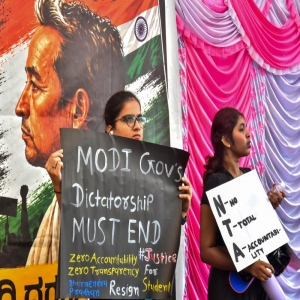
Delhi is witnessing one of the largest student-led mass movements the Capital has seen in recent times. Though the Opposition INDI Alliance has extended its support, students, particularly young women, have emerged as the agitation's face and voice.
They have demonstrated that they are no longer willing to remain on the margins of public life. They can organise, articulate their demands, confront authority and stand up for their rights without waiting for someone else to speak on their behalf.
July 20, 2026, became a defining moment in the agitation. As thousands of protesters attempted to march towards Parliament, the police and security personnel used tear gas, batons and other crowd-control measures. There were videos of students being beaten, injured and detained.
Mohanlal, the Malayalam superstar, is a household name in Keralam. His daughter, Vismaya Mohanlal, was far removed from the crowds at Jantar Mantar, but she felt compelled to speak out against the police action. She shared an Instagram story questioning the use of force against the student protesters.
The post drew attention to the use of tear gas and lathis, injuries suffered by students, road blockades, metro station closures, heavy barricading and reports of internet suspension.
"If the response to citizens raising their voices is overwhelming force instead of dialogue," the message asked, "what kind of democracy are we becoming?" It went on to remind readers that the person demanding to be heard tomorrow could be any one of us, someone from our own city, neighbourhood or family.
The question was not merely about one protest or one political demand. It was about the relationship between citizens and the state in a democracy.
Vismaya's intervention came at a time when she was preparing to make her acting debut. Her decision to speak up brought her a wave of online hostility. Some social media users attacked her for expressing a view on a political controversy and questioned her political awareness. But she did not retreat from her position. She maintained that she had no regrets about speaking out.
I was in Kerala when her first film, Thudakkam (Beginning), was released, and I took the trouble to go to a theatre in Kattanam to watch it. The film, which marked her acting debut, presented her in a role that was quite different from the conventional image of a heroine waiting to be rescued.
She played a martial arts teacher who uses her training to resist her adversaries and ultimately overcome them. I must confess that I was not particularly impressed by her acting. But the theme of the film appealed to me. It conveyed a message that was worth remembering: women need not be submissive in the face of injustice. They can stand their ground, resist aggression and even confront violence when circumstances demand it.
When I subsequently read in detail about Vismaya's response to the police action against the student protesters in Delhi, I was reminded of that film. The circumstances were entirely different, of course. On screen, she used martial arts to confront her adversaries; off screen, she used her Instagram account to question the use of force against young people exercising their democratic rights. In both instances, what mattered was the refusal to remain a silent spectator.
It would be simplistic to equate a film character with the person who portrays her. Yet there was an intriguing consistency between the message of Thudakkam and Vismaya's public intervention. The woman who had portrayed resistance on screen was now expressing solidarity with young women who were standing up for themselves on the streets of Delhi.
She did not need to be physically present at the protest to make her voice heard. Nor did she need to be a seasoned political activist to recognise that the use of overwhelming force against citizens demanding answers deserved scrutiny.
Vismaya's experience also illustrates the price women can pay for speaking out. The online hostility directed at her showed how quickly a woman expressing an opinion can become the target of personal attacks. Yet she stood by her position, making it clear that she had no regrets. Her response that humanity comes before politics was a reminder that compassion and concern for democratic rights need not belong to any one political camp.
The significance of the Delhi agitation, therefore, extends beyond the immediate demands concerning the disenfranchisement of millions. It lies in the emergence of young women who are prepared to question authority, confront intimidation and exercise their independence. Some do so by joining demonstrations; others use the platforms available to them. What unites them is the conviction that silence is not the only option available to women. Sometimes, resistance begins with the simple decision to speak.
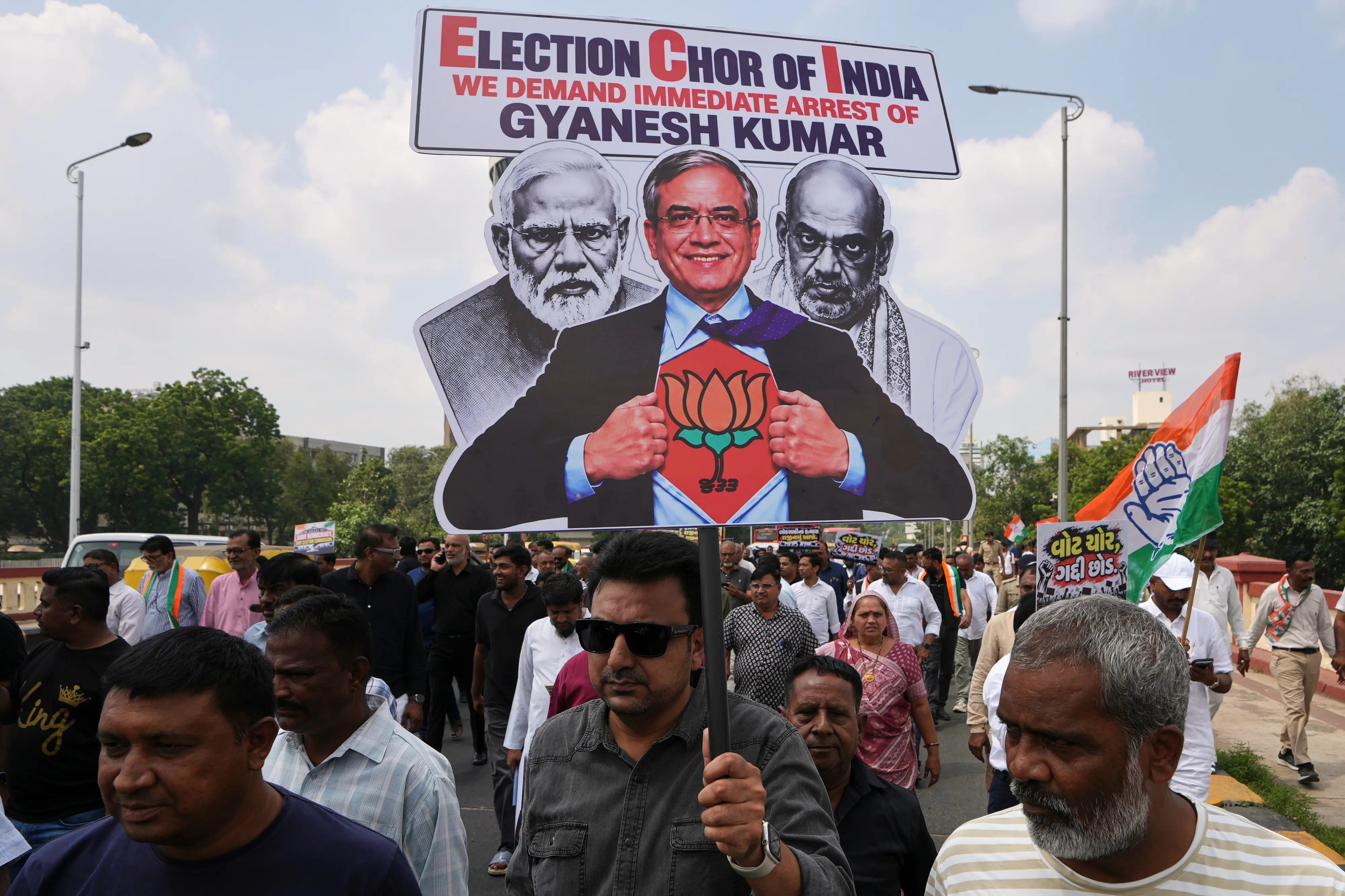
The agitation in Delhi today is demanding the resignation of Chief Election Commissioner Gyanesh Kumar. Once again, women are in the forefront of the agitation. They defy barricades, climb over them and challenge the police. There are countless women whose courage deserves to be celebrated. They are united by a simple but powerful conviction: the right to protest is central to democracy, and no authority can be allowed to extinguish it.
Among the many acts of defiance, one particularly struck me. Let me call the young woman Riya, although I know her real name. She is a freelance journalist who had the courage to speak publicly about what a Delhi police officer allegedly did to her. I shall not reproduce the details of her account, though she herself had no hesitation in narrating her ordeal in public. Sometimes, discretion is necessary even when the victim has chosen to speak out.
Riya named the officer and went to the police station to have an FIR registered against him. The Supreme Court has repeatedly affirmed that the police cannot arbitrarily refuse to register an FIR when the law requires it. Yet Riya had to spend an entire day waiting under the blazing sun before her complaint was registered. I have seen a video in which a woman police officer tries in vain to drive her away from the area.
Think of the social transformation this represents. A few decades ago, a woman subjected to such an experience might have hesitated to speak about it publicly, perhaps even to her closest friends. Her parents might have worried more about family honour than justice, doing everything possible to hush up the matter. Worse, they might have hastened to arrange her marriage, as though marriage could erase the humiliation and silence the victim.
Riya refused to be silenced. She demanded accountability, even when the machinery meant to protect her appeared determined to wear her down.
The subsequent developments make the episode even more disturbing. Within days, the officer was promoted to the rank of Deputy Commissioner of Police, creating the impression that the allegations against him had counted for nothing. Following public protests, however, the promotion was put on hold.
Riya's courage deserves admiration. Her struggle is about more than personal justice. It is a reminder that democracy depends on citizens, especially women, who refuse to surrender their rights to those entrusted with protecting them. When a woman stands up to authority, she is not merely defending herself; she is defending the rights of us all.
This week, I happened to watch a long interview Yashaswinee Raje Singh had given to a television journalist. Later, I watched another interview she gave to The Print. I was struck by the clarity of her views and the courage with which she expressed them.
Yashaswinee is no ordinary young woman. A successful model, she has worked as a consultant with organisations, including the British government and United Nations agencies. She holds a master's degree from the London School of Economics. Yet it is not her professional accomplishments that have brought her into the spotlight. It is her willingness to challenge the political establishment, even when doing so puts her at odds with her own family's ideological convictions.
Her comments were startling in their directness. She described Narendra Modi's continuance in office as a shame for the nation. She argued that police brutality against students in Delhi had been allowed to flourish because similar excesses elsewhere in the country had gone unnoticed. Her criticism was not merely of individual acts of violence but of a political climate in which the abuse of state power increasingly seemed to escape accountability.
Her views on food and the politics surrounding it were equally forthright. Every Indian, she insisted, had the right to eat what he or she wished. She recalled the lynching of Mohammad Akhlaq in Dadri, Uttar Pradesh, on September 28, 2015, after rumours that beef had been stored in his refrigerator. She challenged the justification offered by those who targeted him, pointing out that the meat was reportedly mutton, not beef.
She also questioned the ex
The terminology, she argued, reflects a hierarchy of food habits that has acquired an increasingly political character. Food, she insisted, should be a matter of personal choice, not a test of patriotism or religious loyalty.
What makes Yashaswinee particularly interesting is her family background. Her father, Vikram Singh, is a former two-term BJP MLA from Uttar Pradesh associated with cow-protection politics. Yet she has chosen to chart her own political course, asserting her financial independence and her right to hold views different from those of her family.
She has supported Palestine, expressed admiration for New York's mayor and spoken out against the government's handling of the NEET examination controversy. She also highlighted how young people used social media, memes and the satirical Cockroach Janta Party banner to challenge the establishment. Her interventions have attracted online abuse, including threats of rape and death. Her father, despite their political differences, reportedly approached the police over the threats against her.
Vismaya, Riya and Yashaswinee represent a generation unwilling to accept political authority as unquestionable. Whether one agrees with all their arguments is immaterial. In a democracy, the right to dissent cannot depend on one's surname, family loyalties or political inheritance. Their voices remind us that citizenship demands the freedom to question those in power, and that democracy remains meaningful only when dissent is heard, respected and protected.

 Adv. Rev. Dr George Thekkekara
A. J. Philip
Adv. Rev. Dr George Thekkekara
A. J. Philip
.jpg)
.png) John Dayal
John Dayal
.jpg)
.png) Jacob Peenikaparambil
Jacob Peenikaparambil
.jpg)
 P. A. Chacko
.png)
.png) Robert Clements
Robert Clements
.png) Cedric Prakash
Cedric Prakash