

.png) Cedric Prakash
Cedric Prakash
.jpg)
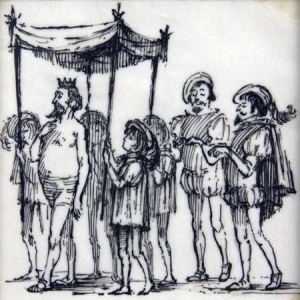
Almost two hundred years ago, in April 1837, the noted Danish author, Hans Christian Andersen, had his short story "The Emperor's New Clothes" published in "The Little Mermaid," as the third and final instalment of Andersen's "Fairy Tales Told for Children." In essence, the story revolves around an arrogant Emperor who is ultimately exposed. The tale made waves: it was translated into over one hundred languages, dramatised, and has poems and songs composed based on it; above all, it is a powerful figure of speech.
The story is direct and straightforward. Andersen revelled in that style. The Emperor is self-centred and thinks no end of himself! He has a terrible obsession with fancy clothes. He just does not bother with the burning issues that are destroying his empire, nor does he listen to the cries of his people.
One day, two crooks visit his palace. They pose as weavers and offer to make for him some magnificent clothes. These clothes, they tell him, are invisible to those who are either incompetent or stupid or who do not understand important things. The gullible Emperor hires them; they set up their looms and pretend to work. A succession of officials/courtiers (the Emperor's 'chamchas'), starting with the Emperor's wise, competent and all-knowing minister, and ending with the Emperor himself, visit them to check their progress. Each sees that the looms are empty but pretends otherwise to avoid being regarded as a fool.
Finally, the all-important day arrives when the "weavers" loudly proclaim that the suit for the Emperor is completed. He strips out his royalty finery, and whilst he is stark naked, the 'weavers' mime dressing him. They applaud when they have 'dressed' him, and the Emperor is delighted. He sets off with all pomp and pageantry, in a procession before the whole city.
The people who have gathered cheer him to no end. Even those who realise the reality, uncomfortably go along with the pretence, not wanting to appear like morons: inept or stupid. Out of the blue, a little child screams in a shrill voice, "The Emperor is naked!" The people are startled - some pretend that they have not heard the child, while others accept that they have been fooled. The Emperor, who has also heard the child, is naturally rankled; but given the fact that he is delusional and self–obsessed, he does not care about the truth which comes from the lips of an innocent child. He continues unperturbed with the procession.
The story has several variations. Andersen himself adapted it from an ancient folk tale. Significantly, there is also an Indian version. The story appears in the L?l?vat?s?ra by Jinaratna (1283), a summary of a now-lost anthology of fables, the Nirv??al?l?vat? by Jine?vara (1052). The dishonest merchant Dhana from Hastin?pura swindles the King of ?r?vast? by offering to weave a supernatural garment that cannot be seen or touched by any person of illegitimate birth. When the King is supposedly wearing the garment, his whole court pretends to admire it. The King is then paraded about his city to show off the garment; when the common folk ask him if he has become a naked ascetic, he realises the deception, but by then the swindler has already fled; the King becomes a laughingstock.
Whatever the variation or adaptation according to the storytellers, the fable is an apt parable for our times. There are several important and relevant lessons to be learnt for all today. The dramatis personae have much to teach us all: what not to be and what to be:
The Emperor
He is there, holding sway on his throne with crown and sceptre. Power has gone to his head. He lives under the false belief that no one can touch him. He equates himself with God. He has decided that he has absolute power, and well, absolute power corrupts absolutely. The Emperor is arrogant, corrupt, and self-obsessed; he looks down on others and imprisons or kills all those who dare question him. He is not accountable to anyone; he simply does not care and is unable to listen to the cries of his people. He is busy travelling around the world, wearing fancy costumes, and, of course, taking selfies. He has reached a pathetically low level mentally - he is unable to realise that he is naked!
The Courtiers
These are the chamchas, the ones who sing praises of the Emperor, they 'hee and haw' in front of him. They are the Emperor's crony capitalist friends, who know that if they are on his right side, they can do what they want: loot the nation, plunder precious natural resources, buy vast tracts of land at a pittance and above all, amass wealth at the cost of the poor. They pay for full-page advertisements to celebrate the Emperor. They know that flattering him will pay rich dividends. These are the sycophants; the user of sycophancy, which is insincere flattery given to gain advantage from a superior.
The Weavers
They are the deceivers, the manipulators, the crooked ones who play decisive roles in today's society. They know the tricks of the trade: how to take huge loans from banks and not repay them. They know how to beat the system - creating shell companies just before demonetisation, and bribing through electoral bonds. It is now easier to understand the phrase 'to spin a yarn.' In Gujarat, the term 'lapete' is used in the context of kite-flying. They have mastered the art of telling a lie a thousand times until people start believing it is the truth, referred to as Goebbelsian—the art of lying and manipulation perfected by Hitler's Minister of Propaganda, Joseph Goebbels.
The Proletariat
These are the ordinary people, the hoi polloi, on the streets. They have been taken out of their schools and farms, from the slums and the villages. They are ferried by public transport and given a cold, packed lunch. Never mind if many of them have to lose their daily wage. They are given flags to wave and told to shout "Long live the Emperor!" when he passes by. They are given rose petals to felicitate him as his chariot goes by. Several of them still believe in his false promise of "achhe din." They live in hope of receiving some money in their bank accounts, which the Emperor has stashed abroad. Many are gripped with fear: they know that the Emperor is naked, but if they open their mouths to say so, they will have to face serious consequences – jailed or even killed.
The Child
The child represents all those who stand up and cry out for justice and truth. Those who have a conscience to speak truth to power, even if one has to pay the price. The child manifests the four qualities so essential for all today - Transparency, Humility, Integrity, Simplicity (THIS), the very opposite of what the Emperor manifests. Besides, he lacks the humility to listen to the spontaneous words of truth that come from a child - "the Emperor is naked."
It is significant that in the Gospel of Matthew, Jesus says, "Truly I tell you, unless you change and become like little children, you will never enter the kingdom of heaven" (18:3). Jesus says this to his disciples after they asked who was the greatest in the kingdom, emphasising humility, dependence on God, and a trusting, childlike faith as prerequisites for entering God's kingdom.
Dr BR Ambedkar, the architect of our Constitution, gave a long but passionate speech to the Constituent Assembly on November 25, 1949, the eve of the adoption of the Constitution. Interestingly, his speech set the vision and the spirit of what the new Constitution should be for the people of India. Ambedkar said, "If we wish to maintain democracy not merely in form, but also in fact, what must we do? The first thing in my judgement we must do is to hold fast to constitutional methods of achieving our social and economic objectives…. where constitutional methods are open, there can be no justification for (..) unconstitutional methods. These methods are nothing but the Grammar of Anarchy, and the sooner they are abandoned, the better for us. The second thing we must do is to observe the caution which John Stuart Mill has given to all who are interested in the maintenance of democracy, namely, not "to lay their liberties at the feet of even a great man, or to trust him with power which enable him to subvert their institutions in politics, Bhakti or hero-worship is a sure road to degradation and to eventual dictatorship. The third thing we must do is not to be content with mere political democracy. We must make our political democracy a social democracy as well. Political democracy cannot last unless there lies at the base of it, social democracy."
Dr Ambedkar challenges all of us today to say fearlessly in one voice, like the little child in Hans Christian Andersen's story, "the Emperor is naked!"
.jpg)
 A. J. Philip
.jpg)
.png) Jacob Peenikaparambil
Jacob Peenikaparambil
.jpg)
.png) John Dayal
John Dayal
.jpg)
.png) Joseph Maliakan
Joseph Maliakan
.jpg)
 Pachu Menon
.jpg) Jose Vattakuzhy
Jose Vattakuzhy
.jpg)
 P. A. Chacko
.png)
.png)
.png) Robert Clements
Robert Clements
.jpg) A. J. Philip
A. J. Philip