

Jesus does not mince words: “It would be better for him if a millstone were hung around his neck and he were thrown into the sea, than that he should cause one of these little ones to sin.” (Luke 17:2)
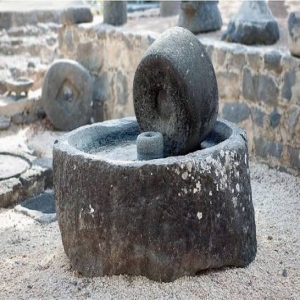
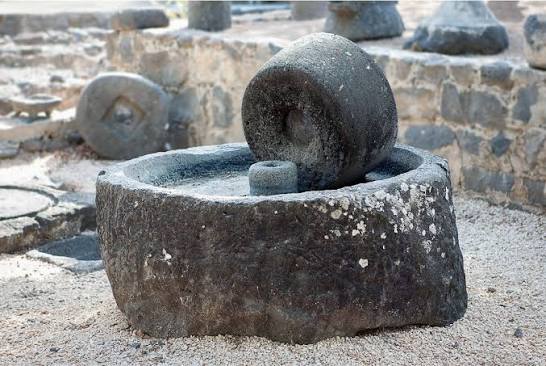
A millstone was a cylindrical grinding stone, about eighteen inches to two feet across, heavy enough to be hung around a person’s neck to cause drowning. The great millstone (μ?λος ?νικ?ς, mylos onikos) mentioned in Matthew 18:6 and Mark 9:42 indicates an even heavier type, so huge that it needed a donkey or other animal to turn it, and it could sink a body irretrievably underwater. Better that fate, Jesus declares, than causing a little one—the child, the innocent, the one dependent on our example—to stumble.
We rarely see such millstones today. But they have not disappeared; we have reinvented them in a way only the twenty-first century could imagine. The stone is no longer massive and external but small, pebble-sized, sleek, fitting neatly in the palm or pocket. We choose it ourselves, carry it willingly, tie it around our necks—sometimes literally—and step into the sea every day, slowly drowning in it.
We put it around our necks in the morning: notifications first thing upon waking, a quick scroll at the table, the phone kept close during conversations (as if the person sitting in front of us were secondary to the screen), and even in quiet moments meant for rest or prayer. We willingly dive into the ocean: the endless dopamine loop, constant scrolling, the fake urgency that promises connection but only results in fragmentation, and ongoing communication that creates a false sense of intimacy without real connection. As the writer Jessie Minassian observes, "When you're getting an IV drip of media all day, every day, you start relying on it. You get numb to its presence but become super-aware of its absence." [1] We are sinking not into seawater but into an ocean of superficiality and restlessness.
And the little ones watch. Children see their parents and teachers hunched over their screens. Seminarians observe formators checking messages during the Liturgy of the Hours or in moments of silent adoration. Priests can sometimes be seen throwing a last hurried glance at their phones just before entering the church to begin Mass. The young assume that this is normal, that the pebble is essential, and that the sea is where life happens. By our voluntary plunge into the ocean, we unintentionally become the cause of their stumbling, not by forcing the stone on them, but by setting the example.
I have been through this. For years, I fought the urge with rules, timers, app blockers, designated “no-phone” zones, and set hours. They worked temporarily. Then the pull returned, stronger, because the deeper hunger remained unmet. Restrictions alone could not break the pebble’s grip, as it fed on a profound emptiness and needed constant stimulation to reassure me that life still had meaning. When the soul fled silence, the device always stood ready to fill it with endless distractions.
This is more than a habit we passively fall into. It is a modern form of what St. Francis de Sales calls “scandal taken without occasion”—the scandal ab intrinseco—which means a scandal created by the self within one’s own mind and will. In The Catholic Controversy, the Genevan saint wrote that such a scandal is “the most frequent, the most dangerous, and the most injurious.” It is an inward cruelty, a form of self-murder of the soul and a slow injury to the body, which God has given as a temple (1 Corinthians 6:19–20). We tie the pebble not because someone forces us, but because our own disordered will invents the reason, choosing distraction over the silence where God speaks. St. Francis reminds us: “Not one of us men is scandalised save by his own fault.” The device is not inherently evil; we scandalised ourselves by preferring it over God and the silence in which He speaks.
This is a subtle form of idolatry in which the device becomes a false saviour, offering quick relief from the pain of purposelessness. As Dostoevsky writes in The Adolescent: “Man cannot live without kneeling; he would not be able to bear himself. If he rejects God, he kneels before an idol—of wood, or gold, or imagination. They are all idolaters, not atheists.” In ancient times, idols were placed in temples or shrines: people travelled to them, offered sacrifices in public rituals, and then left them behind. Now, with this pebble, the idol lives in our own pocket. We take it out at will, pay homage with secret glances and endless touches, and carry it everywhere. We cling to this pocket idol because we fear the silence that might reveal how little our days are ordered towards the eternal.
"It would be better for him if a millstone were hung around his neck and he were thrown into the sea . . ." Even in their apparent severity, these words of the Lord Jesus are acts of mercy. Jesus awakens us to protect what is most vulnerable—the treasure of our souls in these earthen vessels. The pebble need not weigh us down. We can untie it, set aside its weight, and run the race set before us with ease and endurance, not by willpower alone, nor by stricter rules that only create a vacuum for another distraction. True freedom comes when something greater takes hold of the heart.
As I have argued elsewhere (“Defanging the Snake,” Homiletic & Pastoral Review, July 29, 2026),[2] the device must be defanged, made harmless by creating a life so compelling that its venom loses its power. The same principle applies here. The key is to build a magnificent life, one in which we make space for silence and deep prayer so that the constant noise fades, engage seriously with truth and wisdom until our minds are expanded, dedicate ourselves to work that genuinely serves others, cultivate real face-to-face friendships, and treat our bodies with discipline, our minds with excellence, and our hearts with authentic love.
In this meaningful life, the self-made scandal would no longer occasion our stumbling. We move from the cycle of repeated failure to embracing the grace that heals and strengthens us, so that even the good things of this world do not become a snare, a trap, and a stumbling block for us.
When life acquires meaning and greatness, the pebble begins to feel like an unwanted burden. The ocean recedes; we surface, breathe fresh air, see true light, and cultivate true friendships. The little ones see not a sign of drowning but of rising.
[1] Jessie Minassian, Unashamed: Overcoming the Sins No Girl Wants to Talk About (Colorado Springs, CO: NavPress, 2015), 54.
[2] Anil Prakash D’Souza, “Defanging the Snake: Why Phone Addiction Demands Meaning, Not Mere Rules,” Homiletic & Pastoral Review, July 29, 2026, https://www.hprweb.com/2026/07/defanging-the-snake-why-phone-addiction-demands-meaning-not-mere-rules/.

.jpg) Stanislaus Alla
Stanislaus Alla
.jpg) Stanislaus Alla
Stanislaus Alla

 Adv. Rev. Dr George Thekkekara
.jpg)
 A. J. Philip

.jpg)
.png) John Dayal
John Dayal
.jpg)
.png) Jacob Peenikaparambil
Jacob Peenikaparambil

.jpg)
 P. A. Chacko
.png)
.png) Robert Clements
Robert Clements