

.png) Ram Puniyani
Ram Puniyani
.jpg)
The RSS Combine's Hindu Rashtra agenda has been built upon narratives through multiple mechanisms. The festivals have been the occasion for promoting its agenda. Highlighting certain deities for 'social political messaging' has become a prominent part of the political arena.
The recently held Kumbh was a mega spectacle, which became more of a national event rather than a religious gathering. One significant change for this year's Kumbh is its heavy marketing as a cultural and developmental showcase. It was labelled as "The Greatest Show on Earth" for Hinduism.
On such occasions, the government's function is to provide security and safe passage for the pilgrims. However, the state got fully involved in organising the event itself. The associates of the ruling party, like VHP, dharma sansads (religious parliaments), and individual sants/sadhus, took the lead and initiatives in propagating the components of the Hindu nationalist agenda and 'Hate for Muslims' at this congregation.
While the devotees highly appreciate the religious and spiritual significance of the event, giving it a political colour was very consequential this time around in the Kumbh. It is not the first time that Kumbh has been organised. The State Government, while inadequate in managing the crowds, had advertised and invited the devotees in large numbers for quite some time. Crores must have been invested in inviting the devotees.
The event was marked by a boycott of Muslim traders from setting up their shops and stalls. The reasons given were multiple, a fake one stated by Swami Avimukteshwaranand that Muslims spit in the food, so they were kept away. Many misleading videos are making the rounds on social media.
Ironically, Muslims opened their Masjids and organised food for the desperate stampede victims. One recalls that during the Mughal period, to make the Kumbh more comfortable for devotees, they built many Ghats (river banks for bathing) and toilets. According to historian Heramb Chaturvedi, Akbar had appointed two of his officers to look after the Kumbh arrangements.
The whole area was replete with hoardings of Narendra Modi and Yogi Adityanath. A large area was reserved for VIPs, leading to stampedes in which a large number of deaths occurred. The transport arrangement was poor, as reflected in the New Delhi Railway station stampede.
One upstart Swami, Dhirendra Shastri, whom Mr Narendra Modi calls his younger brother, merrily said that those who died due to stampede are the recipients of moksha. The water quality reached an abysmally low level with E. coli and high excreta content. To all the criticism about water quality and deaths, the Chief Minister commented, "Pigs got dirt, vultures got dead bodies!"
VHP used it as a golden occasion with its Margdarshak Mandal meetings. Their speeches were full of venom for Muslims. The usual propaganda about Muslims relating to population increase, infiltrators from Bangladesh, and cow protection was repeated at various meetings ad nauseam. Hate spreaders like Sadhvi Ritambhara, Praveen Togadia, and Yati Narsinghanand Saraswati had field days with their acrid speeches. They had large audiences. BJP successfully used sadhus for its political agenda and got publicity at the state's expense.
One such saffron-clad person reiterated the demand for Kashi and Mathura and claimed that such 1860 temples have been 'researched' and need to be restored. The demand for closing Madrassas and converting English-medium schools to Gurukuls to create a Hindu World was also articulated.
In a 2024 book, Irfan Engineer and Neha Dabhade draw our attention to the use of religious festivals as occasions to instigate violence. Our festivals have been pleasant social occasions, cutting across religious lines. The modus operandi is to organise processions during Hindu festivals, pass through Muslim areas, change the green flag on the mosque to a saffron flag, and dance with swords in hand. At the same time, hateful slogans against Muslims are chanted. In this book, the author duo points out the Ram Navami festival, particularly in 2022-2023. The violence covered in the book related to Howrah and Hooghly (2023), Sambahji Nagar (2023), Vadodara (2023), Biharsharif and Sasaram 2023, Khargone (2022), Himmat Nagar and Khambat (2022) and Lohardagga (2022).
Engineer concludes, "Even a small Group of Hindu nationalists masquerading as 'religious procession' could insist on passing through minority inhabited areas and provoke some youth using political and abusive slogans and playing violent songs and music, hoping that in reaction, a stone would be thrown at them. The state would do the rest by arresting a large number of members of a minority and demolishing their homes and properties within days without any judicial procedure."
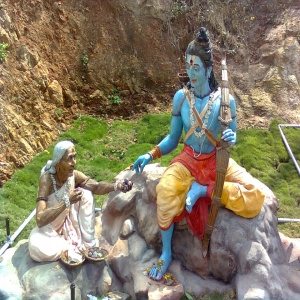
At another level, this rightwing politics has also brought up and promoted a goddess, Shabri and Hanuman, in Adivasi areas. As anti-Christian violence picked the Adivasi areas during the last three decades, these areas saw an intense attempt by Vanavasi Kalyan Ashram and Vishwa Hindu Parishad (RSS progeny) to promote Shabri. Shabri Kumbh was held near Dangs in Gujarat. A Shabri Temple has been erected in these areas. Swami Aseemanand of VHP was active in this area at the time. He was the one who later was accused by Maharashtra ATS of being one of the conspirators of the bombings in Malegaon, Ajmer and Mecca Masjid.
Why were Shabri and Hanuman picked up to be promoted in these areas? Shabri was a poor woman who did not have enough food to offer to her Lord (Ram). So she offered berries after first taking the taste of these before offering. The contrast is evident in city areas. We have Durga, Laxmi and Saraswati to worship, while for Adivasi areas, it is Shabri. Similarly, Hanuman (a devotee of Ram) has been popularised in Adivasi areas. Quite interesting!
Hindutva politics' impact on our festivals reflects a lot about their politics. It is worth pondering how some of these are being weaponised, how Kumbh has been made a ground for anti-Muslim rhetoric, and how Shabri and Hanuman are popularised in Adivasi areas.
.jpg)
.png) Jacob Peenikaparambil
Jacob Peenikaparambil
 A. J. Philip
.jpg)
.png) Cedric Prakash
Cedric Prakash
.jpg)
 P. A. Chacko
.jpg) Thomas Menamparampil
Thomas Menamparampil
.png)
.png) Robert Clements
Robert Clements
.jpg) A. J. Philip
A. J. Philip
 Jacob Peenikaparambil