

.png) Joseph Maliakan
Joseph Maliakan
.jpg)
The harsh north Indian winter is particularly unbearable for the poor and aged homeless people. For years, scores of homeless people have been dying due to exposure to cold in North Indian cities. Following court interventions and proactive policies adopted by municipal bodies, the number of deaths due to exposure during the winter months has been considerably reduced.
However, a recent incident in Indore in Madhya Pradesh has once again thrown light on the insensitiveness of authorities to the perennial problem of the homeless and aged, especially in winter months.
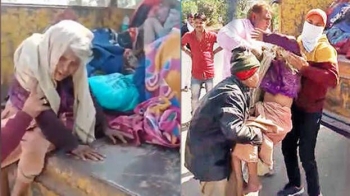
The shocking and traumatic incident is a report on the Indore Municipal Corporation employees rounding up sick homeless senior citizens and dumping them on the outskirts of the city.
On 29 January, a group of Corporation workers went around the city and loaded 10 homeless people, including two elderly women, into a Corporation truck and dumped them on the outskirts of the city on the Indore-Dewas Road.
Rajesh Joshi, a tea seller on the roadside, captured the shocking incident on camera even as villagers vehemently objected to the inhuman act. Most of the people being dumped in the village on the outskirts of the city were old, sick and so debilitated that they could not even stand up straight without help.
The municipal workers told the villagers that they were dropping these people in the village on the orders of municipal officials because the homeless people were dirtying the city. This explained the reason for the inhuman treatment of the elderly homeless people by the Indore Municipal Corporation.
Indore has been judged the cleanest city in India for the fourth consecutive year in a row and the city is currently making all-out efforts to win the ‘Swachh Sarvekshan 2021’ award. Ironically, Indore is also among the 10 cities in India selected for the drive for rehabilitating beggars under the Central Social Justice Department’s scheme for identification, training and employment of beggars.
Unfortunately for the Indore Municipal Corporation, the video of the Corporation workers dumping the homeless in a wayside village went viral inviting immediate reactions from Chief Minister Shivraj Singh Chauhan, the Madhya Pradesh Human Rights Commission, and several political leaders. So far, the Indore Police, which had arrested stand-up comedian Munawar Faruqui and others on charges of promoting communal disharmony, has not taken any action regarding the incidents of dumping the homeless senior citizens on the outskirts of the city.
The Corporation, following an enquiry, sacked eight low level employees and the Chief Minister ordered the suspension of a Deputy Municipal Commissioner. Available evidence from the video footage and reports in the media suggest that the dumping of the homeless on the highway was a deliberate act and it was the normal practice followed by the Indore Municipal Corporation to keep the city clean.
This incident should be treated as a wake-up call for the rest of India to deliberate on the way in which we treat our senior citizens, specially the homeless senior citizens, whose numbers are on the increase. With the population of the senior citizens on the increase they are facing more and more problems with regard to shelter, food, medical care and entertainment opportunities.
Article 41 and 46 of the Indian Constitution has certain provisions for the elderly. Section 20 of the Hindu Marriage Adoption Act 1956, makes it obligatory to maintain aged parents. The Maintenance and Welfare of Parents and Senior Citizens Act 2007 makes it legal for children or heirs to maintain their parents or senior citizens of the family.
In 2010 India had 91.6 million elderly and by 2025 India will have 158.7 million elderly. Of the elderly, two-thirds live in villages and 50 percent are dependents. Also, 70 percent of the elderly are women and poor. There is no proper data available on the abuse and neglect of senior citizens in the country but all available indicators, reports at police stations and in the media point out that both abuse and neglect of the elderly are on the increase.
Deaths due to exposure take place during summer also but deaths in the winter cold far outnumber deaths in summer. The 1980 cold wave killed more Indians than heat wave according to Indian Meteorological Department (IMD ) data. In 23 years between 1980 and 2018, the human death toll in India due to cold wave was higher than due to heat wave. For example, in 1992 the deaths due to heat wave was 111 and cold wave 303; in 2011 it was 12 and 722 (phenomenal increase) and in 2018 it was 16 and 136.
According to the IMD, between 2010 and 2018 there was a whopping 506 percent increase in the number of cold waves in India despite increasing temperature worldwide due to global warming.
.png) Cedric Prakash
Cedric Prakash
.JPG)
 A. J. Philip

.png) Jacob Peenikaparambil
Jacob Peenikaparambil
.jpg)
.png) John Dayal
John Dayal
.jpg)
 Pachu Menon
.png)
.png)
.png) Robert Clements
Robert Clements