

 Fr. Gaurav Nair
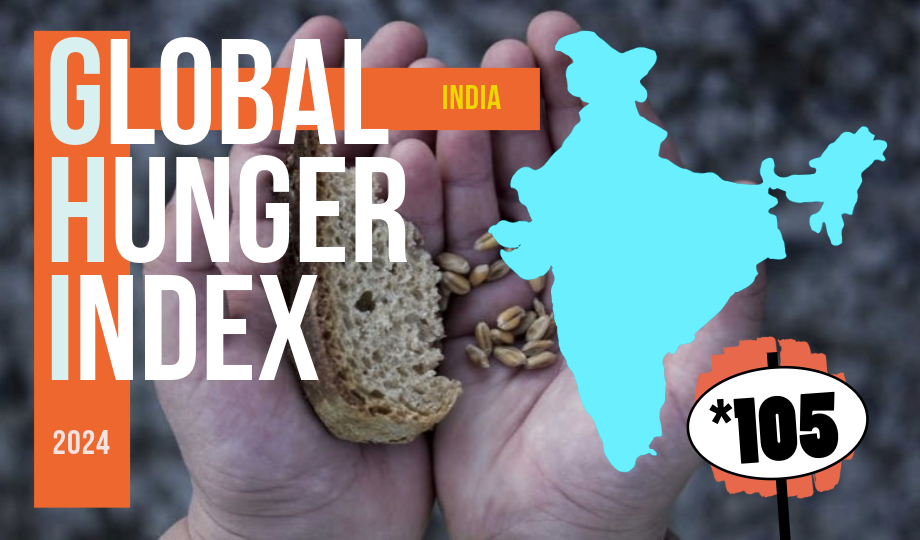
The Global Hunger Index (GHI) is an annual ritual where countries are ranked, and India once again finds itself at the bottom of the feast. Of course, it's the fault of the "foreign" index. India has been ranked 105, causing government officials to roll out their old excuses.
But what does it all really mean? Does this score matter? Is it a reflection of actual conditions, or merely the result of some arbitrary formula concocted by foreign think tanks?
First, we must acknowledge that while the GHI may not be a perfect measurement tool, it still captures the essence of an ongoing crisis. Even if one argues that the GHI gets mixed up with other indices or falls short in some aspects, the brutal truth remains: we are still facing a hunger crisis.
But why should we bother about pesky details like hunger levels when our government has generously declared that poverty has decreased? Ah yes, the miracle of numbers—where millions are lifted out of poverty in reports, yet the streets remain filled with people scrambling for their next meal. It's like a magic show, except the only thing disappearing is the hope of the common man.
The government's propensity to dismiss the GHI findings as "not representative" is quite amusing. Sure, let's disregard the fact that about one-third of Indian children are stunted, which is an alarming figure that only a magician could downplay. It seems the government is quite skilled at pulling rabbits out of hats—except, unfortunately, it's always a rabbit of excuses.
The actual delights served up by our esteemed leaders are the policies designed more for show than for substance. The government's response to hunger appears to be more about brandishing schemes like "Let them eat subsidised rice" rather than tackling the root causes of malnutrition.
Indeed, the latest data suggests that while the government pats itself on the back for its efforts, the underlying issues of corruption, mismanagement, and inefficiency continue to bubble beneath the surface. According to the National Family Health Survey, child malnutrition levels are shockingly high.
Perhaps the most absurd aspect of this whole scenario is the government's constant need to play the blame game. When not blaming foreign indices, they point fingers at minorities and Dalits, all while sidestepping their own policies that have failed to address these challenges effectively.
The GHI serves as a mirror reflecting the failures of governance and policy decisions that have resulted in a grim reality for many. It's not just a number; it's a stark reminder that for every statistical improvement, our leaders claim, literally lakhs of people sleep without food every night. So, while our leaders may continue to deny, deflect, and distract, the truth remains: the GHI may be flawed, but it reveals a hunger that is all too real.
In the grand banquet of global nations, India sits at a table marked by hunger and neglect while those in power serve up excuses instead of solutions. The time for magic tricks and empty promises is over; it's time to face the harsh reality and do something about it. After all, a true feast can only be enjoyed when no one is left hungry at the table.
.jpg)
.png) Cedric Prakash
Cedric Prakash
 ICPA
ICPA
 ICPA
ICPA
 ICPA
ICPA
 ICPA
ICPA
 ICPA
ICPA
 ICPA
ICPA
.jpg)
 A. J. Philip
.jpg)
.png) Jacob Peenikaparambil
Jacob Peenikaparambil
.jpg)
.png) John Dayal
John Dayal