

 Fr. Gaurav Nair
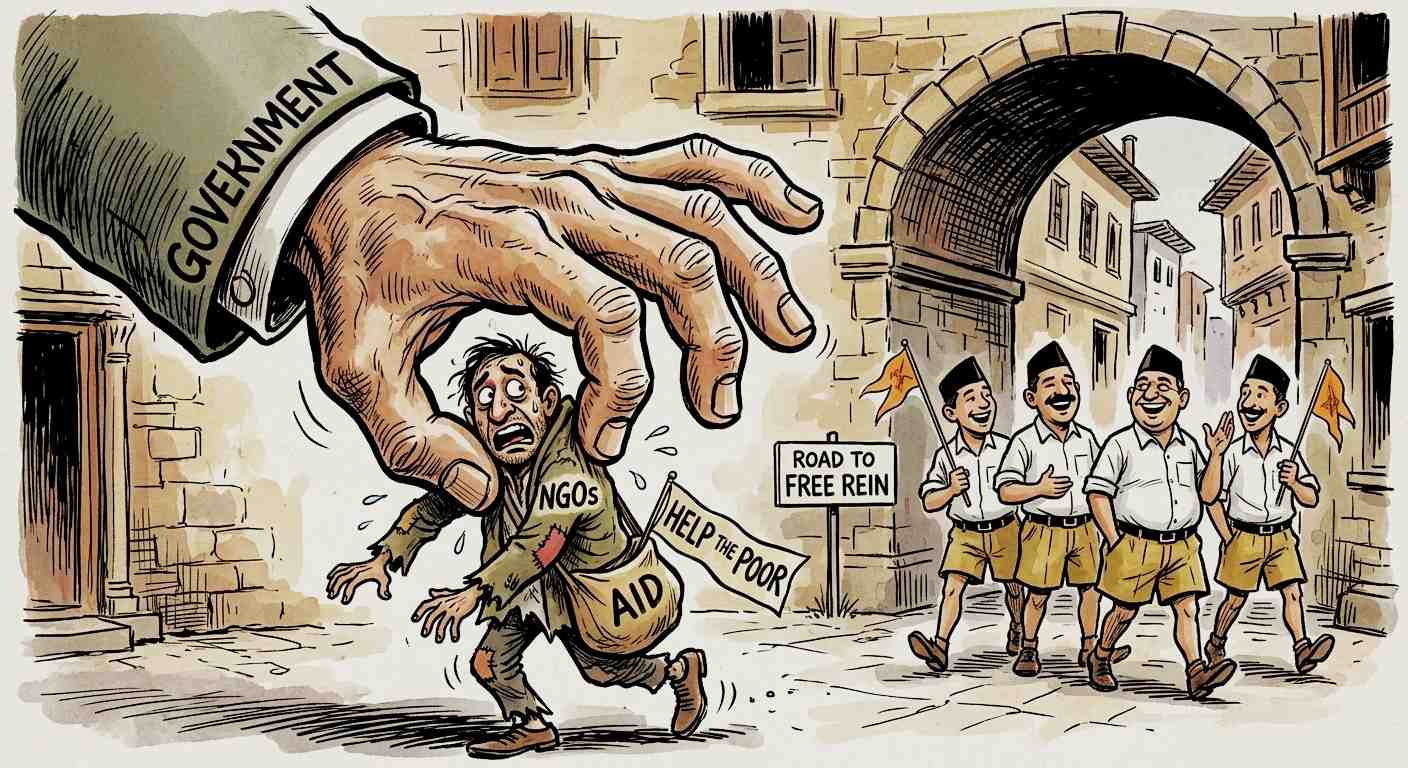
After the protests in March, earlier this year, it was only a matter of time before the FCRA amendment bill was pushed again. At the time, political pundits had alleged that the bill was not brute-forced through owing to the upcoming elections in the South. To no one's surprise, the bill is slated to rear its ugly head again in the coming Monsoon session of the Parliament.
However, a recent letter by Karnataka's Minister for Information Technology and Home Affairs, Shri Priyank Kharge, to RSS's Mohan Bhagwat and the ensuing reply present an opportunity for a study in contrasts.
On the one hand, the Government seeks to randomly appoint a "Designated Authority" with discretionary (read: "at its whims and fancies") powers to take provisional or permanent control of foreign contributions and assets wholly or partly created with foreign funds. On the other hand, there runs the self-proclaimed largest organisation in the world without any checks or accountability. An organisation that is provably dismantling the Constitution and the country, directly and through its subsidiaries.
It is an incongruity difficult to swallow.
The Government insists that NGOs, charitable institutions, educational establishments, hospitals, religious organisations, and civil society groups must submit themselves to ever-expanding layers of scrutiny. Every rupee received, every expenditure incurred, every asset created, and every activity undertaken must be accounted for. Nay, it goes a step further. It effectively wants to seize assets built over decades through the contributions of donors and the labour of countless individuals serving the poor and marginalised.
Yet when similar questions are asked of the RSS, the response is indignation rather than transparency. Why should the questions relating to its legal status, sources of funding, assets, expenditures, and accountability mechanisms be met with such vehement resistance? What is it that it is hiding?
No one who projects accountability as a virtue can apply it selectively. If transparency is essential for a small village NGO running a school or health centre, it must surely be equally essential for an organisation that exercises enormous influence over public policy, political discourse, educational content, cultural narratives, and even the functioning of governments.
Institutions do not become exempt from scrutiny merely because they claim patriotic intentions. If so, the Christians, who served the educational sector and the poor and the underprivileged, are far, far more patriotic than the RSS and must be made completely exempt from all scrutiny.
The FCRA amendment bill is not a simple administrative measure. It is a measure to weaken voices and centralise authority. It is the NGOs and voluntary organisations that have stepped in where governments failed—in education, healthcare, disaster relief, rehabilitation, women's empowerment, child protection, and support for vulnerable communities. To place these institutions under the constant threat of asset seizure is to create an atmosphere of fear and compliance.
Before the Government considers granting itself extraordinary powers over civil society, it may first wish to answer a simpler question: should accountability begin with the weakest organisations in the country, or with the most powerful?
But that is the question the Government would prefer not to answer.
.jpg)
.png) Cedric Prakash
Cedric Prakash
 ICPA
ICPA
 ICPA
ICPA
 ICPA
ICPA
 ICPA
ICPA
 ICPA
ICPA
 ICPA
ICPA
.jpg)
 A. J. Philip
.jpg)
.png) Jacob Peenikaparambil
Jacob Peenikaparambil
.jpg)
.png) John Dayal
John Dayal