

.png) John Dayal
John Dayal
.jpeg)
They close schools and meat shops for "Kavad Yatra," the annual march on the road by young men fetching the water of the Ganges River to their village Shiva temples in much of North India, so there ought to be no surprise if other religious taboos enter the public domain, especially of education.
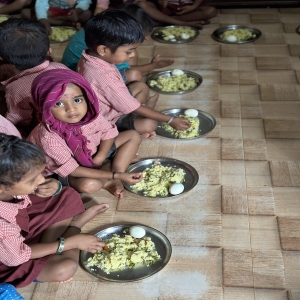
This summer, a school lunch menu in West Bengal ignited a fierce debate that cut to the heart of faith, nutrition, and politics. The newly elected state BJP government announced that the religious organisation ISKCON (International Society for Krishna Consciousness), which strictly adheres to vegetarian principles, would be entrusted with supplying midday meals to schools within the Kolkata Municipal Corporation area.
Eggs, a staple in Bengali cuisine and a cheap, high-quality protein source, would vanish from the menu for children whose possibly most nutritious meal of the day was the school lunch, as their families can barely dream of chicken or duck eggs for the young of the family.
Opposition TMC leaders were quick to pounce, and their parliamentary leader Derek O'Brien delivered a stinging rebuke in the Rajya Sabha: "Before elections, they ate fish for photo-ops. After results, they take away children's eggs, an imposition of vegetarianism which Bengal will not accept."
Defending the decision, Chief Minister Suvendu Adhikari spoke of providing "pure food," while the state's Education Minister insisted that vegetarian alternatives could fully meet children's nutritional requirements.
This controversy touches upon a profound question for India - in a country where nearly a third of its children remain trapped in the grip of malnutrition, how much space should ideology occupy on a child's plate?
According to the sixth National Family Health Survey (NFHS-6), released in May 2026, 29.3% of children under five are stunted (short for their age), 19% are wasted (underweight for their height), and 31.8% are underweight. In plain terms, one in every three Indian children is malnourished.
More worryingly, data shows that a state's economic prosperity or reputation for good governance does not reliably predict child nutrition outcomes.
Prime Minister Narendra Modi's home state, Gujarat, long governed by the BJP and often hailed as a development model, shows that 35.3% of its children are stunted and 20.2% are wasted. These are worse outcomes than in significantly poorer states like Jharkhand, where stunting stands at 35%.
In Madhya Pradesh, another BJP-ruled state, the proportion of underweight children has climbed from 33% to 39.7%, while wasting has risen from 19% to 23.8%.
India ranks 102nd out of 123 countries on the Global Hunger Index 2025, with a score of 25.8, placing it in the "serious" category, and its child wasting rate is the second-highest in the world.
While the Indian government has criticised the index's methodology, the numbers point to an undeniable truth: tens of millions of Indian children are being denied the nutrition they need to grow, learn, and thrive.
Against this backdrop, any alteration to children's nutritional sources must answer a simple question: replacing eggs with vegetarian substitutes upgrades or downgrades the nutrition available to a poor child.
From a nutritional standpoint, the egg is a near-perfect food as it delivers complete, highly digestible, high-quality protein, along with essential micronutrients critical for childhood development—Vitamin B12, choline, Vitamin D, and iron.
The National Institute of Nutrition (NIN) strongly recommends including eggs in midday meals, recognising them as a cost-effective, high-quality protein source.
Proponents of vegetarian alternatives argue that carefully combined plant-based foods—paneer (cottage cheese), soy, rajma (kidney beans)—can deliver comparable protein. Nutritionist Dr Suneet Khanna acknowledges that soy and tofu, being complete proteins, are the "closest substitutes."
A single egg costs about ?8, and to match the quantity and bioavailability of protein in an egg using paneer or soy products will cost significantly more.
Feeding over 11 crore children daily, the world's largest school meal initiative, even a marginal cost increase can break the budget.
Moreover, plant-based proteins like soy and kidney beans are not staples of Bengali culinary tradition in the same way eggs are. Children, especially those from food-insecure households, may not readily accept unfamiliar foods, potentially leading to plate waste and wasted investment.
The West Bengal egg controversy has naturally drawn comparisons to other states, giving rise to a political narrative that maps the egg-versus-vegetarian divide directly onto the BJP-versus-opposition map.
On one side stand states where eggs remain part of the midday meal menu, including all southern states and most eastern and northeastern states—precisely the regions where the BJP is electorally weak or out of power.
Tamil Nadu offers eggs daily; Andhra Pradesh, five days a week; Karnataka has expanded egg distribution to six days a week; and Maharashtra, under the Congress-era coalition government, added eggs weekly.
On the other side, BJP-ruled states have often been the sites of ideological tussles over the egg.
The most vocal has been Madhya Pradesh, which saw a political split even within the BJP itself. In 2019, the state's BJP vice-president opposed a Congress proposal to add eggs to meals, arguing that vegetarian children might stop attending anganwadis, a claim critics found astonishing, given that anganwadis are supposed to serve children at risk of malnutrition, not serve as temple kitchens.
Jharkhand, despite being one of India's poorest states and ruled by a JMM-Congress-RJD coalition, recorded better nutrition outcomes than Gujarat, with over 13% of children receiving an adequate diet, while Andhra Pradesh, with broad welfare programming, showed over 19% of children receiving an adequate diet.
Any serious discussion of midday meal nutrition must also engage with the economics of the programme. PM POSHAN (formerly the Mid-Day Meal scheme) operates under a 60:40 cost-sharing model between the central and state governments. The Union Budget for 2026-27 allocated ?12,750 crore to the scheme, covering cooking costs and foodgrain.
The central government fixes cooking costs—the money for pulses, oil, vegetables, and condiments, excluding grain—at ?6.78 per day for primary students and ?10.17 for upper-primary students, revised in May 2025. Adding the value of free foodgrain supplied by the Food Corporation of India (FCI), the all-in cost per meal is approximately ?12.13 for primary and ?17.62 for upper-primary.
The financial implication of egg removal or retention is significant. Haryana, for instance, has budgeted ?747 crore for FY27—a state share of ?525 crore and a central share of ?222 crore.
When states opt for vegetarian menus, the savings on protein costs are marginal, but the potential loss in nutritional value is disproportionately high for the poorest children.
Conversely, when states like West Bengal reversed the ISKCON decision and announced eggs would return via Self-Help Groups from August 1, 2026, they implicitly acknowledged that the cost of not feeding eggs—measured in cognitive deficits, reduced learning outcomes, and future productivity losses—far outweighs the immediate savings.
India's politics of food is guided by purity factors dictated by religion, and eggs, meat, and fish have long been caught in the crossfire of upper-caste vegetarianism and the protein needs of India's majority population.
The BJP's ideological parent, the RSS, has historically argued that India's food habits should be "reformed" to align with "cultural" norms.
In Karnataka, the state's own NEP position paper argued that eggs and meat could cause "lifestyle disorders" and hormonal imbalance—a claim that nutritionists dismissed as unscientific.
In Madhya Pradesh, the argument that vegetarian children might stop coming to school if eggs were served made a mockery of the scheme's objective: to bring the most vulnerable children into classrooms.
These arguments rest on a false premise: that the midday meal is optional, a charitable add-on rather than a statutory entitlement. Under Section 5 of the National Food Security Act, 2013, every child in government and government-aided schools is entitled to a cooked, nutritious meal.
The egg controversy in Bengal is ultimately not about eggs. It is about whether India's political class can rise above identity politics and commit to evidence-based policymaking.
Eggs are one of the cheapest, most effective ways to combat protein deficiency among malnourished children. The National Institute of Nutrition, the WHO, and UNICEF all agree.
The PM POSHAN scheme is not a temple kitchen or a party platform. It is a lifeline for millions of children. Any decision that prioritises ideology over nutrition is not just unscientific—it is an act of cruelty disguised as cultural pride.
.jpeg)
 A. J. Philip
.jpg)
.png) Jacob Peenikaparambil
Jacob Peenikaparambil
.jpg) John Dayal
John Dayal
.jpg)
 Pachu Menon
.jpg)

.png)

.png)
.png) Robert Clements
Robert Clements
.jpg)