

.jpg) F. M. Britto
F. M. Britto
.jpeg)
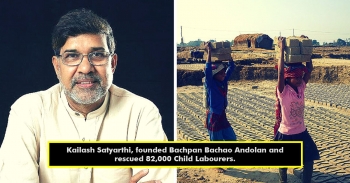
The mission of the electrical engineer has changed the fate of thousands of children in India and around the globe.
As the youngest child, Kailash Satyarthi was born as Kailash Sharma on Jan 11, 1954 in Vidisha of Madhya Pradesh in a middle class family to a head constable father and house-wife mother. His illiterate mother’s idealistic and helpful nature greatly influenced Satyarthi.
Living in a Uttar Pradesh locality of Hindus and Muslims, the Hindu Brahman boy learned Urdu from the local Maulvi from childhood.
After completing his higher secondary education in the local government school, Satyarthi got his graduate and post-graduate degrees in Electrical Engineering. Then he taught for two years in his college in Vidisha. In his younger days itself he had started a football club to raise money for poor students and to start a textbook bank for them.
Employed in Delhi, he gave up his high caste Brahman surname Sharma and adapted the title Satyarthi, meaning Truth. He then found a magazine Sangharsh Jaari Rahega (Struggle will continue) in which he recorded the lives of vulnerable people. He came in association with Swami Agnivesh who founded in 1981 the Bandhua Mukti Morcha (BMM- Bonded Labour Liberation Front).
Confronted with children not studying but labouring to earn for their families, Satyarthi gave up his lucrative career in 1980 and started Bachpan Bachao Andolan (BBA-Save Childhood Movement). Along with police and his associates, Satyarthi descended into the guarded brick and carpet factories and began liberating the employed children, against the violent opposition of the owners. The BBA has now rescued more than 81,000 children from exploitation.
In the outskirts of Delhi Satyarthi established a short term rehabilitation centre Mukti Ashram and a long term rehabilitation centre Bal Ashram at Virat Nagar near Jaipur. Begging international cooperation, the BBA established in the 1990s several ashrams where these freed children could study.
He launched Bal Mitra Gram (BMG-Children Friendly Villages) in 2011, where the child labour is banned and all the children are enrolled in the schools. Now nearly 400 villages have adopted it.
To partner in the nearby Bangladesh, Nepal, Pakistan and Sri Lanka, Satyarthi formed in 1989 the South Asian Coalition on Child Servitude (SACCS). Nearly seven million people participated in his 1998 Global March Against Child Labour, a series of demonstrations in 103 countries.
For his fight against child slavery for four decades, Satyarthi was awarded, along with Pakistani education advocate Malala Yousafzai, the Nobel Peace Prize in 2014. The Fortune magazine named him in 2015 as one of the “World’s Greatest Leaders”. He had also received many awards and honours like the Guinness World Record in 2017 for the Largest Child Safe Guarding Lesson; the Harvard University’s Award “Humanitarian of the Year” in 2015; the Robert F. Kennedy’s Human Rights Award in 1995.
“The hands which were meant for holding pens and books are washing dishes and serving plates.” – Miss Prayani
.jpg)
 A. J. Philip
.png) Cedric Prakash
Cedric Prakash
.jpg)
 P. A. Chacko
.jpg)
.jpg)
.jpg) Thomas Menamparampil
Thomas Menamparampil
.png)
.png)
.png) Robert Clements
Robert Clements
.jpg)
.png)
.png) Chhotebhai
Chhotebhai