

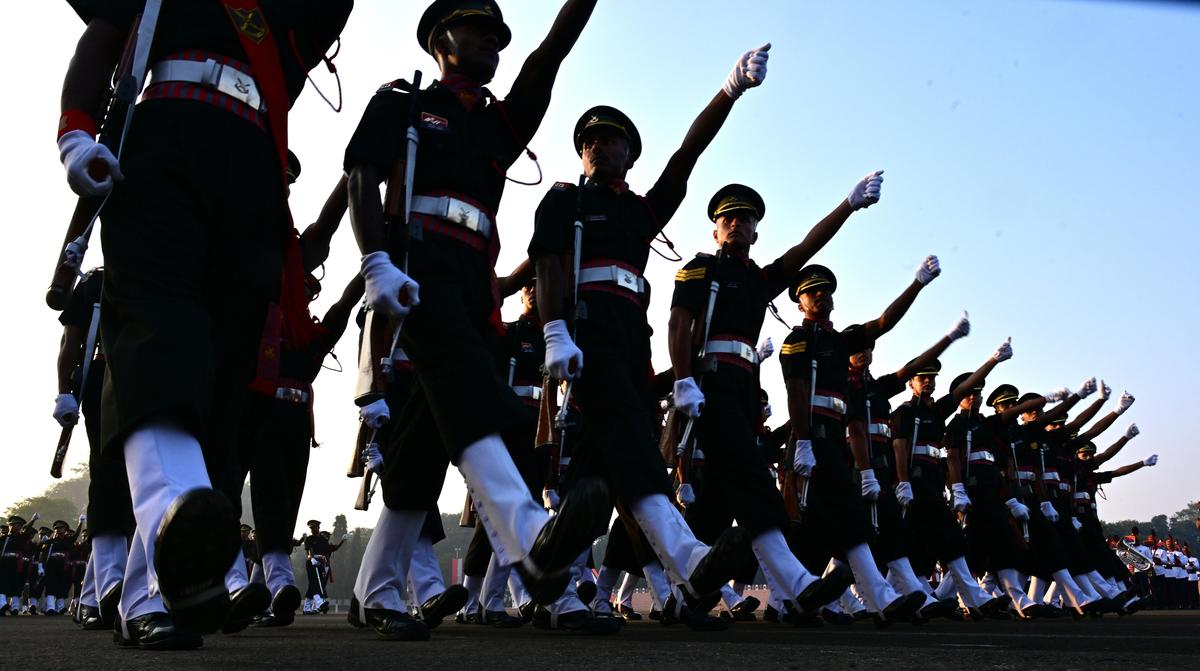
The dismissal of Lt. Samuel Kamalesan and the courts' endorsement of it reopen a question India has sidestepped since Independence: Can a constitutional republic continue to run its armed forces on a religious framework inherited from an empire that designed it to prevent unity among its soldiers?
To understand why this question matters, one has to return to 1857. When Hindu and Muslim soldiers fought shoulder to shoulder, the British saw not rebellion but the danger of solidarity. Their response was not moral outrage but administrative precision. They built a military in which every soldier was categorised, classified, and governed through rigid religious and caste compartments. Rituals were instruments of control. Shrines inside cantonments existed not to honour diversity but to ensure separateness. The objective was simple: fragment identities, prevent cohesion, and avoid another 1857.
In effect, the British created an elaborate architecture of administrative communalism. It used religious identity as an administrative tool; preserved each group as a rigid compartment, insulated from any shared national identity; and controlled those compartments from above, ensuring every soldier's religiosity remained predictable and manageable. This was bureaucratised segregation, not pluralism. Indeed, scholars like David Omissi described it as "managed pluralism," while Douglas Peers termed it "controlled communalism"—a stable, segregated system designed to maintain obedience rather than equality or fraternity.
Independent India inherited this structure intact. Instead of dismantling it, it was repackaged. British-designed multi-faith parades and inter-religious ceremonies were rebranded as symbols of national harmony. Cantonments continued to house, and in several cases, maintain temples, gurudwaras, mosques, and churches. Regiments remained organised along religious identities. Religious teachers remained official appointments. 'Unity in diversity' was layered on top of a structure that was designed for precisely the opposite. The underlying template of separate identities, maintained separately, administered separately, was never aligned with the Constitution of India adopted in 1950.
It is within this inherited structure that the Kamalesan case unfolded.
Commissioned in 2017, Lt. Samuel Kamalesan, a Protestant Christian, was posted to 3 Cavalry—a regiment with three fixed-class squadrons: Rajput, Sikh and Jat. He was appointed Troop Leader of the Sikh Squadron. The regiment did not have a Sarv Dharm Sthal; it maintained one mandir and one gurdwara, which formed the centre of its weekly religious parades.
He did not avoid these parades, the troops, or the social life of the regiment. He attended every parade, removed his shoes and belt, tied a turban when required, and stood with his men in the courtyard. He celebrated Diwali, Navratri, Lohri, Gurpurab, Holi and other festivals with them. As recorded in his Writ Petition (C) 7564/2021, his bond with the troops was firm and unambiguous.
His reservation was narrow: he sought exemption from entering the sanctum sanctorum during puja, havan, aarti or similar rituals. Christian doctrine prohibits participation in idol worship, and he did not wish to offend the religious expectations of his Sikh troops by entering the sanctum without performing the requisite rituals. He remained present throughout, standing just outside the sanctum with complete respect, participating in every other aspect of the parade—even donning the Sikh turban.
The escalation began in June 2017, when Commandant-1 directed him to enter the sanctum. Kamalesan explained his constraints. The Commandant refused the exemption. What followed, according to the officer, was harassment: repeated 'patti parades,' frequent guard checks without adequate rest, and comments in the mess suggesting his career was over unless he complied.
The professional consequences were palpable. According to court documents, in January 2018, he was denied the Young Officers Course without notice. Subsequent cycles in July 2018, January 2019, July 2019, and January 2020 also passed without his nomination.
In addition, his UN mission application was rejected, two junior officers superseded him, and he was repeatedly told that if he simply bent halfway before the idols, the issue would end.
Commandant-1's adverse ACRs in 2017 and 2018 linked his supposed 'disconnect' with men to his refusal to enter the sanctum. Yet under Commandant-2 in 2019, the picture reversed: he was rated 7/9, praised for his maturity and rapport with troops, and described as someone the men enjoyed working with. One command viewed him as a liability; the next saw him as an asset. This contradiction lies at the heart of the matter.
Later, on January 31, 2019, he was issued a Show Cause Notice proposing dismissal under Section 19 of the Army Act, read with Rule 14 of the Army Rules. The notice alleged that he refused to enter the Sarv Dharm Sthal (which did not exist), refused to attend religious functions (though he attended them all), and harmed morale by remaining outside the sanctum. It also recorded that court-martial proceedings would be "inexpedient and impracticable" owing to the involvement of religious beliefs.
He replied in March 2019, reiterating that his reservation was limited to sanctum entry during rituals, not to parade attendance. He maintained he never distanced himself from his troops nor disrespected their faith.
According to the officer, the Army's rejoinder was never served on him. A ban on discipline and vigilance was quietly imposed, after which he filed a statutory complaint in December 2020. In February 2021, he was instructed to split his complaint into two parts: ACR tampering and religious discrimination. He refused to do so, arguing the issues were inseparable. On March 3, 2021, he was dismissed without pension or gratuity.
The Army's position, as revealed in the record, was clear. Attendance at regimental religious parades was a professional obligation. Participation inside the sanctum was deemed essential to show solidarity and maintain motivation. Standing outside, it said, signalled a lack of oneness, and this was treated as a refusal of a lawful command. It argued that multiple officers—both Christian and non-Christian—had counselled him. When he remained firm, administrative termination under Section 19 read with Rule 14(2) became necessary. A court-martial, they said, was too sensitive and impracticable.
This is where the constitutional questions arise.
India has no statute—neither the Army Act, nor the Army Rules, nor Defence Service Regulations, nor any parliamentary law—that compels a soldier or officer to bow before an idol or participate in a religious ritual. The Army Act and Rules provide broad powers, but there is no express provision mandating ritual participation. This disputed obligation rests entirely on custom, command interpretation, and Para 332 of the Regulations for the Army, which is often cited in litigation.
But Para 332 says only this: "Religious customs and prejudices will be respected." It mandates respect—not worship, not sanctum entry, not ritual performance. It is an administrative guideline to prevent offence, not a statutory basis for compelling religious compliance, much less a basis for a judicial ruling against the officer. Yet over time, it has been stretched into a substitute for law, elevating custom into obligation, whereas Parliament has enacted none.
Article 25 protects freedom of conscience, including the right not to participate in religious observance. Articles 26 to 28 restrain the state from compelling religious participation. Article 33 empowers Parliament to restrict fundamental rights of armed forces personnel—but only by law. Parliament has enacted no law mandating ritual involvement.
When the Delhi High Court upheld his dismissal, it reasoned that discipline and cohesion override individual conscience, that the Army is best placed to judge morale, and that a court-martial was rightly dispensed with. It did not identify any statutory requirement for ritual entry. Instead, it accepted the Army's assertion that religious rituals serve a secular, motivational function and therefore fall within the scope of military duty.
On November 25, 2025, the Supreme Court dismissed Lt. Kamalesan's Special Leave Petition, leaving the High Court's reasoning undisturbed.
But neither the Army nor the Courts cited any empirical evidence—no study, no report, no comparative data—showing that compulsory participation in religious rituals enhances cohesion or combat effectiveness. There is no research demonstrating that abstaining from sanctum entry undermines leadership.
Democracies with large, diverse forces have taken the opposite view. The United States, after years of resistance, formally accommodated Sikh turbans and beards in 2017, not because ritual conformity builds cohesion, but because religious freedom does not weaken professionalism. The Indian Army itself extensively accommodates Sikh troops, recognising that symbols of faith do not obstruct unity. Accommodation, not compulsion, is the tested model.
Yet in the Kamalesan case, this logic was reversed: compulsion was elevated above conscience.
This is where the shift becomes stark. Tradition becomes ethos. Ethos becomes an operational necessity. Operational necessity is treated as law. A colonial-era system designed to divide is given precedence over a constitutional framework designed to unify. Conscience becomes negotiable, custom becomes binding, and leadership becomes synonymous with ritual performance without evidence to support such an equation.
The larger question is not about one officer or one regiment. It concerns the incongruity between the Republic's constitutional identity and its military's inherited identity. India's armed forces remain among its most professional institutions. Yet cantonments continue to maintain temples, gurudwaras, mosques and churches. British-era mosques stand in Meerut, Ambala, Jabalpur and Danapur; British-era churches operate in Bengaluru, Secunderabad and Mangalore. The Belagavi Cantonment maintains the Military Mahadev and Military Durga temples on military land. Religious teachers remain formal appointments. Class composition continues to shape recruitment.
These structures were not designed by the British to promote integration. They were designed to manage differences for the interests of the British Crown. A constitutional republic cannot indefinitely function on a framework built for colonial subjects.
Modern militaries build cohesion through shared hardship, training, discipline and trust—not through forced ritual participation. What message does compulsion send to officers with deep religious convictions? To atheists? To citizens who see uniformed service as duty, not doctrine?
The Kamalesan case shows that the absence of legal clarity places conscience at the mercy of custom. It risks discouraging men and women of conviction from joining the defence forces.
The tragedy is that the matter never needed to escalate. A middle path existed. The officer offered it: he attended every parade, stood with the troops, participated in all aspects except ritual entry into a specific sanctum.
Instead, the case moved from Commandant to Brigade to Division to Army Headquarters to the Delhi High Court and finally to the Supreme Court—with no examination of the deeper structural inheritance that produced the conflict.
One wonders whether the matter would have gone to the extent it did if it had been dealt with in a court-martial, where his case could have been argued within the framework of the defence forces and relevant laws by his in-house counsel.
In all of this, neither the officer nor the Army leadership is personally to blame. The problem is a colonial practice preserved without scrutiny, treated as if it were constitutional, and left untouched after 1950, when the armed forces should have been realigned with the values of a democratic republic. The troops are known to be magnanimous; this was a moment for that magnanimity.
A military designed to fragment identities cannot serve as a model for building cohesion in a republic committed to equality. The Kamalesan matter is not a threat to discipline. It is an opportunity. The armed forces deserve structures aligned with the Constitution they defend. Tradition may guide, but law must govern. Ethos may inspire, but cannot override fundamental rights without statutory authority. Cohesion must rest on constitutional values, not colonial categories.
India cannot remain a constitutional democracy while its key institutions operate on frameworks designed by an empire. The Kamalesan episode is a reminder that the time for review and reform is not in the distant future. It is now.
References:
1. Delhi High Court, W.P.(C) 7564/2021 (May 30, 2025).
2. Supreme Court of India, Order of November 25, 2025 (SLP dismissed).
3. Army Act, 1950 — section 19, 41.
4. Army Rules, 1954 — Rule 14(2).
5. Regulations for the Army, 1987 — Para 332.
6. Defence Service Regulations.
7. Omissi, The Sepoy and the Raj.
8. Peers, Between Mars and Mammon.
9. U.S. Army Directive 2017-03.
10. Cantonment Board records (Meerut, Ambala, Jabalpur, Danapur; Belagavi Military Station listings).
11. Constitution of India — Articles 25–28, 33.
.jpg)
.png) Cedric Prakash
Cedric Prakash
 ICPA
ICPA
 ICPA
ICPA
 ICPA
ICPA
 ICPA
ICPA
 ICPA
ICPA
 ICPA
ICPA
.jpg)
 A. J. Philip
.jpg)
.png) Jacob Peenikaparambil
Jacob Peenikaparambil
.jpg)
.png) John Dayal
John Dayal